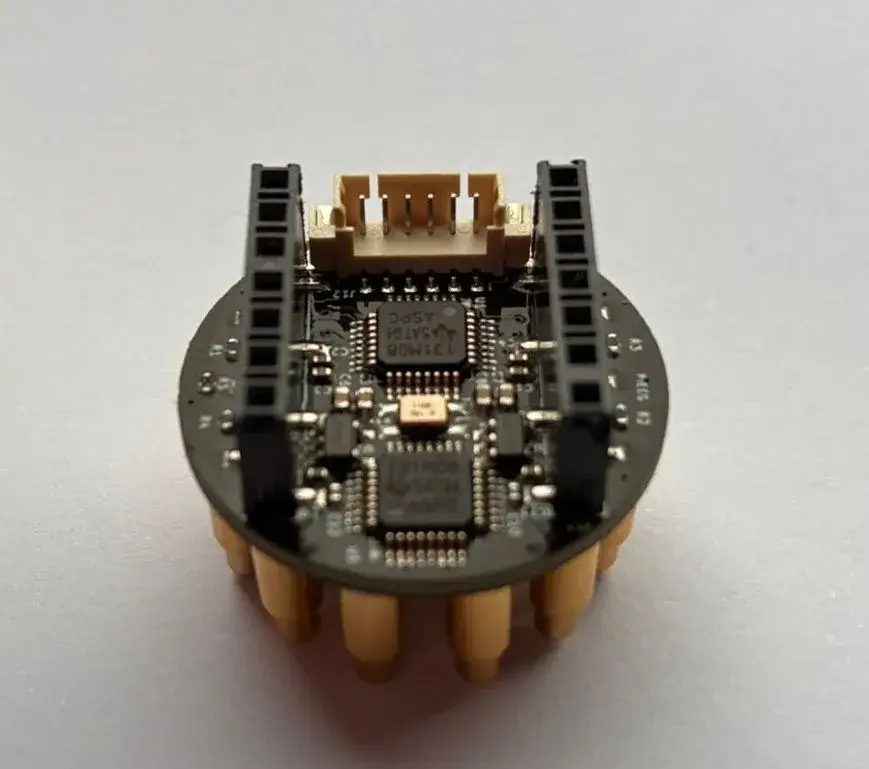
Sixteen EEG electrodes fit onto a 26 mm board
The open project puts sixteen EEG contacts, reference and ground on one small circular board, then streams measurements over Bluetooth. The most important part of the README may be the safety warning.
Archive
IRZ Tech archive, page 14.

The open project puts sixteen EEG contacts, reference and ground on one small circular board, then streams measurements over Bluetooth. The most important part of the README may be the safety warning.

Marco Arment did not build another productivity system. He built an interface where dismissing, ignoring or postponing a reminder is not enough to make it disappear.

ShieldFont uses OpenType substitution to show one text to humans and hand another to scrapers. It is not a lock. It is friction.

A teardown shows how a cheap caliper measures by capacitance, and why its battery drains itself in the drawer.

A rare late-1980s IBM prototype, the 7496 Executive Workstation, comes back to life: floppy drive fixed, hard drive added, sound card grafted on.

MXene flakes made magnetic travel through soil to capture microplastics, then are recovered with a magnet. Shown in the lab, not yet in the field.

The open-source Manyfold app can now render FreeCAD project thumbnails. Another small brick for makers who want to keep their 3D library under their own control.

TasmoShelf controls Tasmota devices directly over the local network. Recent ESP32 hardware can join Apple Home through Matter, while one ESP32 can bridge older ESP8266 devices.

G’MIC 4.0 adds new filters, guided color transfer and creative-coding tools to an open-source framework that keeps exposing composable image-processing primitives.

Two tiny microcontrollers are enough to make a laptop’s keystrokes appear as a real USB keyboard on another machine. LapBoard targets a very ordinary headless-computer problem.