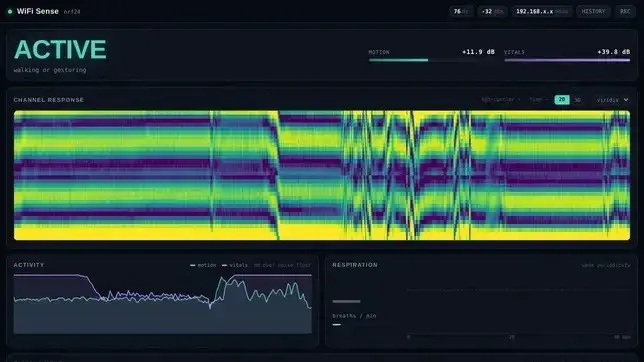
WifiSense-Pi starts from an ordinary detail: a Wi-Fi signal does not travel straight to the receiver. It bounces off walls, furniture and bodies. When something moves, that mixture of paths changes. The Masked Bear’s open-source project uses those variations as a presence sensor.1
An ESP32-S3 samples channel state information, or CSI, at 100 Hz. A Raspberry Pi 4 then filters the signal, separating a motion band from a slower band used to estimate breathing.1 The system therefore needs neither a camera nor a worn device.
The repository is most useful where it refuses to overclaim. With one radio path, WifiSense-Pi cannot locate a person, reliably count several occupants, identify anyone or infer sleep stages. A motionless person who also holds their breath eventually removes the phenomenon the system is looking for.1
Hackaday captures the tradeoff neatly: the device can work through some walls because it observes an existing radio channel, but that does not turn it into a radar that draws a skeleton behind plasterboard.2
The transferable trick is elsewhere. The project deliberately generates regular UDP traffic so CSI samples arrive at a stable rate. The sensor is therefore not just the hardware. It also includes the traffic the system creates to make the phenomenon measurable.1