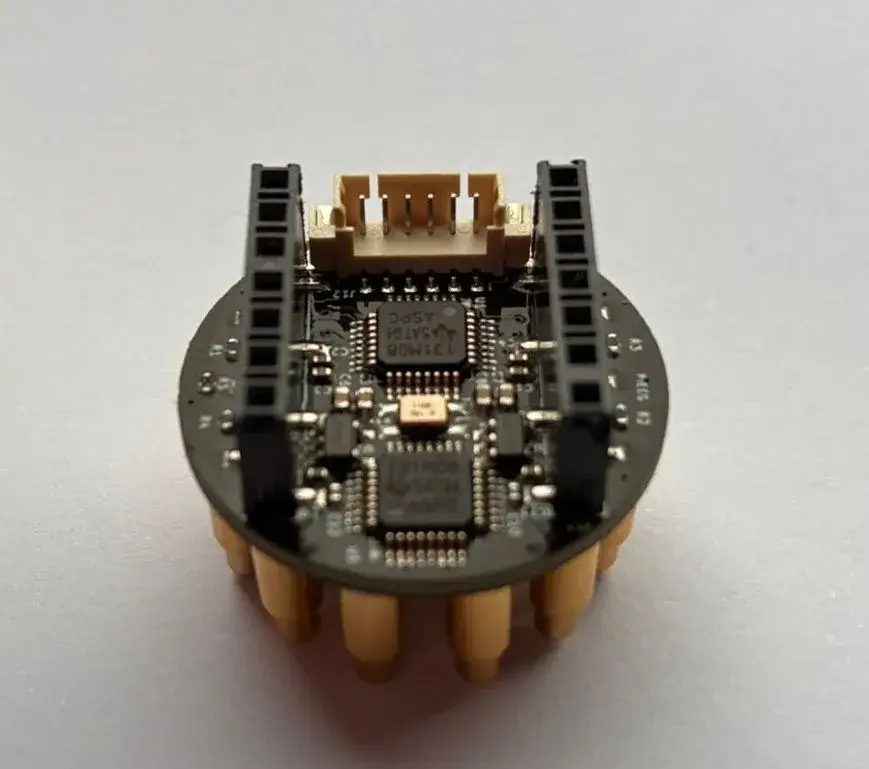
An EEG headset can start looking like a wiring session before it looks like an interface. Octopus 16 tries to reduce that choreography by putting sixteen active contacts, reference and ground on the same small disc.1
The circular PCB is 26 mm across. Its 18 spring-loaded pogo pins provide sixteen EEG channels, one common reference and one ground contact.1
The repository specifies two eight-channel ADS131M08 converters, a 250-samples-per-second output rate and a XIAO ESP32-C6 for Bluetooth Low Energy data transfer.1 An ESP32-S3 variant can also expose USB/Bluetooth HID output for neurofeedback or control experiments.1
Hackaday surfaced the project through demos where EEG signals feed simple game environments.2 That is fun, but it is not the part worth inflating. The project does not demonstrate that a 26 mm board can “read thoughts” or replace medical equipment.
The README says the opposite very clearly: Octopus 16 is not a medical device. It also requires isolated 5 V battery power and warns against connecting it to mains power, including indirectly through USB.1
That warning is almost part of the design. Making a sensor smaller and easier to start experimenting with makes the limits more important to surface, not less.
The project is interesting as a maker tool for exactly that reason: it reduces the physical complexity of the setup without pretending the signal itself has become simple.