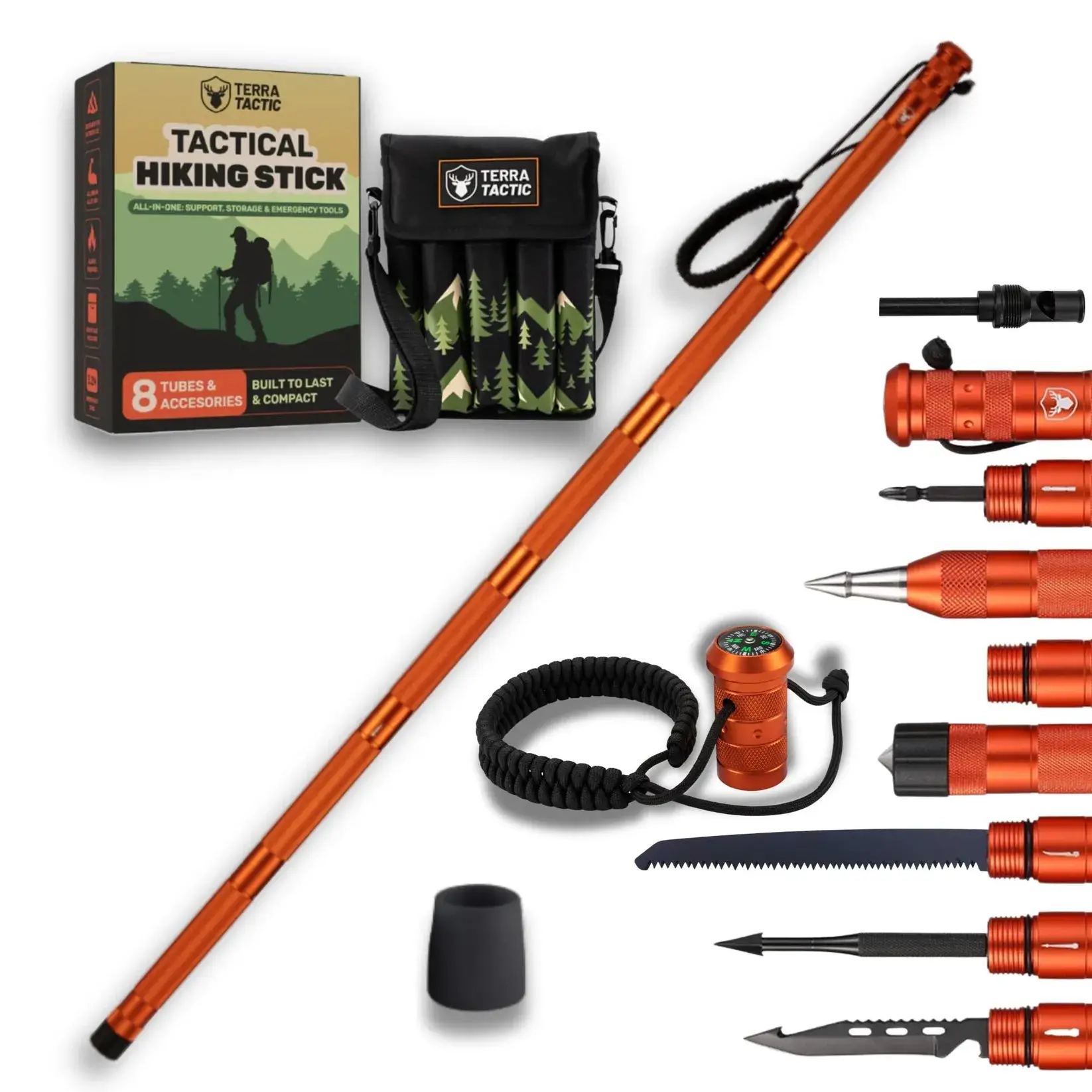
A hiking stick already provides a long hollow tube, and TerraTactic decided to make that otherwise unused volume carry part of the hiker’s equipment.
Its Tactical Hiking Stick consists of eight aluminum tubes reaching 54.4 inches, about 138 cm, when fully assembled. Around and inside that shaft are a compass, whistle, bottle opener, harpoon, screwdriver, knife, fire starter, rope and wood saw.12
The pitch looks almost free: if a stick already occupies that length, why not make it carry equipment that would otherwise live somewhere in the backpack?
Length is only one part of the trade. Reaching some tools requires unscrewing the stick, while changing its height means removing sections, and each tube used as storage also belongs to the structure that takes the hiker's load.12
The storage problem becomes smaller, while access, mass and the interfaces between sections become more important.
Eight tubes
TerraTactic markets the product as a “15-in-1,” although the architecture is more interesting than the score.1
Instead of hanging a large toolbox from the grip, TerraTactic makes the storage part of the shaft itself, distributing components along threaded sections that function as body, height adjustment and container at the same time.1
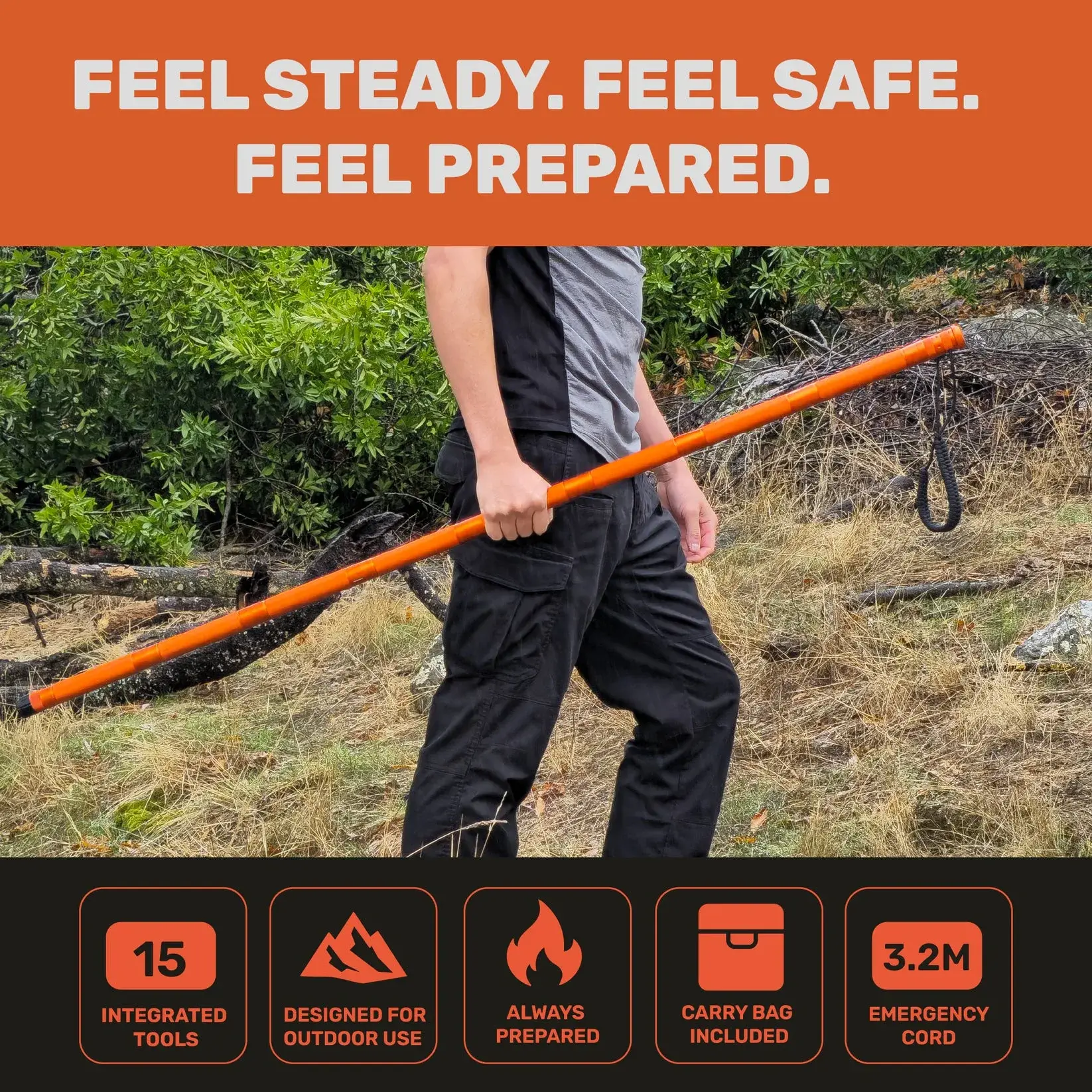
The geometry makes sense because a walking stick needs length without needing to be solid, whereas a separate tool pouch creates another volume in the pack; Tactical Hiking Stick tries to overlay both functions inside the same overall envelope.
This kind of modularity feels obvious once drawn, although combining several jobs in one component also prevents each job from being optimized independently.
The tool in the middle
Consider the fire starter.
An outside pocket can make a fire starter available almost immediately; put the same item inside a tube halfway down the pole and the user must know its location, stop walking, unscrew the relevant sections, retrieve it and rebuild the stick before moving again.
Core77 states the trade-off plainly: storage is consolidated, but access requires unscrewing the stick, which makes the order of items along the shaft part of the design.2
An emergency whistle close to the grip could remain quick to reach, while something used only after camp is set up can live deeper in the assembly; reverse those priorities and the packing stays compact at the cost of making the most urgent object require the most disassembly.
Counting the objects replaced says little about the quality of the modular system unless the number of operations required to move from the primary function to a secondary one is considered as well.
The joints
The threaded interfaces are visible in TerraTactic's own product photography. The company presents them as the mechanism for assembling the tubes and changing the height.1
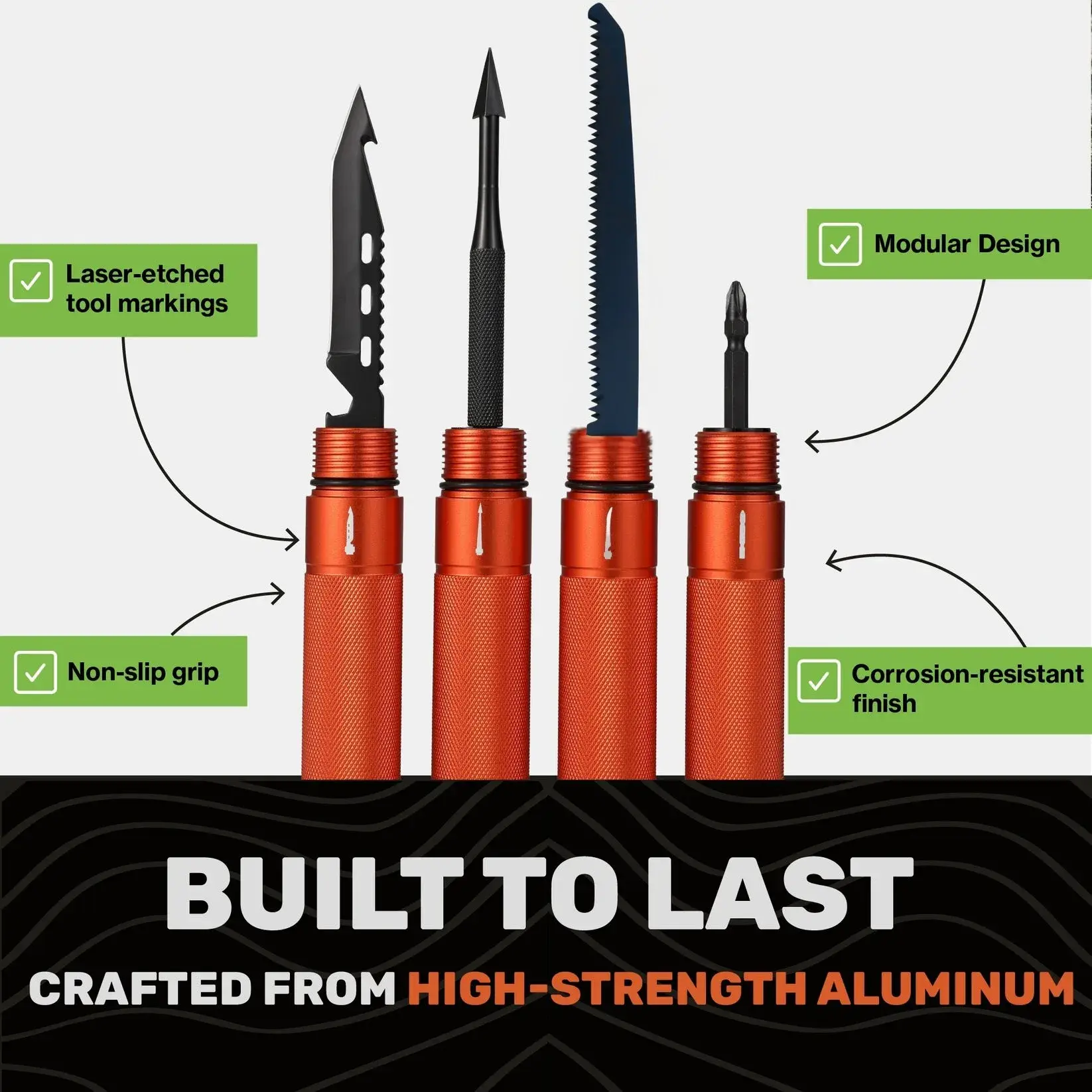
Mechanically, that choice adds interfaces to a part that could otherwise be continuous, although their existence alone says nothing about whether the stick is weak; TerraTactic describes durable aluminum construction and warrants manufacturing defects, including some structural failures under normal use.1
Because the page publishes no bending test, allowable load or play measurement at the joints, eight tubes cannot support a conclusion about strength; what can be said is that modularity moves part of the design problem into connections whose tightening, wear, tolerances and resistance to developing play matter alongside the tube material.
The basic idea also predates this product: a US patent published in 2015 described a hiking stick built from multiple coupled parts with interchangeable implements attached to the shaft, so TerraTactic’s denser axial storage should not be confused with inventing either sectional poles or tool-bearing sticks.4
Missing weight
The product page lists “zero extra weight” among the benefits while omitting the product’s actual weight.1
Core77 noticed the same omission, and as of August 24, 2026, TerraTactic publishes the material, eight-tube count and maximum length without giving a total mass that could be compared with an ordinary hiking pole.12
A charitable reading of the slogan is that a hiker already carrying a knife, saw, rope and fire starter may add no mass to the complete inventory by moving those items into the shaft; the claim still tells us neither the mass of the assembled stick nor how it compares with a simpler pole.
Where that mass sits matters as well. A 2023 review of poles used in walking and other sports found that experiments varying pole mass showed no clear difference in VO₂, heart rate or perceived exertion, while heavier poles increased biceps brachii activation; one study compared poles of 240, 300 and 360 g.3
The evidence leaves little room for either easy story: a few extra grams do not automatically make a pole exhausting, yet an object lifted and planted on every walking cycle still needs its weight and mass distribution specified if users are meant to compare it seriously.
Fifteen in one?
The “15-in-1” label raises another small accounting problem.
The current page lists eight tubes, a storage bag, then a magnetic compass, whistle, bottle opener, harpoon, screwdriver, knife, fire starter, emergency rope and wood saw.1 Depending on how functions inside the tools and the stick itself are counted, reaching fifteen is certainly possible.
The page provides no numbered “function 1 through 15” breakdown, which is harmless to the structure of the product but makes the marketing number a poor basis for evaluating it.
The architecture tells us more than the score.
A long drawer
Tactical Hiking Stick ultimately turns a linear object into a structural drawer.
The strategy can travel elsewhere because tool handles, furniture legs, tubular frames or transport equipment sometimes contain unused interior volume, and storing an accessory there can recover space somewhere else; the stick simultaneously demonstrates the condition attached to that trick, since hidden volume stops being free when it belongs to the structure.
Someone still has to decide how the system opens, how many interfaces are acceptable, which item belongs closest to the hand, how much mass is added and how the user restores the primary function after retrieving a tool, which leads to the more useful question: how much modularity can be added before the storage starts getting in the way of the stick?