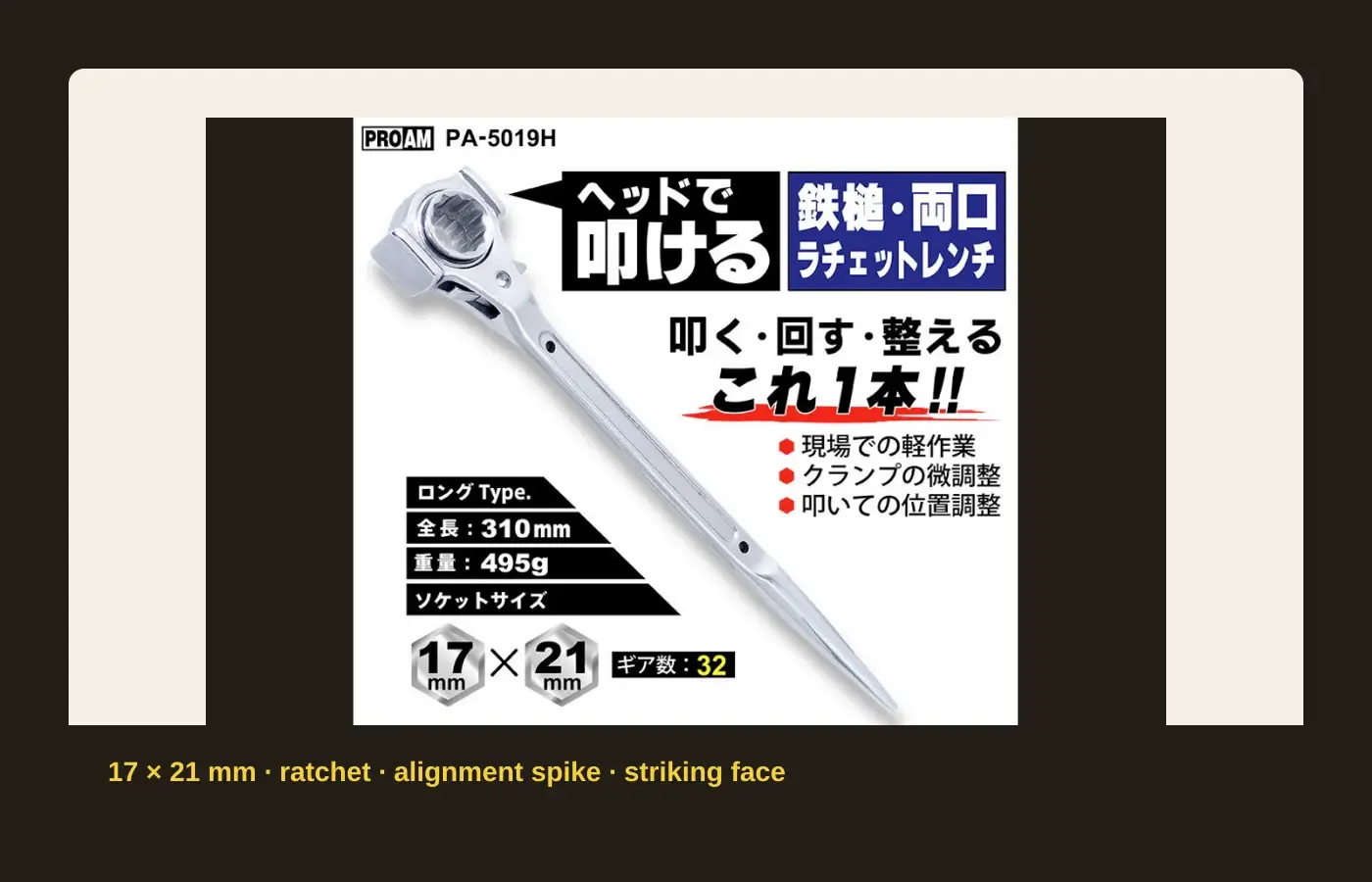
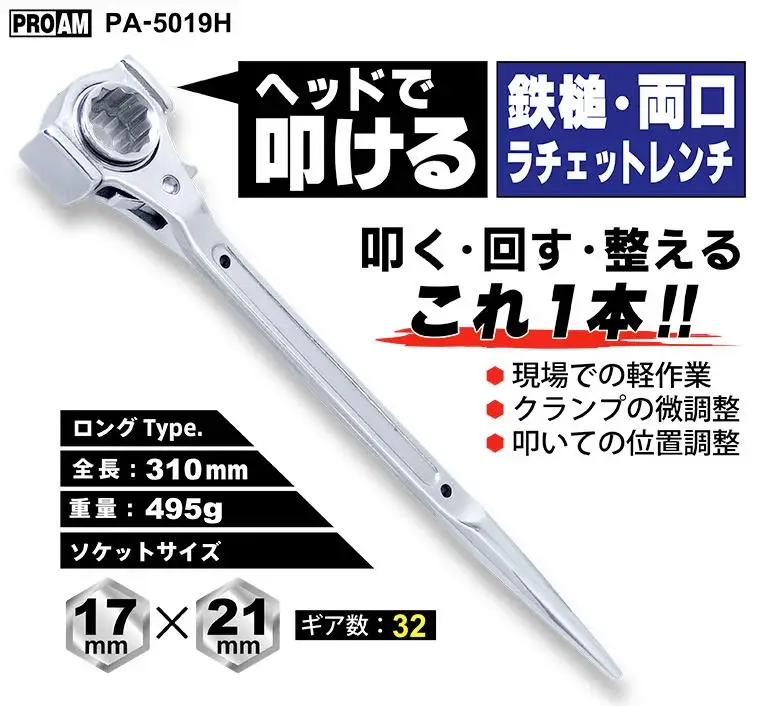
TOP Tools gives a very ordinary warning for its 17×21 mm scaffold ratchet: do not use it as a hammer.4 Toyomitsu's PA-5019H becomes interesting at exactly that point, because its head carries a flat steel shoulder intended for the light strikes that happen during assembly.13
On a white background the wrench looks almost over-equipped, with two ratcheting sockets, a long tapered spike and a square block beside the head, but on scaffolding or steelwork those shapes correspond to problems that often arrive within the same few minutes of work.
A few millimetres
One bolt may already be holding a bracket while the next hole lands a few millimetres out of line, leaving the worker with no reason to dismantle the first connection simply to recover that small offset; the long pointed tail, called a shino on this family of Japanese construction ratchets, goes through the neighbouring holes and uses its taper to bring their axes progressively together.25
Core77 describes the next nuisance in almost the same sequence: with the joint nearly aligned, a light knock on a clamp or steel part can recover the last bit of movement before tightening resumes.2 The PA-5019H lets the same tool make that small correction instead of sending the worker after a hammer, while its distributor is explicit that this does not turn the wrench into equipment for heavy blows.3
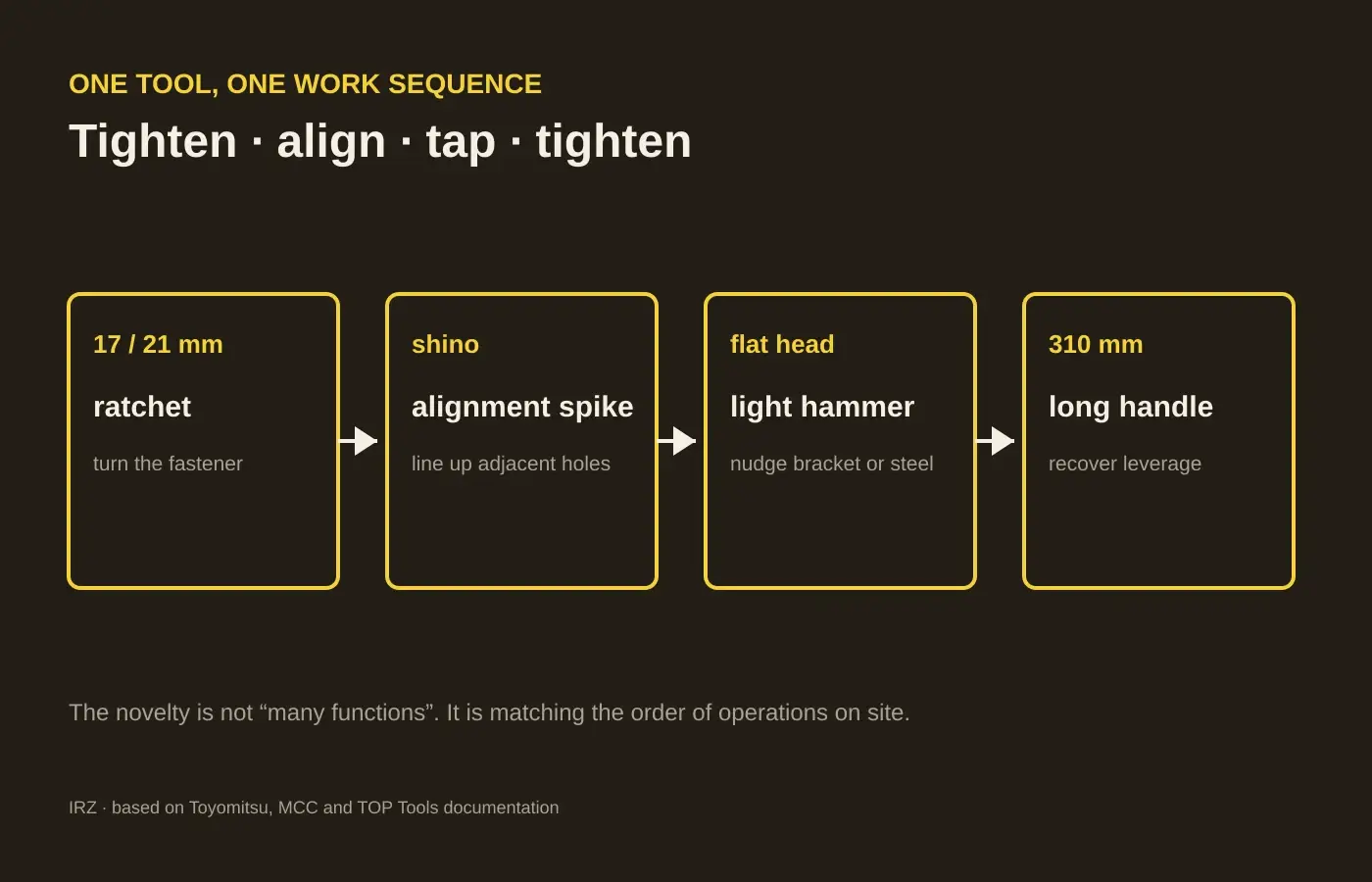
That sequence is what separates a specialised tool from a collection of unrelated gimmicks: the PA-5019H does not add three distant uses for a brochure, it keeps together three actions that normally interrupt the same fastening job.
The spike was already there
Toyomitsu did not invent the pointed tail. MCC already sells the 312 mm, 450 g RWC1721 with 17 and 21 mm sockets and a bent shino for scaffold work,5 while Super Tool describes the spike on its SRB-1721 as a way to align H-beam connection holes and hold parts temporarily during assembly.6
TOP Tools belongs to the same family with the RM-17X21N, a 310 mm, 420 g ratchet intended for scaffolding and formwork.4 The 17×21 pairing, long handle and alignment spike were therefore established features before Toyomitsu's model appeared, and attributing all of that geometry to the PA-5019H would make the innovation sound grander than it is.
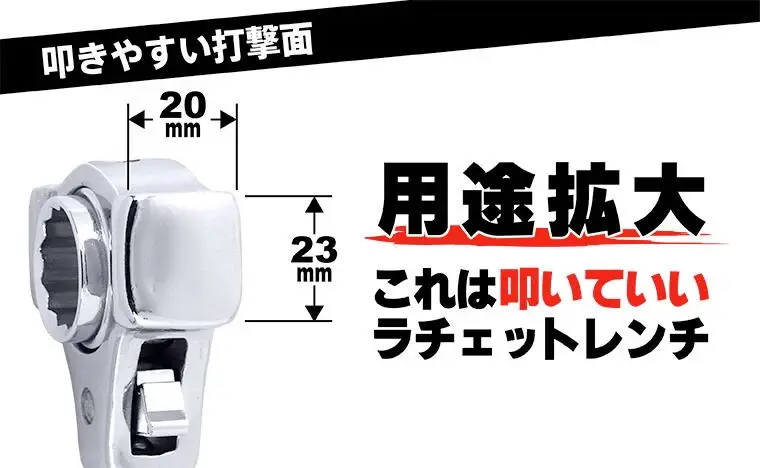
Toyomitsu changes something much smaller: the area other manufacturers tell users not to strike becomes a surface designed to accept a modest blow.
A head built for tapping
Toyomitsu describes the PA-5019H as a double-ended ratchet whose head was redesigned for this use.1 MULHANDZ gives examples that fit the same narrow job, including clamp adjustment and nudging components into position, while warning that excessive hammering remains outside the intended use.3
That limit matters because a 495 g wrench has neither the mass nor the purpose of a proper erection hammer; its value appears in the awkward middle case where a part needs to move only slightly and changing tools costs more time than the correction itself. In that situation, the difference between tolerated misuse and an intended feature can amount to a few square centimetres of steel placed where the blow already tends to land.
The comparison with TOP Tools is unusually direct: one manufacturer prints “do not use as a hammer”, while another has apparently looked at the same site reflex and modified the head so a controlled version of it becomes legitimate.14
The tail is a lever
The shino solves a different interruption and also explains why the wrench remains long. When its taper enters two offset holes, forward movement along the handle is converted into sideways movement between the steel parts, forcing the hole centres closer together as the point travels farther through them.
Super Tool documents this use explicitly for H-beam hole alignment, while MCC associates its own version with scaffolding and wire work.56 The pointed tail is therefore not styling applied to a handle; it is a compact alignment lever that remains available without putting the ratchet down.
Read from one end to the other, the wrench is almost a map of the assembly problem: turn the fastener at the sockets, recover hole alignment with the taper, give the reluctant part a small corrective knock beside the head, then return to tightening without changing what is in the worker's hand.
Slightly heavier
Toyomitsu lists the PA-5019H at 495 g and describes a combination of chrome-vanadium and carbon steel.1 MULHANDZ gives an overall length of about 310 mm and a 32-tooth ratchet mechanism, while comparable TOP and MCC models weigh 420 g and 450 g respectively.345
The manufacturer says the longer format improves grip and leverage and that the sockets were made thinner than on its earlier products to reach tighter spaces.1 Those are measurable choices of mass and geometry; they are not evidence of higher torque capacity or longer service life, because we found no independent endurance or torque test for the new model.
Demand arrived quickly enough to be worth noting without turning it into a performance claim. Toyomitsu reported at the end of July that orders had exceeded expectations and initial stock had sold out, with sales expected to resume around mid-October 2026.1 A sell-out says nothing about the ratchet after thousands of cycles, but it does show that the workflow the tool targets made sense to buyers as well as to design writers.
The procedure in steel
The PA-5019H is a useful industrial-design example precisely because it does not try to become universal. It watches a repetitive sequence in which a worker tightens, reaches for something to realign or tap the joint, then returns to the ratchet, and compresses that interruption into the geometry of a tool that already belongs on the job.
The difference is modest enough to be easy to miss, which is part of the lesson. Tool innovation does not always require a new mechanism or material; sometimes it begins by paying attention to the fifteen seconds in which the user stops using the main tool, then shaping the tool so those fifteen seconds no longer require leaving it behind.