The odd thing about replacing a manual toothbrush is that the handle usually has nothing wrong with it. The bristles are worn; the handle gets sentenced with them.
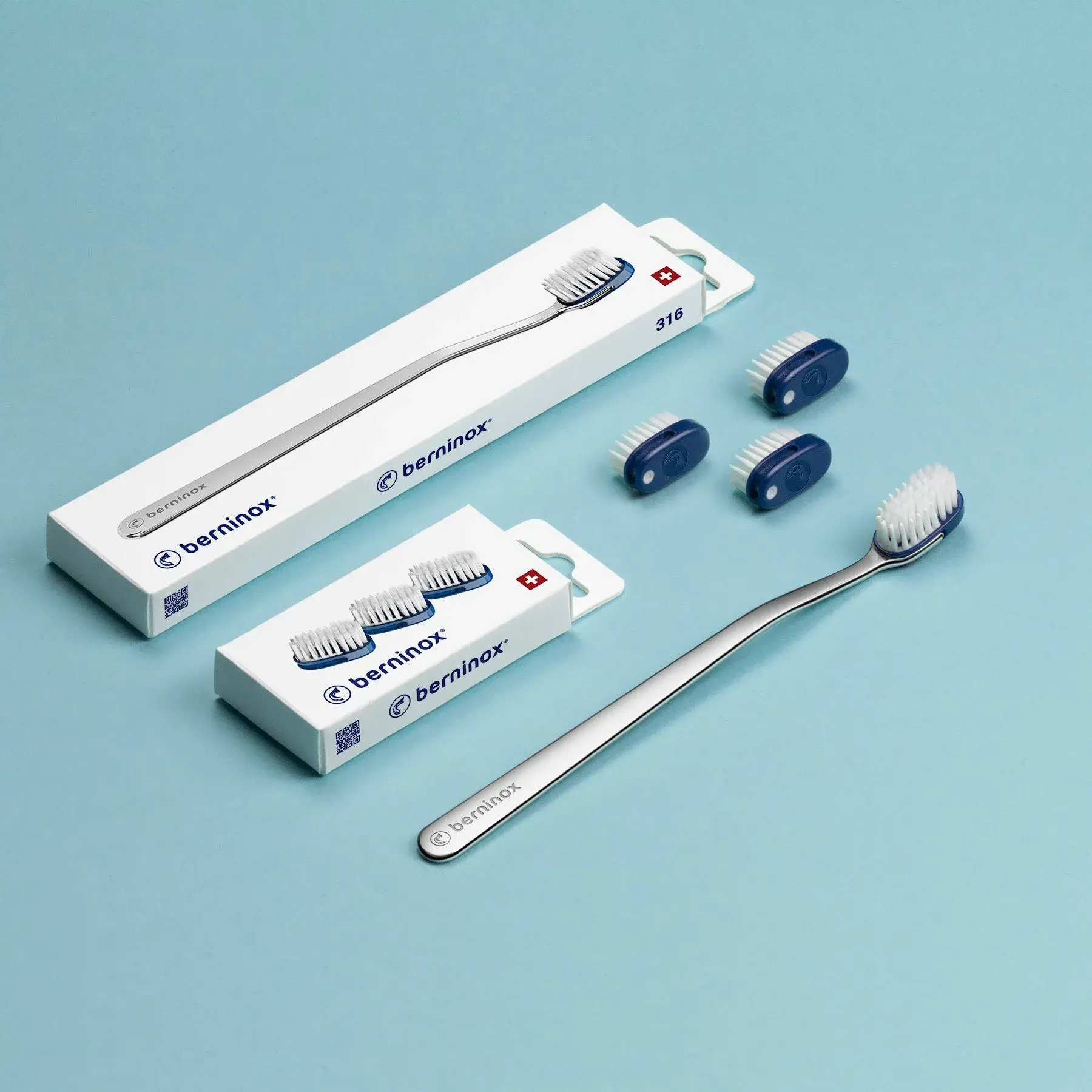
Berninox keeps the two on different clocks. Its 316 model has a 316L stainless-steel handle and a small head that pulls off for replacement.12 That is the whole mechanism. No motor, cartridge or release button. Pull the head straight, push another one on.
The company is also quite blunt about the result. A used head is not a neat little recyclable module. Berninox says the mix of plastics and metal makes it hard to recycle and advises putting it in household waste.2 What shrinks is the amount being thrown away, not the existence of waste itself.
The clip
Core77 featured the toothbrush on August 27, 2026. The design itself goes back further. Super150, the studio of Swiss designer Julien Luc Bernard, dates Berninox to 2020 and describes the clip as the key piece: it has to release for a head change but stay put during brushing.3
That job sounds trivial until the same joint has been pulled apart over and over in a wet bathroom.
Berninox lists the head at 28 × 15 × 17 mm. Inside that small volume are a recycled-PP body, recycled-PBT interdental bristles, medical-grade elastomer and metal staples.2 The steel handle is comparatively uneventful. Its usefulness does not decline just because the bristles do.
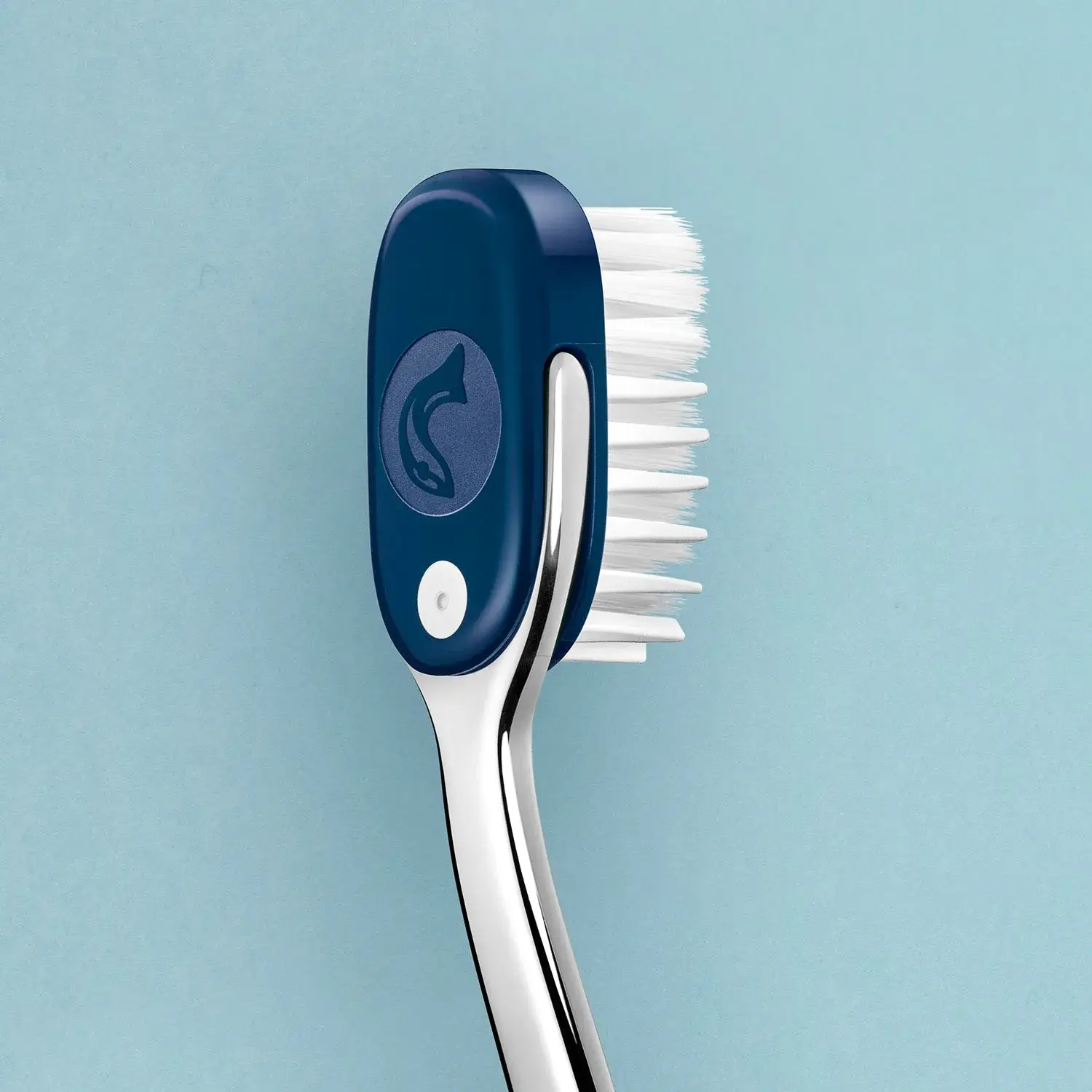
There is a nice bit of evidence in Berninox's maintenance instructions. The head is supposed to fit tightly, so the company tells owners to grab it with the whole hand and pull straight. Yank it sideways and the two steel prongs can bend.4
If that happens, the official fix is to tap the bare prongs on a wooden board, then try the head again. Three taps, test the click, repeat if needed.4 Not elegant, perhaps. Very understandable, though. You can inspect the failure with your eyes and correct it without buying a tool.
A year
The American Dental Association recommends a new toothbrush every three to four months, or earlier when the bristles become matted or frayed.5 Berninox uses a three-month rhythm for its own packs. One starter box contains a handle, the fitted head and three more heads, which it sells as about a year's supply.2
With a conventional one-piece brush, each change also means another handle. Berninox says retaining the handle cuts plastic use by a factor of eight.2
I would stop the claim there. The product page does not publish a Berninox-specific life-cycle assessment, and “8× less plastic” is not another way of saying “8× lower environmental impact”. The steel still has to be produced and finished; the benefit depends on keeping it in service.
A steel handle used for ten years and one lost after six months are materially identical products with very different stories. Durability only pays when the durable thing is actually kept.
Into the bin
The head is a useful example of why recycling labels get slippery.
Its main body is recycled polypropylene. The principal bristles are recycled PBT. There is also TPE and there are metal staples.2 Several sensible material choices, assembled into a lousy object to take apart at the end.
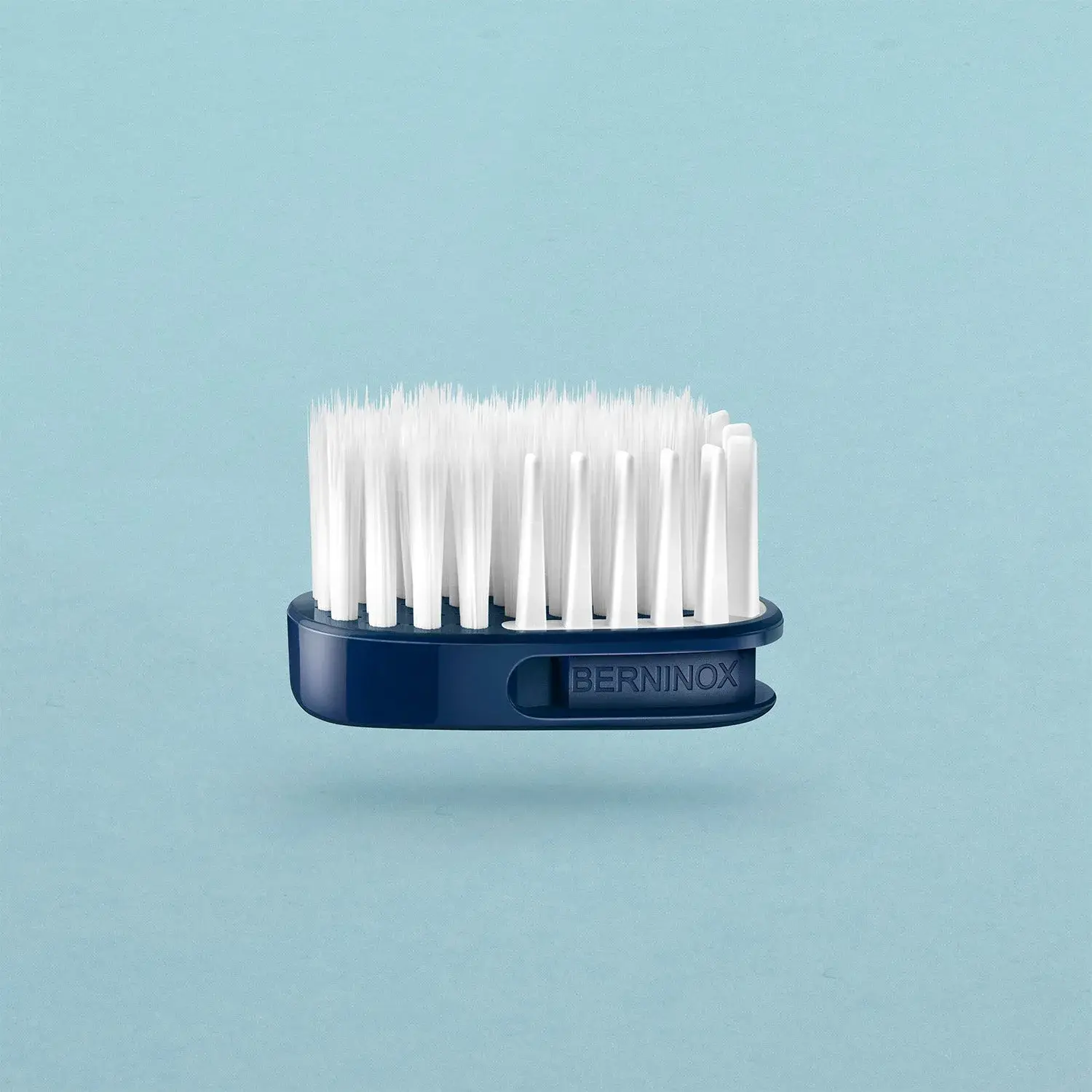
Berninox says separating those materials, especially the staples, is difficult. It also points out that collecting tiny heads for a special return stream would add transport.2 Its present recommendation is therefore ordinary household waste.
This is where “made with recycled plastic” and “recyclable” part company. The former describes where some material came from. The latter depends on what the finished thing looks like to a real waste system. A mixed part the size of a toothbrush head is not helped much by good intentions.
Berninox's answer is simply to make that mixed part the replaceable one and keep the big piece out of the bin.
Outside evidence
There are life-cycle studies on replaceable-head toothbrushes, just not on this particular one.
A 2020 British Dental Journal study compared four types over five years: a conventional plastic manual brush, a manual brush with replaceable plastic heads, bamboo and electric.6 Bamboo and the replaceable-head manual design had the lowest impacts across the categories studied. The electric brush came out worst in 15 of 16.
That cannot be copied onto Berninox. Its handle is steel; the study's products and assumptions were different. It does, however, show why separating a long-lived handle from a short-lived head is worth measuring rather than dismissing as packaging theatre.
A second paper, published in 2024, modelled manual toothbrush materials and also compared whole-brush disposal with head-only replacement.7 In that model, changing only the head avoided 4.69 g CO₂e per replacement. The authors' design recommendations included lighter brushes, less superfluous material and replaceable heads.
The 4.69 g belongs to their model, not to Berninox. The useful overlap is architectural: throwing away less of the object can show up in an LCA.
The catch
Steel brings a condition with it. The handle needs time.
Berninox cites corrosion resistance, washability and long life as reasons for using 316L.2 Fair enough for something that lives next to a sink. Yet material durability is only one half of a modular product's lifespan.
The other half is boring infrastructure. Will replacement heads still be sold? Will the fitting remain compatible? Will the owner keep the handle rather than lose it in a hotel bathroom?
Super150 says the design is registered and the clip is patent pending.3 That makes the refill ecosystem worth noticing. A proprietary interface can be mechanically perfect and still strand the permanent part if refills disappear.
The little tapping-on-a-board repair is encouraging because it deals with physical longevity. Long-term refill availability is harder. No amount of 316L fixes a discontinued connector.
Where to split
That leaves a design question bigger than toothbrushes: when a product is regularly thrown away, which component actually reached the end of its useful life?
For a razor it may be the blade. For a vacuum, a filter. Shoes have soles; tools have abrasives; machines have seals and batteries. Sometimes those pieces can be separated cleanly. Sometimes adding an interface creates more trouble than it removes.
The interface can loosen, collect dirt, cost too much, or turn a common consumable into a proprietary one. “Replaceable” is not automatically better. It is a proposal that has to survive use.
A toothbrush is a favourable case because the mismatch is so obvious. Bristles visibly age. The handle mostly sits there doing handle things.
Berninox has not abolished the toothbrush's waste stream. Its head is still a mixed disposable part, and there is no public product-specific LCA here proving the stainless version wins every comparison.
What it has done is place the split in a sensible spot: close to the thing that wears out. That modest decision is probably the most interesting part of the whole shiny object.