Robotics is often photographed as if it already had a movie poster. Low angles, blue light, clean metal, a pose that announces either a threat or a miracle. Remove those signs and you may find an object that waits, stumbles, gets adjusted or depends on the person standing next to it.
That is the shift in Italian photographer Mattia Balsamini’s images of robots, mechas and mechanical dogs. He does not decide before the exposure whether a machine should look reassuring or frightening.1 The subject becomes less “the future” than the very present chain of human work that builds it.
A less heroic frame
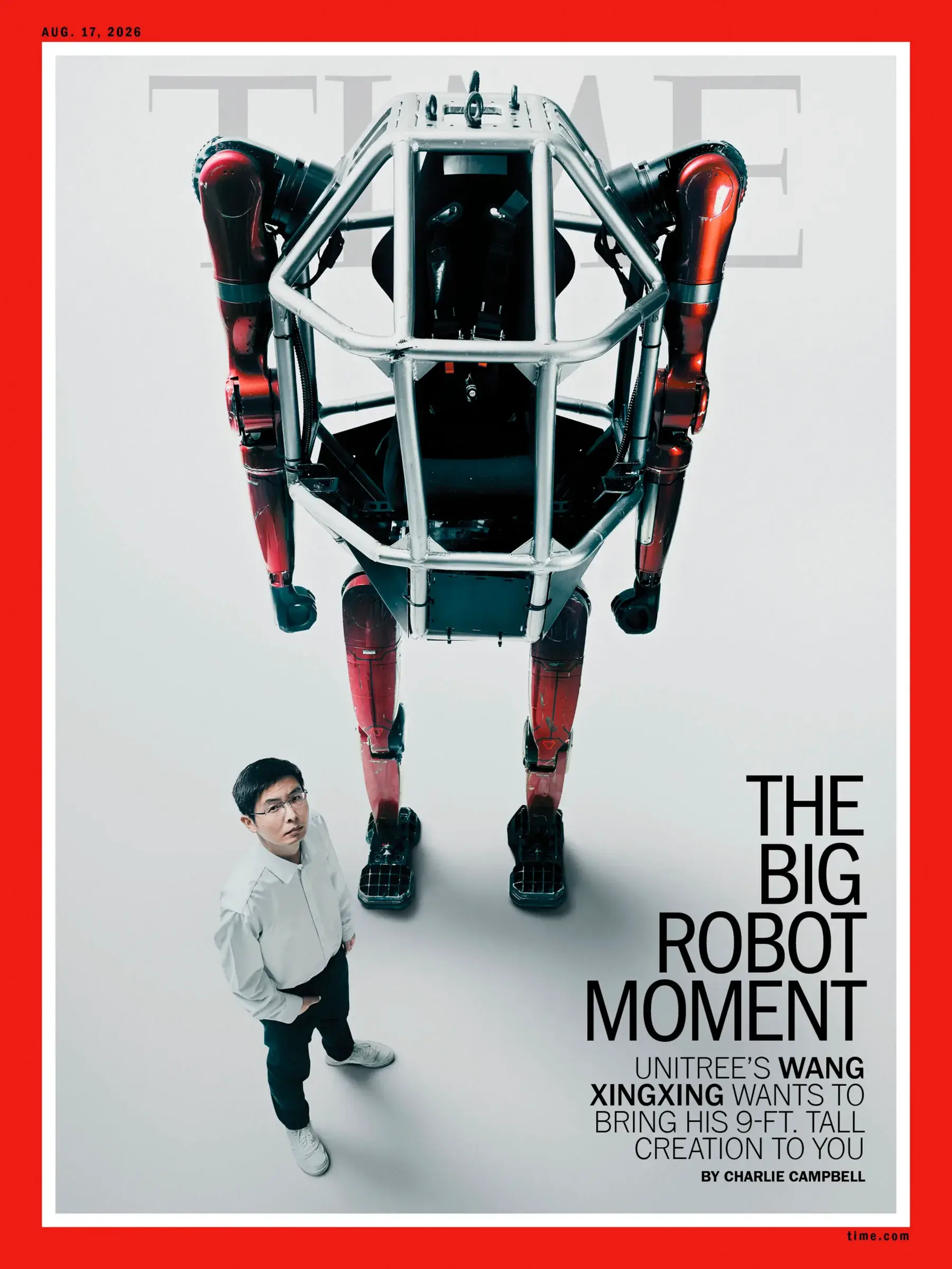
Balsamini’s portfolio brings together very different images: his Androids project shows Sophia and iCub, photographed in 2019–2020, while his TIME series presents Unitree robots in more recent compositions.23 The images share no single visual recipe; Balsamini keeps the machine from arriving with a ready-made personality.
In the article presenting his work, Balsamini says he tries to understand what he is looking at while photographing it: the technology, what it does, the people involved and the access he has.1 That changes the photographer’s role. He is not only searching for the robot’s best profile; he is looking at the conditions that make that profile possible.
A machine photographed in its environment keeps clues that advertising images tend to remove: a test surface, a cable, a joint, the distance to its operator, sometimes an ordinary wall. Those details keep the object from turning into a mascot detached from its workshop.
Ambiguity as method
The article about Balsamini’s work contains a line that sums up the method: “Technology is rarely morally simple.”1 The sentence does not excuse vagueness; it stops the image from carrying a conclusion the scene cannot prove.
A robot designed for disaster response and a system developed for military use can both be photographed with beautiful light. Beauty does not make them equivalent; it simply cannot condemn or absolve them. Context has to remain visible, and the text has to do the work a photograph cannot do alone.
That restraint is the opposite of viral clips in which bipedal robots are hit with sticks to demonstrate their resilience.4 In those videos, the mechanical body becomes the spectacle and the test becomes the story. Balsamini moves the other way: show enough to make us look at the machine, without pretending that one image settles what it is, what it will do or who controls it.
Look at the people
The choice is also biographical. Balsamini grew up around his family business designing and installing air-conditioning systems. He says he was surrounded by tools, machinery, materials and people making, repairing and testing things.1 That may explain why his robots do not float in abstract space: they belong to a workshop culture.
The value of documentary robot photography is therefore not making technology more “real” through a sober effect. It is making visible what the futuristic story removes: the gestures, trials, money, decisions and failures around the machine. The robot remains spectacular, while the people and decisions around it stay in the frame.
For image-makers, the lesson is practical. Before searching for an appearance that summarises the subject, let in what explains it. A joint, an off-frame person, a workshop floor or a hesitation in the movement can tell us more than a perfectly clean science-fiction set.