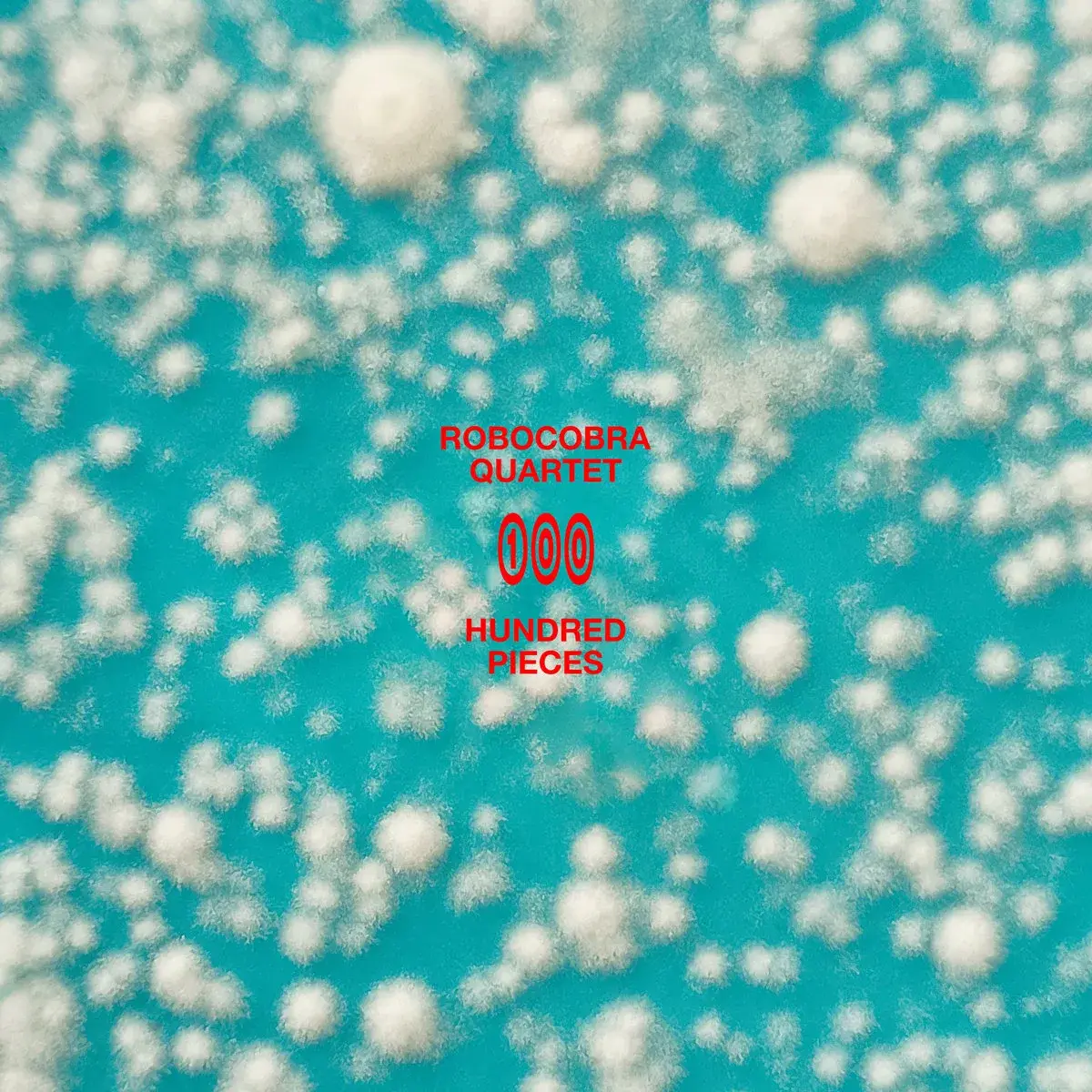
To make the images for Hundred Pieces, Thibault Barillon did not begin in Photoshop. He bought agar plates and started growing mould at home, trying different organic matter to see what would appear a few days later.3
Timing changes the whole story. Barillon began this experimentation before the hundred-track record had properly taken shape, and he describes those early cultures as improvised play with no grand plan. Robocobra Quartet only later recognised how closely the process resembled the album itself: start something, wait, allow accidents to happen, and then decide what deserves to stay.13
Eventually, one hundred petri dishes became one hundred images for one hundred tracks.3
As an anecdote, this is merely a slightly disgusting way to make an album cover. As a design system, it is more useful: biology produces the differences and design supplies the rules that let those differences be compared.
Before the album
The idea for Hundred Pieces itself began as an off-hand joke. The band soon started writing specifically for “the hundred”, eventually building a 100-track record scheduled for release on November 13, 2026.12
Robocobra Quartet works from a studio in an old Belfast linen mill, configured to capture each instrument separately during writing sessions. Their own account is refreshingly unromantic: many days generate roughly eight hours of useless material, with perhaps three or four minutes where the chaos suddenly organises itself into something worth keeping.1
That working method explains the petri dishes better than any metaphor added afterwards. Some songs, including Haha and Nothing, were developed over months, while others such as Gilded and Ashes Again stayed close to moments captured within a few minutes.1 The band also cites Marina Abramović's durational art, specifically her memoir Walk Through Walls, as an influence on the record.1
So the problem was larger than “how do you write one hundred songs?” It was also how to build a process long enough for unexpected things to have time to appear.
Barillon was already doing something similar at home.
One hundred experiments
There is no reason to turn the domestic cultures into a pretend scientific laboratory.
The available accounts say Barillon bought agar plates, added different organic matter and invented his own “techniques” to see which moulds would grow.34 They do not provide a microbiology protocol with identified species, controlled temperature, sterile handling, exact formulations or standard incubation times.
The missing control is part of the output rather than an embarrassing omission.
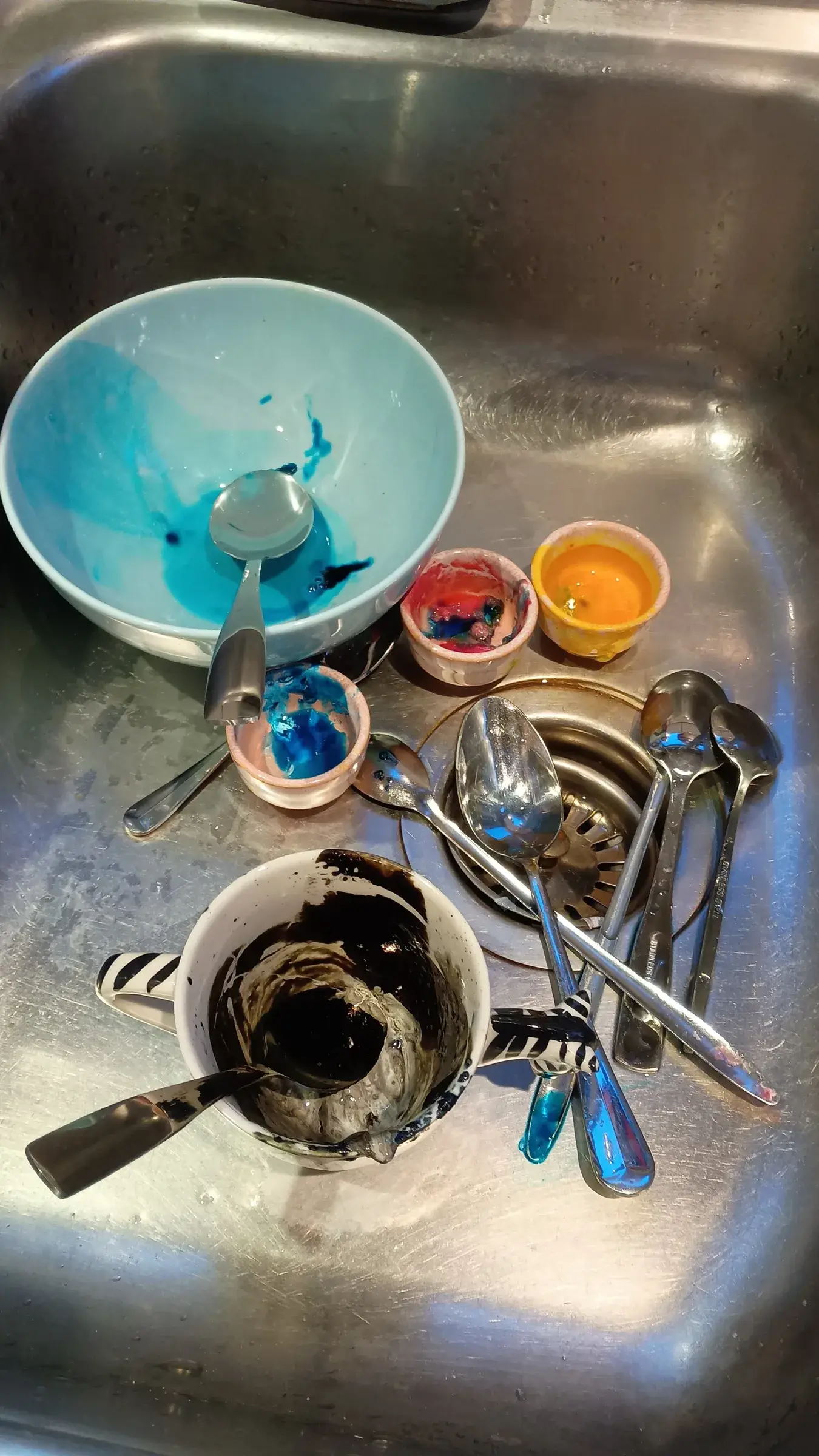
One dish can become turquoise with scattered white colonies. Another turns brown, pink or nearly black. One growth spreads, another stays compact. Barillon can influence the starting conditions, but he does not directly draw the final shape.
In the older procedural sense, the project is generative: define a process that produces a family of outcomes. Model generation works differently. No prompt can request another instant variation here, and no slider can make a dish redder, fuzzier or denser on demand. The culture has to be started and left alone long enough for biological time to contribute.
The band's publicity explicitly stresses that the album was made without AI.3 There is no need to turn that choice into a moral contest. The practical difference is enough, because this material has real duration, probable smells, possible contamination and an evolution that cannot be undone with Cmd+Z.
Fix the frame
Left entirely random, one hundred cultures would simply remain one hundred unrelated objects. The system arrives at the photographic stage: Creative Boom says every dish was shot dead-centre, from the same angle, inside a square white-background frame, and some cultures were photographed again days or weeks later as they continued to change.3 Repetition in the camera turns biological variation into a visual alphabet.
Bandcamp's credits make the distinction explicit: Barillon receives Petri Dish Art, while Design, Layout & Typography go to Timothy Farrell.1 The project therefore contains at least two different acts, first producing unpredictable visual material and then building a coherent editorial identity from it. Collapsing those roles would erase the interesting part.
One image per track
Each photographed culture is intended to accompany one of the album's one hundred tracks.3 The images are also cycled through rapidly in a GIF used as the Spotify Canvas for Haha.3
Quantity is therefore doing more than decorating the title Hundred Pieces. It structures both the musical object and its visual system.
One hundred tracks create a navigation problem. The band openly asks whether anyone will listen through five hours in sequence, jump to intriguing track names or return to the record like a book.1 One hundred images answer in the same spirit: a culture can be encountered alone, as part of a grid, as a rapid sequence or simply as one state among many.
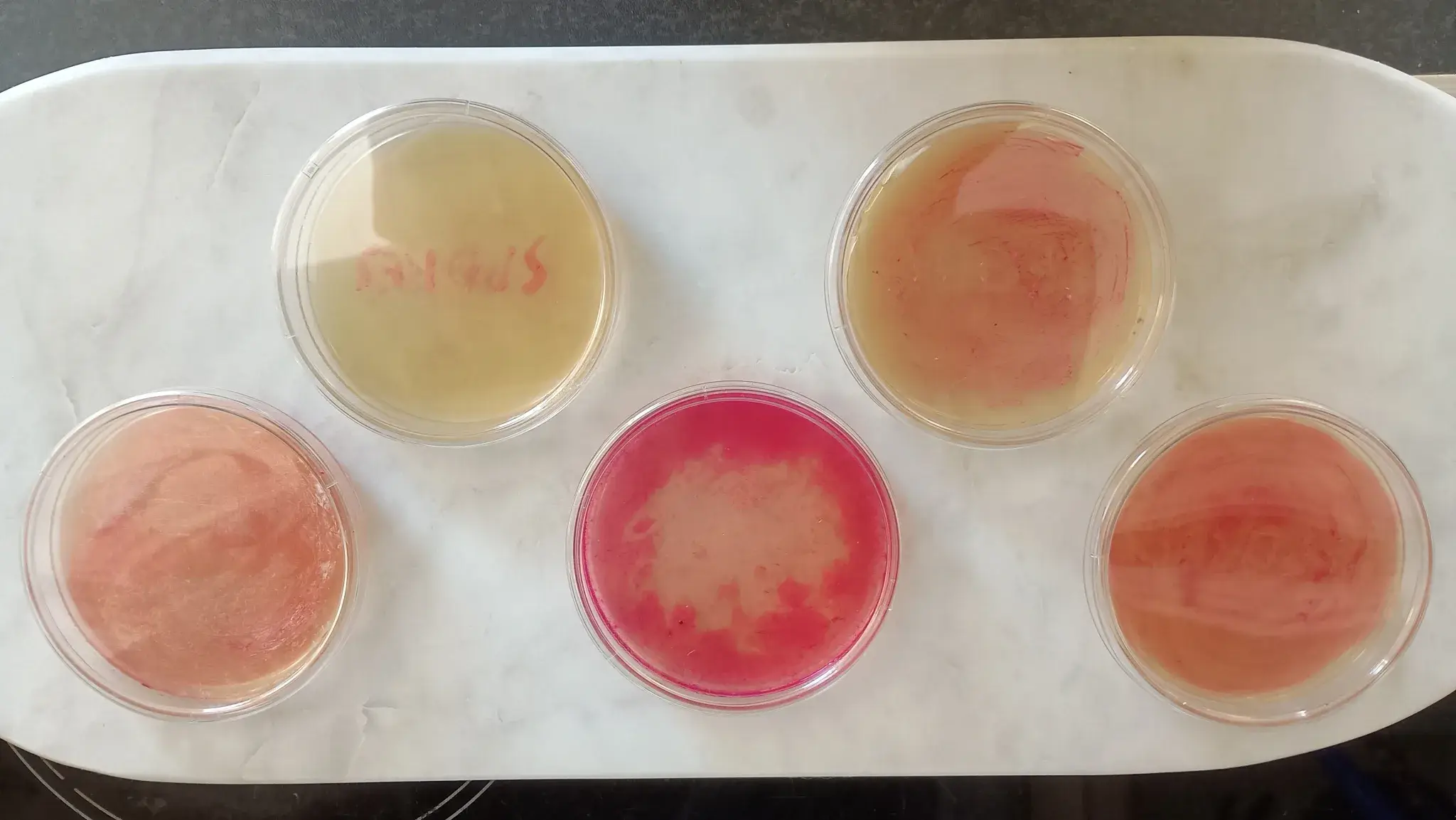
The music-image relationship remains deliberately loose. The sources say each image will accompany a track. They do not say each culture was originally grown to represent one specific song.3 That looseness is probably the stronger choice. If every dish had to illustrate its track title literally, the process would become a factory for metaphors, whereas letting the cultures exist first preserves the logic used in the recordings: produce material, observe what it becomes, and organise it afterwards.
Designing the wait
Digital graphic tools have trained design around very short feedback loops. Change a colour, move a shape, generate a variation or undo an experiment, and the response arrives within seconds.
A biological culture reverses that timing.
The initial gesture can be simple, but the answer arrives later, some decisions cannot be reversed, a failed dish may be unrecoverable, and a successful one can keep evolving after the moment when it first looked “finished”. The designer's job therefore includes choosing when to start the process, when to look and when to stop documenting it.
This is where the visual process meets the album without forcing the comparison. Robocobra Quartet describes songs that find their final form almost immediately and others that take months,1 while the petri dishes can likewise be photographed at different stages of development.3 Duration becomes production material in both cases.
The useful lesson sits inside that division of labour. To make an image whose exact appearance cannot be planned in advance, a designer does not have to ask software to simulate more randomness. Another option is to construct a real situation in which something grows, drifts and resists complete control, then design the frame that makes this unpredictability readable as a series.