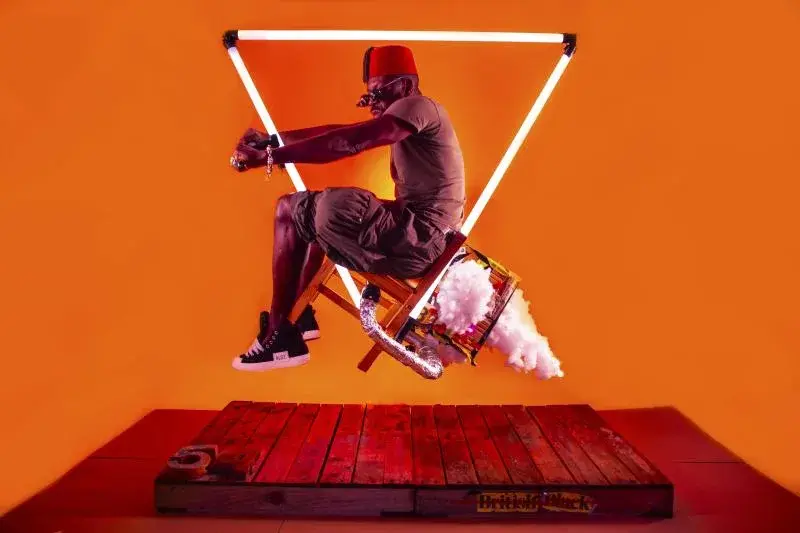
To make somebody float on a cloud, Benji Reid does not necessarily need to erase the trick. The wooden support and cotton can stay almost visible enough for you to understand how the lie is standing up.
That is one thread connecting his work with Zana Masombuka’s in an October Gallery pairing announced for 3 September to 3 October 2026.1 Both artists construct highly deliberate photographs, but neither treats the disappearance of the making process as an automatic final step.
Creative Boom describes Reid using cotton-wool clouds supported by wooden rigs, with the construction sometimes left perceptible in the frame.3 Reid also comes from performance and calls his practice “choreo-photolism”: bodies, objects and staging work together before the camera fixes the image.3
Masombuka begins from a different place. October Gallery documents a practice spanning photography, film, sculpture and performance, rooted in Ndebele culture.2 Some bodies of work combine photographs with sculptural beaded frames and symbolic objects connected to the practices and stories of her community.12
It would be simplistic to turn this into an analogue-versus-digital argument, as if an image becomes more truthful because it contains cotton or beads. The work does not prove that.
The useful common ground is narrower: the construction of the world is part of the image’s content. Set, costume, material and fabrication time are not merely production residue that must disappear to make a perfect surface.
For a photographer or illustrator, that changes the question. Instead of asking only “how do I make this scene believable?”, you can also ask “which traces of making deserve to remain visible?”.
Fantasy does not have to hide every seam in order to work. Sometimes the seam is what gives the world its internal logic.