The headline almost writes itself: a cookie made from plastic. It is also the wrong mental picture.
PET genuinely matters, just not in its familiar form. SIU first grinds bottles, then treats the material with water, oxygen, heat and pressure. Yeast enters only after the polymer has been replaced by a mixture of smaller molecules it can assimilate.13
Yeast comes in only after that dismantling. It takes some of the carbon and rebuilds biomass, proteins or useful molecules. Then the recipe becomes surprisingly ordinary again: starch, fiber and sweetener are still added before 3D extrusion.1
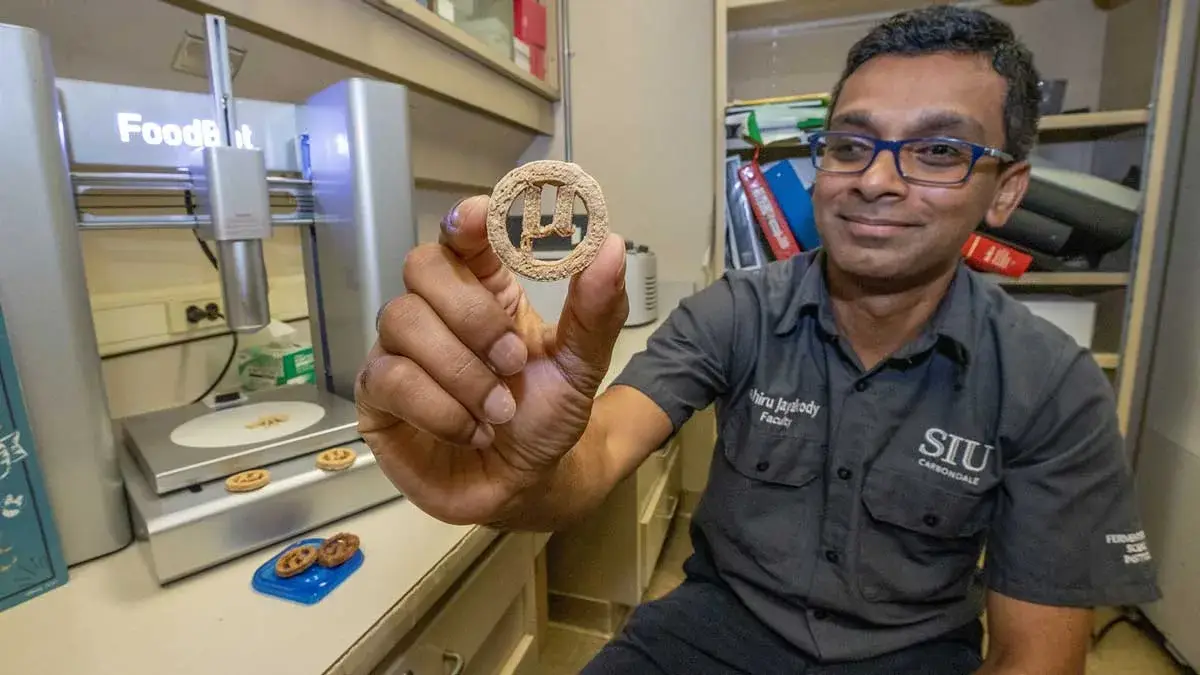
Printing is the final shaping step. It neither recycles the PET nor performs the conversion that makes its carbon part of a food ingredient.
Remove the bottle
Forget the printer for a moment. The first machine that matters is a reactor.
SIU calls the process oxidative hydrothermal dissolution, or OHD. Developed by geologist Ken Anderson, it uses water, oxygen, high temperature and pressure to break difficult materials — PET, corn stalks and leaves, other biomass — into soluble carbon molecules that microbes can access.13
“Transform” is excellent headline language because it makes all this plumbing vanish. Unfortunately, the plumbing is the project.
Yeast does not attack a bottle like a tiny laboratory Pac-Man. Waste is mechanically and chemically reduced until it becomes a liquid feedstock. That intermediate material enters the bioreactor.3
The principle extends beyond µBites. A 2026 SIU review describes bio-upcycling as a chain: release monomers or small molecules first, then route their carbon through chosen metabolic pathways. Plastic becomes a usable carbon reservoir only through that controlled sequence.6
Program the yeast
The 2026 work also asks microbes to make more than the protein-rich bulk.
The abstract names three yeasts the team describes as safe-to-eat strains: Saccharomyces boulardii, Saccharomyces cerevisiae and Rhodosporidium toruloides.2
One S. cerevisiae strain is engineered to produce vanillin from ferulic acid derived from plant biomass. Another route uses R. toruloides. Through adaptive laboratory evolution, the team improves its ability to use ethylene glycol, a product of PET breakdown, as a carbon source and produce beta-carotene, a vitamin A precursor.2
This is where PET returns in a measurable way: some of its carbon feeds a pathway that can end in a pigment and nutrient. Not in the whole cookie.
It also exposes the ingredients still arriving from elsewhere. Fiber, starch and sweetener are added to the recipe; making microbes produce those too remains a future goal.1
The 2026 cookie is therefore a hybrid: recovered waste carbon, microbial biomass and fermentation products, plus conventional food ingredients.
Print last
Only at this point does the printer return to the story.
The mixture is loaded into a food printer and extruded layer by layer to create a controlled portion and geometry. ACS's explainer then describes microwave finishing.1
The printer mainly adds repeatability, portion and geometry. Nothing in these sources makes it necessary for carbon conversion. Its contribution is geometric and operational, not metabolic.
Projects combining biotechnology and digital fabrication often suffer from the same headline problem: the most visually legible machine gets the main verb. Here the difficult work happens upstream, in feedstock control, contaminants, strains, yields and the molecules produced.
Which cookie was tasted?
Then the public sources disagree on a fairly important detail: who tasted which version?
In May 2024 SIU said it had tested a µBites prototype for safety and nutritional parameters and then run human sensory analysis. The university reported an overall hedonic score of 6.5 out of 9, with aroma at 7.33 and colour, shape and texture all above 5.3
The August 2026 ACS release nevertheless says the team is waiting for institutional approval to conduct taste tests. It says aroma has been evaluated and participants indicated willingness to eat the product in resource-limited situations.1
The sources never explain why both statements can be true. Different formulation? New protocol? Fresh approval? We cannot tell. What we can say is that a prototype was tasted in 2024, while its score cannot simply be transferred to the 2026 vanillin-and-beta-carotene version.
More importantly, the 2026 results are being presented as a conference presentation and ACS abstract, not as a detailed peer-reviewed experimental paper.2
The team's use of “safe” is therefore a prototype claim. It is not broad regulatory clearance for food made from PET-derived feedstocks.
NASA, phase one
The NASA badge needs tidying too.
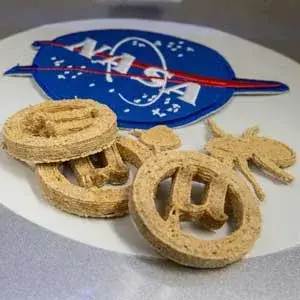
µBites really was selected in Phase 1 of NASA's Deep Space Food Challenge in 2021. NASA chose 18 U.S. teams and awarded each $25,000, including µBites in Carbondale.4
The official later-stage lists also tell the rest of the story. µBites is absent from Phase 2 winners and the final Phase 3 winners.5
Today's project descends from a concept rewarded by a NASA challenge. It is not a food system selected for a mission, much less flight-qualified space food.
The less glamorous version is more concrete: a $25,000 Phase 1 award helped start work that continued after the team left the competition.
Count the conversions
µBites remains a prototype with extremely terrestrial questions: how much energy does OHD require, what yields survive dirty heterogeneous waste, what purification is necessary, what toxicology is required, which regulatory pathway applies, what does it taste like, and at what scale does the process make economic sense? Recent bio-upcycling literature puts process integration, energy, economics, strain robustness and downstream separation among the barriers between laboratory conversion and industrial systems.6
The project still offers a useful rule for reading circular-material announcements.
When a headline says A becomes B, count everything that happens in between.
Here the bottle first loses its shape and polymer identity. Its carbon becomes feedstock, passes through yeast metabolism, joins added ingredients, then reaches a dough the machine shapes.
That is not less surprising than “eating plastic”.
It is simply much more interesting.