A pair of scissors already does something mechanically strange: two rigid bars and one pivot create a large motion while asking the material itself to deform very little.
Connect several such mechanisms and the logic begins to resemble an expanding gate or a Hoberman toy, but the problem becomes much harder once that chain is expected to become an entire curved surface and still return cleanly toward an almost one-dimensional state.
That is the problem Noah Toyonaga, Seri Nishimoto, Colter Decker, Robert Wood, Tomohiro Tachi and L. Mahadevan formalize in Collapsible scissored surfaces, published in PNAS in June 2026.13
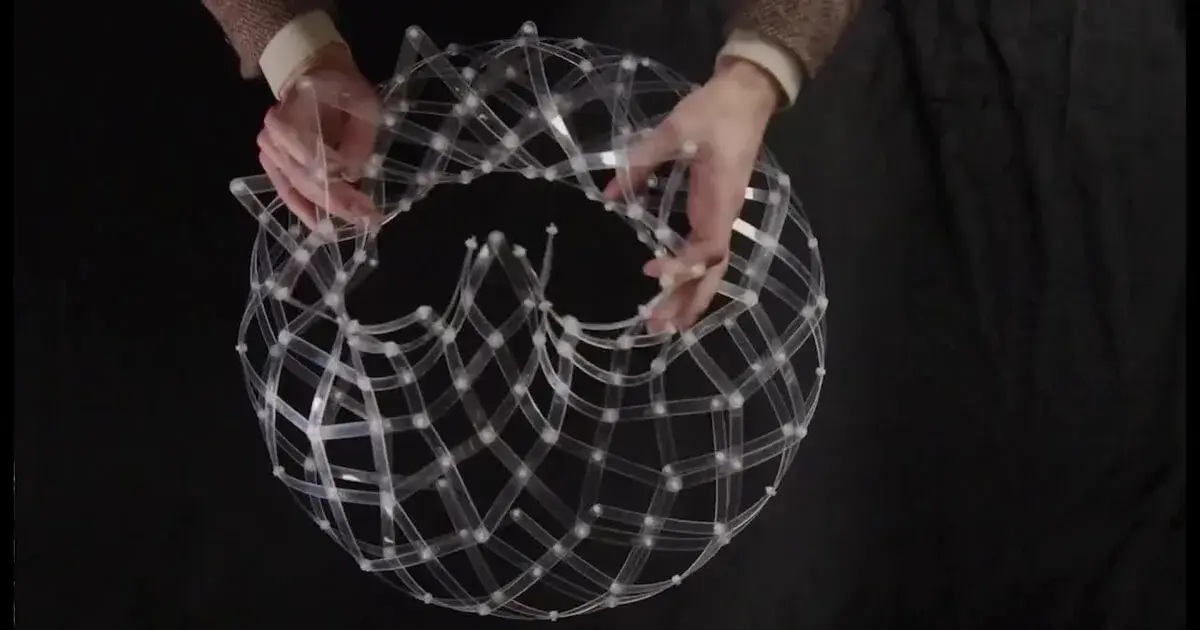
The prototypes opening into helices, toroids and doubly curved “eggbox” surfaces provide the photogenic result,2 while the useful result sits underneath: the team shows how to grow these mechanisms one linkage at a time without losing their ability to collapse.
Start with a line
The researchers call the structure a pantograph lattice, a network of two-bar scissor mechanisms pivoted at their centres and connected to neighbouring units.1
In the compact state, the legs can align so that the whole network approaches a one-dimensional geometry. When opened, the same network occupies a surface that may be flat, singly curved or doubly curved.1
That transition changes the design problem, because a conventional approach might begin with the final surface and then search for a mechanism able to reach it. As the network gains joints, however, the constraints become coupled: changing one local length alters how its neighbours can close, which in turn affects the rest of the structure.
A beautiful final surface therefore says nothing by itself about whether the mechanism can pack down, which is why the geometry of motion has to be designed alongside the geometry of appearance.
Rule before form
The important move in the paper is refusing to solve the entire structure at once; Harvard instead describes the algorithm as additive: start from a boundary and add scissor mechanisms one by one. At every step, the new piece must satisfy the constraints that preserve compatibility, deployment and collapse.2
This avoids posing one large optimization in which every length and angle of the final surface becomes an unknown simultaneously.
Work Toyonaga presented at the APS meeting in 2024 already shows the underlying idea: leg lengths determine deployed geometry, but they must obey a local constraint that keeps the mechanism compatible with its folded state.4
That local condition changes the design question, because instead of asking “which set of hundreds of bars gives me this torus?”, the designer can ask “which next mechanism can be added here without destroying the properties accumulated so far?”
A frightening global problem becomes a sequence of geometric decisions that can be checked locally, each one concerned only with the next viable addition to the network.
Grow the mesh
The 2026 publication says the algorithm explores the mechanism space for this class and produces surfaces with single and double curvature.1
The 2024 APS description already said the method could target surfaces represented by quadrilateral meshes.4
“Target” needs to be read carefully, because the algorithm does not accept any arbitrary sculpture and magically convert it into a perfectly collapsible machine. It works inside a constrained mechanical family: bars, pivots, cell connections and closing conditions must continue to cooperate.
That restriction is exactly why the method is interesting. The target geometry is not a decorative skin applied afterwards; it is encoded into the dimensions and connections of the mechanism.
Torus, helix, eggbox
The team validates the framework in simulation and then as physical objects fabricated with multimaterial 3D printing.12
Harvard highlights helical, toroidal and doubly curved “eggbox” geometries among the resulting prototypes.2
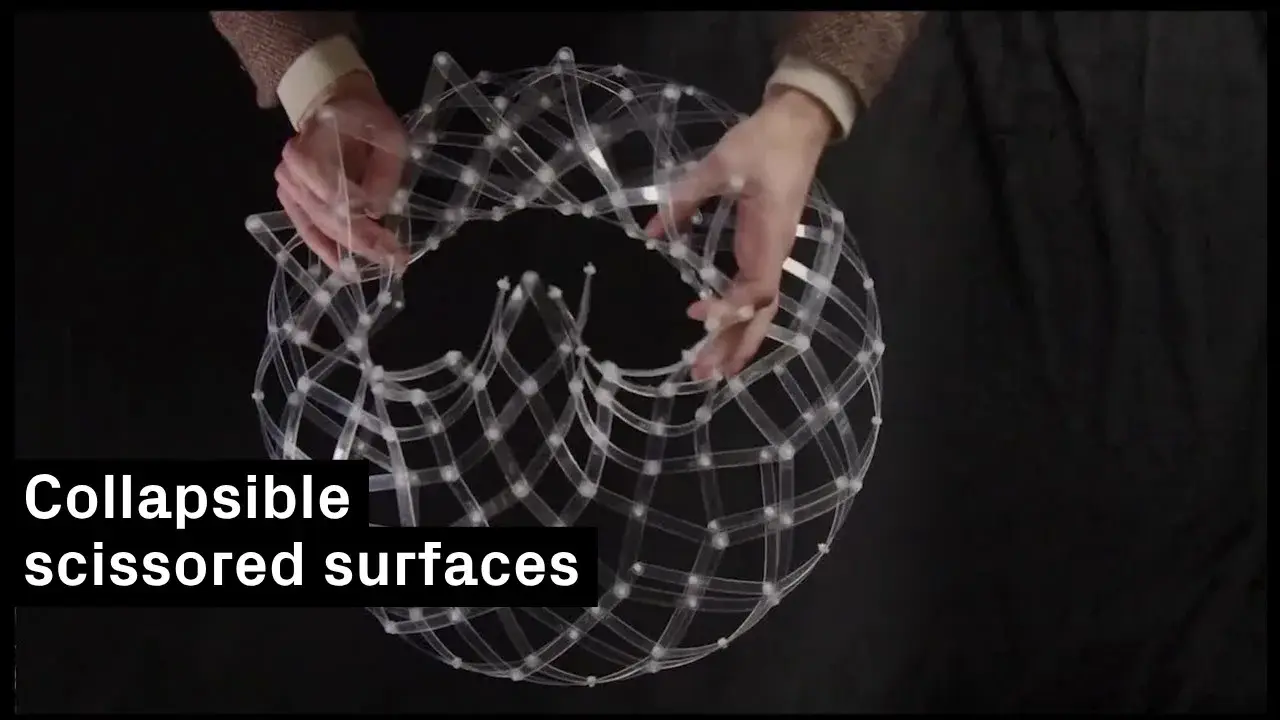
Multimaterial printing matters because one fabricated object contains parts performing different mechanical roles while still coming out of one coherent manufacturing workflow. The publication presents this mainly as a streamlined route for automated fabrication of the lattices.1
That result is more modest, and more useful, than declaring a ready-made “programmable material,” because the prototypes show that the calculated geometry can become a physical mechanism and execute the intended transformation. They do not yet show that a roof, satellite or implant built this way survives its real loads for years.
Before 3D printing
The project did not begin with multimaterial printing.
At the 2024 APS presentation, the team described desktop models made from plastic sheeting and rivets, along with a possible construction method for larger architectural structures.4
That detail separates two contributions, the first of which is geometric: find the rules that keep the network deployable and collapsible.
The second is manufacturing, meaning the efficient production of the joints and bars of a complicated prototype; that manufacturing route could change without discarding the geometric result.
An architectural application, for example, need not imply a building emerging from a giant 3D printer. The mathematical result could in principle inform bars and pivots made by other processes, provided their clearances, stiffness, tolerances and stops still respect the intended kinematics.
This is where the laboratory result hands the problem back to engineering.
No sheet
Harvard frames pantograph lattices as a third language alongside origami and kirigami.2
The comparison mainly classifies geometric operations: origami encodes motion through folds in a sheet. Kirigami adds cuts, unlocking different deformation modes. Mahadevan's laboratory has long treated both families as inverse-design tools for transformable structures.6
The new work starts from a different primitive, articulated connections between bars, and treats the empty space between them as a normal part of the geometry rather than as missing material.
That has an obvious practical consequence. A pantograph surface does not need to remain a continuous sheet; the voids belong to the structure.
The reverse is equally important. A network of bars does not automatically provide functions that a continuous skin may offer, such as sealing, opacity, an aerodynamic surface or a load-carrying membrane. Applications requiring those properties would have to add them elsewhere.
Ranking the three families as better or worse therefore misses the point, because each moves constraints to a different part of the system and that relocation determines where it is useful.
What is missing
The releases mention deployable aerospace structures, adaptive architecture, robotic systems, medical devices and programmable materials as possible applications.25
Those are directions, not demonstrated products.
The public material around the study establishes geometry, the algorithm, simulation, prototype fabrication and physical deployment.123
It does not provide, in the evidence available for this article, an application-scale structural load campaign, cycle-life data, shock or vibration qualification, pivot ageing, a field deployment, or an economic comparison with commercial deployable systems.
Those absences do not weaken the mathematical contribution; they define the next engineering step and the distance between a geometric mechanism and a qualified product.
A lattice that repeatedly finds its shape on a laboratory bench and a mechanism expected to work a thousand times in space live under radically different specifications.
The small choice
The design strategy may ultimately transfer more widely than the scissor mechanism itself.
When a final object depends on hundreds of coupled decisions, the instinct is to optimize the entire system at once. The researchers instead look for a local rule that preserves an important global property, the ability of the surface to collapse, every time a new piece is added.2
The result resembles growth under constraint. A new piece only needs to satisfy the conditions that let it join the existing network while preserving the collapse mechanism; global knowledge of the complete torus is unnecessary at that step.
Repeated across the network, those local decisions produce a curvature that does not belong to any isolated cell.
That is what makes the prototypes more interesting than an elaborate Hoberman object: they show that a deployable surface can be generated through compatible additions, instead of being drawn first and mechanically rescued afterwards.
The network closes because closing remained possible at every stage of its growth.
In a mechanical system where one bad joint can condemn the motion of the whole structure, that local modesty is exactly what enables the global ambition.