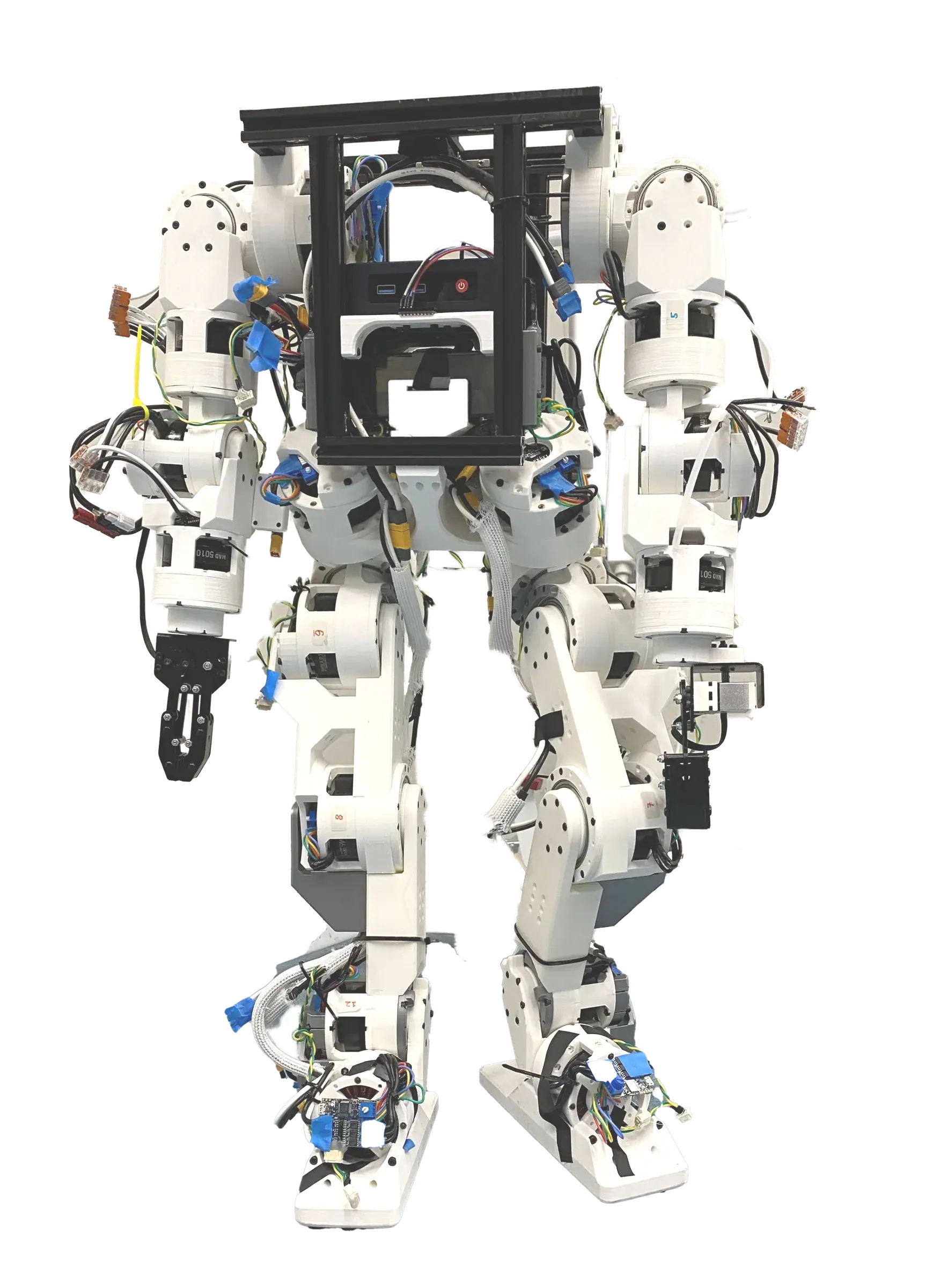
Berkeley Humanoid Lite costs $4,312 in the US bill of materials published by its team.1
That is already a low number for a research humanoid standing 0.8 metres tall and weighing 16 kg, yet the breakdown is more revealing because $3,512 goes into its 22 actuators: ten large 6512 modules at $188 each and twelve 5010 modules at $136.1
That is roughly 81% of the entire robot, which immediately locates the problem the Berkeley project actually attacks, rather than the much cleaner story of “print a plastic robot for almost nothing”: the large actuator's motor alone costs $129 and the smaller one $84, while the printed gearbox and housing parts cost only $4 and $3 respectively in the US BOM.1
Openness lowers the barrier in a different way by turning the part consuming most of the budget into a legible stack of motor, driver, encoder, bearings, fasteners and printed reduction, so a failure or modification no longer forces the builder to treat the whole actuator as a black box.
Eighty-one percent
The paper's bill of materials is almost a financial X-ray of the robot: the Intel N95 mini PC costs $129, the 6S battery $70, four USB-CAN adapters $68, two grippers $72, and all the other printed components together $200.1
Then come the joints:
- 10 × 6512 actuators: $1,880;
- 12 × 5010 actuators: $1,632;
- all actuators: $3,512;
- complete robot: $4,312.1
The same paper prices the robot at $3,236 using China-market component costs, which makes “sub-$5,000” a dated bill of materials across two sourcing environments rather than a universal retail sticker.1
The direction remains clear: joints dominate the marginal cost.
Open module
An industrial actuator can package motor, reduction, encoder, controller and mechanics inside one compact proprietary body; Berkeley works almost backwards, choosing parts that can be bought online and then designing the mechanical stack around those available components.1
The 6512 combines a MAD Components M6C12 drone motor, ST B-G431B-ESC1 controller, AS5600 magnetic encoder, ordinary bearings, fasteners and printed parts, while the smaller 5010 follows the same architecture around a cheaper motor.1
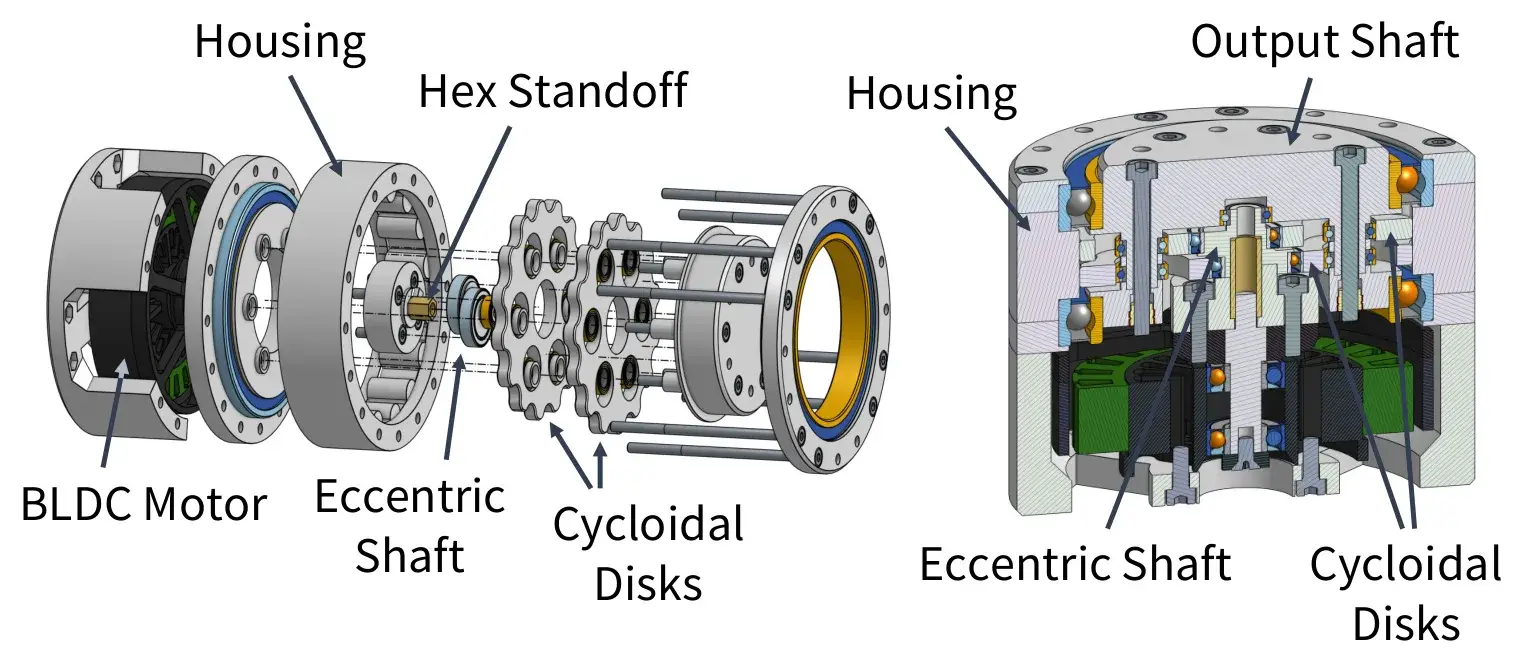
This does not remove manual work, because the build documentation asks users to reconfigure the AS5600 board by moving resistors, solder power and CAN wiring, mount the supplied magnet on the rotor shaft and connect the motor controller.3
The page even warns that the CAN pads on the controller are fragile and that the soldering takes some familiarity,3 a useful reminder that “accessible” here means buildable in an ordinary workshop, not plug-and-play.
Plastic works
The gearbox remains the risky part because a humanoid loads its joints on every step, so replacing metal housings and gears with PLA from a desktop machine immediately introduces a different engineering problem: anisotropy, wear and lower stiffness have to remain tolerable under repeated dynamic loading.1
Berkeley uses a cycloidal reduction. Loads are shared across multiple teeth, and the geometry tolerates the resolution limits of FDM better than a finely meshed small planetary gearbox.1
Through-screws and embedded brass hex stands reinforce places where printed layer boundaries would otherwise be vulnerable,1 while every non-standard part is kept inside a 200 × 200 × 200 mm printer volume so the mechanical architecture remains compatible with ordinary desktop hardware.1 The documentation uses different print profiles for housings and for the more sensitive transmission components.4
The target is therefore more demanding than “it fits on a printer.” A mechanical part whose accuracy matters has to become repeatable on common hardware.
Sixty hours
The team ran the large 6512 actuator for 60 hours lifting a 0.5 kg pendulum at a 0.5 m radius and cycling between -45° and +90° at 0.5 Hz, a focused test of the printed drive rather than anything resembling a five-year humanoid lifetime claim.1
Efficiency initially declined and later returned close to its original value, while backlash increased slightly as printed parts wore without leaving the range the authors considered acceptable during the test.1
Across most measured operating points the gearbox maintained about 90% mechanical efficiency; at high torque and velocity it lost efficiency partly through heat.1
Measured transmission stiffness for the 6512 was about 319 N·m/rad, compared in the paper with roughly 1,468 N·m/rad in earlier work using a carbon-fibre-reinforced polyamide printed cycloidal reducer; the authors attribute part of the gap to softer PLA, making the mechanical debt of cheaper fabrication measurable rather than invisible.1
Six samples
A printed robot part is only useful if the second copy behaves enough like the first, which is why the authors evaluated six 6512 actuators fabricated on two different 3D printers rather than reporting the nicest single specimen.1
Efficiency and torque-tracking results stayed close, with torque error within ±0.5 N·m across the measured range; across six freshly printed actuators, maximum backlash was 0.0229 rad, and in a five-DoF serial arm repeating four targets one hundred times, end-effector position had a 3.433 mm standard deviation.1
Those numbers do not turn the platform into a metrology machine; they answer a more practical question for anyone considering replication: can multiple joints be printed under realistic conditions without each becoming a mechanically unrelated universe?
Within the published protocol, the copies behave closely enough for the team to use them as one platform rather than six individually tuned experiments.
Same geometry
The open design goes beyond STL files, since the repository also publishes URDF, MJCF and USD robot descriptions, Isaac Lab environments, low-level code, sim-to-sim validation, real-hardware deployment, motion capture and teleoperation tooling.6
Robot descriptions can be regenerated from the Onshape project, while the release documentation links the CAD and print projects for both actuator sizes,46 which matters because geometry should not silently diverge between the printed robot and the robot learning to walk in simulation.
The project demonstrates a locomotion policy trained in simulation and transferred directly to the physical platform, alongside teleoperated tasks.12
Useful openness is not simply “here is a ZIP.” It is the ability to trace a physical part back to the description the software stack believes it is controlling.
Change body
A self-contained joint needs only power and CAN communication. The team uses that boundary to illustrate several morphologies: quadruped, biped, centaur-like arrangement and mobile base.1
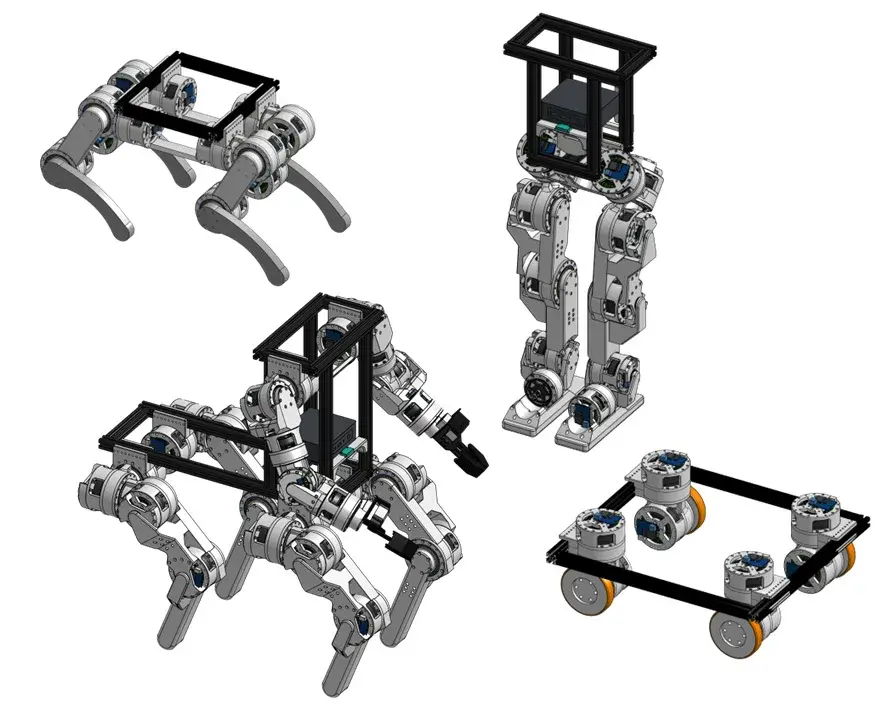
The paper even sketches an adult-scale configuration by extending links with commercially available carbon-fibre tubes,1 although these illustrations are not a full experimental validation of every morphology; they follow from the mechanical and electrical boundary the team chose: when the joint is self-contained, changing link length or some joint ordering demands less redesign of the entire machine.
For a research lab, that freedom may matter more than the raw purchase saving.
Three days, one week
The paper says the full robot can be assembled in about three days once parts are available.1
A few months later, Berkeley Engineering gives a more conservative estimate: Yufeng Chi expects a novice roboticist to need around one week, depending on experience.5
The numbers do not have to contradict each other, because they describe different builders around a machine involving 3D printing, soldering, motor calibration, CAN wiring and software setup, all of which punish the assumption that assembly time is a property of the CAD file.
It is a useful warning for every “reproducible” hardware project, because BOM cost excludes workshop time, failed prints, tools and experience, while the project documentation itself explicitly warns that this is high-power electronics and asks builders to follow the steps carefully.2
Repair price
Berkeley Humanoid Lite is not a $4,312 humanoid because a printed gearbox magically replaces a multi-thousand-dollar industrial joint.
The cost is still real: in the large actuator the motor is $129 and the printed parts four dollars, with driver, bearings, encoder, connectors and labour still sitting between those two numbers.1
What changes is their visibility.
A builder can know the reducer wears, measure its backlash, print a replacement, swap a bearing, choose another controller, alter geometry and update the robot description.
Berkeley Engineering summarizes the motivation plainly: proprietary commercial hardware can make replacement and modification difficult.5
The project does not abolish the humanoid bill; it makes the bill disassemblable, and when 81% of that bill sits in the parts that move, wear and fail, that difference is far from cosmetic.