
The titanium alloy used by RMIT's team has a theoretical density of roughly 4.43 g/cm³. Fresh water in their tests is 0.997 g/cm³. Yet some of their metal cubes remain afloat for more than two months.1
Calling the result “titanium lighter than water” hides the mechanism. The cube is mostly empty, built from hollow Ti-6Al-4V struts with large cells left open between them so water can flow straight through the lattice. Polyurethane enters inside the hollow struts rather than closing the whole object into a shell, and its tiny closed cells preserve internal volume that water cannot occupy.1
The useful question is therefore more interesting: when water can move through a structure, which volume should count when calculating its density?
The fake 0.25
A highly porous metal lattice can report an impressively low bulk density. The unfilled hollow titanium lattices in this study sit around 0.23 to 0.27 g/cm³.1
A calculator makes those numbers look comfortably lighter than water. Every unfilled specimen nevertheless sinks in the tank. Bulk density uses the cube's outer envelope as though all of that space displaced liquid, even though the large lattice cells and the channels inside the struts are open before foam filling; water enters, leaving much of the apparent “empty” volume with no useful contribution to displacement.1
The researchers therefore use skeletal density, which relates mass only to the volume that actually remains inaccessible to the liquid. Foam-filled strut channels belong to that dry volume in the hybrid material, whereas the large open cells remain available to the water.1
Once those two volumes are separated, the paradox disappears: the titanium alloy keeps its ordinary high density, while the architecture distributes a small amount of metal around enough internal volume that remains dry.
Foam in the beams
A cross-section makes the arrangement obvious.
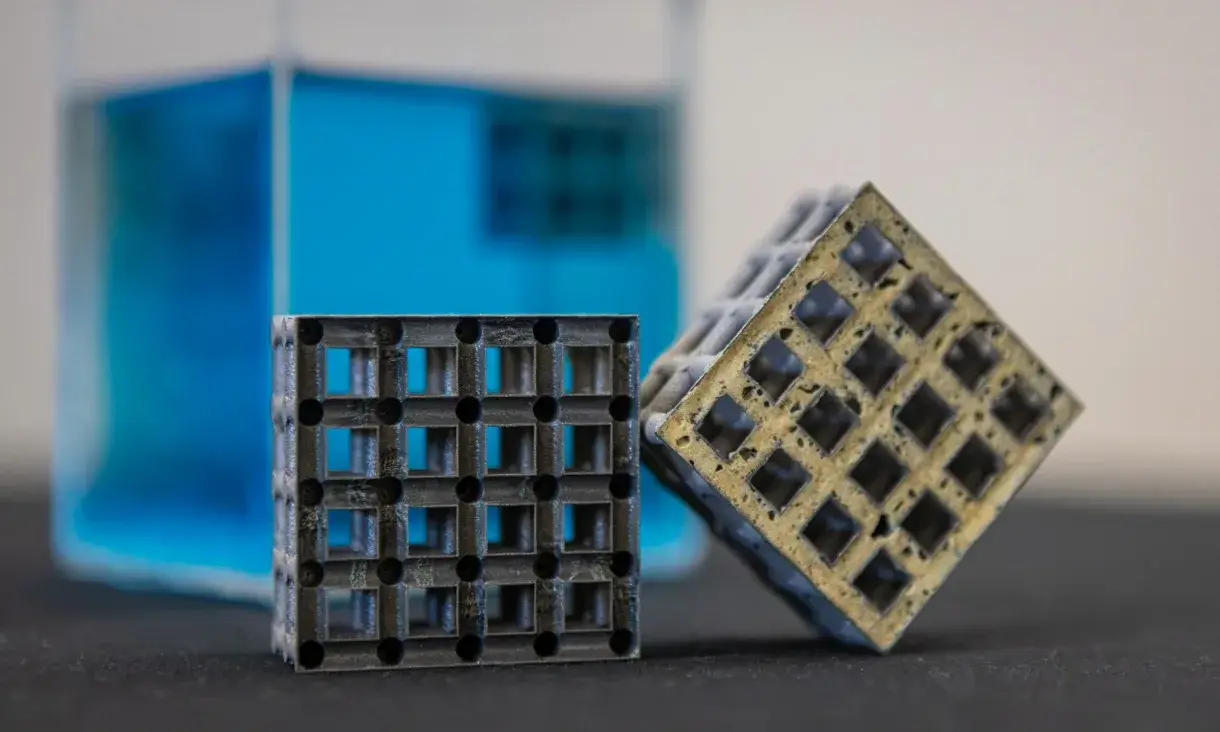
The skeleton is made by laser powder bed fusion. In the reference series, the researchers use a simple-cubic 4 × 4 × 4-cell lattice with 10 mm cells. Strut walls are designed at 0.2 mm, while the internal channel diameter varies from 2.5 to 4 mm.1
Expandable polyurethane is injected into those channels after printing. Its own density is only about 0.08 to 0.11 g/cm³, and the microstructure consists mainly of closed cells roughly 10–200 µm across.1
The foam adds little mass: bulk density rises only 5.9–7.3% after filling, and the measured changes in mechanical properties are similarly small.1 Titanium remains the load-bearing skeleton, while polyurethane preserves the internal volumes that keep water out of the beams. Strength and buoyancy are therefore assigned to different parts of the architecture, with no need for one large perfectly sealed external hull.
0.98 becomes 1.06
Buoyancy now looks almost like a CAD constraint: keep the hybrid skeletal density below the density of the surrounding liquid.
The four geometries in the study target skeletal densities of 1.17, 0.98, 0.86 and 0.75 g/cm³.1 On paper, the last three fall below roughly one gram per cubic centimetre.
Additive manufacturing does what physical manufacturing often does to neat thresholds.
The printed parts end up roughly 7.4 ±0.6% denser than their designs, mainly because of adhered powder and walls that print thicker than intended. The four measured values become 1.27, 1.06, 0.92 and 0.80 g/cm³.1
The second specimen tells the whole story: CAD predicted 0.98 g/cm³, just below fresh water, but the manufactured part measures 1.06 g/cm³ and sinks.1
That failed float is almost as informative as the successful ones because it turns manufacturing tolerances into buoyancy variables: adhered powder, real wall thickness and filling quality all shift the result away from ideal geometry. The same problem grows with scale, where the authors expect powder removal, uniform foam infiltration and channel sealing to become harder.1
Break without flooding
An ordinary hollow shell can lose buoyancy quickly once a crack opens a continuous path from water to its trapped air volume. Polyurethane changes the failure mode by distributing thousands of small closed cells through the struts, so a local fracture need not expose one large cavity to immediate flooding.
Compression tests expose the difference. Hybrid specimens can remain afloat after exceeding ultimate compressive strength, after node fracture and even after a complete lattice layer fractures.1
Further compression eventually makes the specimens sink through densification: effective excluded volume shrinks while mass remains, pushing skeletal density above the density of water.1 The loss of buoyancy follows that geometric compression rather than a sudden flooding of every foam cell.
At a comparable bulk density of roughly 0.27 g/cm³, the paper also estimates yield strength around 10.3 MPa for the Ti/PU hybrid, versus about 5.5 MPa for density-scaled HDPE and 6.9 MPa for density-scaled 316L stainless steel.1 The comparison isolates what the metal skeleton contributes at similar density. Universal superiority over either alternative across marine applications is a much larger claim than these tests support.
A small buoy
RMIT also built something easier to read than a laboratory cube: a buoy 100 mm tall and 85 mm wide, using nominal 0.2 mm strut walls and 4 mm internal channels.12
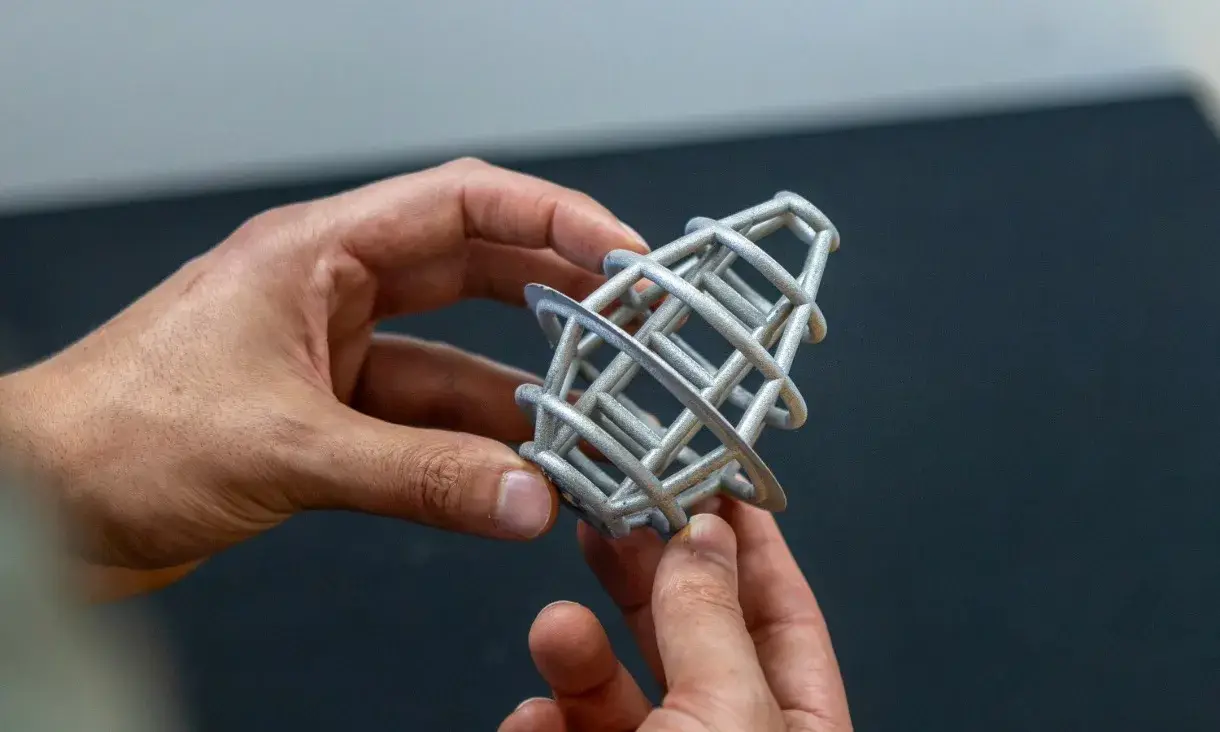
In natural seawater under oscillating, turbulent flow, the buoy remains stably afloat while rotating by as much as roughly 45°, using neither a sealed external casing nor an additional flotation device.1 Hybrid coupons also spent two weeks immersed in seawater. Over that short test, the researchers report 0.15 ±0.03% mass loss, a 0.37 ±0.12% fall in yield strength and a 0.86 ±0.42% fall in ultimate compressive strength, with buoyancy preserved.1
Two weeks is far from an offshore lifetime.
The study does not answer what happens over millions of fatigue cycles, repeated impact, combined damage and corrosion, or years of immersion. The authors point toward buoys, marine structures and energy devices, but moving from a laboratory cube to a large structure introduces exactly the printing, channel cleaning and foam-infiltration problems that the paper already identifies.12
“Floating titanium” is therefore only the headline version. The actual design lets water enter where empty space provides no buoyancy and keeps it out where every small dry volume matters. Titanium carries the load, polyurethane preserves dry internal volume, and the useful density belongs to the skeleton that genuinely displaces water rather than to the cube's visible outer envelope.