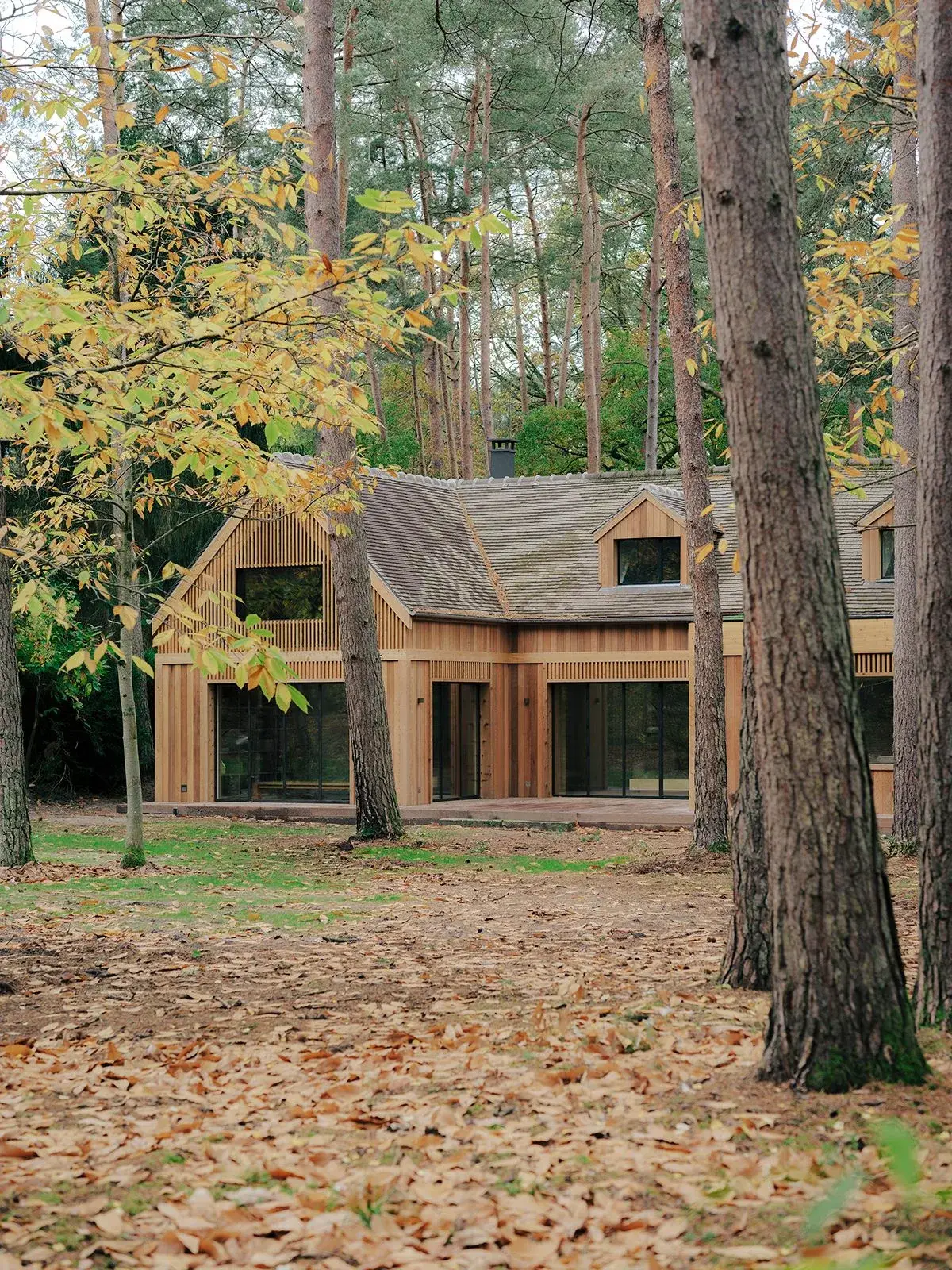
Timber usually enters a house as a product: species, section, quantity, price. For Maison de l’Orée, In Sinu describes a stranger sequence: the studio bought trees on a neighbouring plot before bringing them into the project.13
It is a small move at building scale, but it changes how the material can be understood. The wood is not merely “local” because a specification gives it a reasonably nearby origin. It belongs to the immediate landscape of the site, then reappears in the building and its furniture.1
Designing with what exists
In Sinu describes its practice as attentive to local resources, know-how and histories.2 Maison de l’Orée pushes that method far enough to make it visible. The site is not a neutral background for a form. It supplies constraints, materials and part of the project’s vocabulary.1
That avoids a familiar problem with the word “context”. In architecture it can end up meaning that a façade vaguely repeats a neighbouring colour. Here the relationship is more material. It passes through what can be recovered, transformed, preserved or made nearby.
Wallpaper*, which selected In Sinu for its 2026 Architects’ Directory, also stresses this continuity between architecture, interiors and objects.3 Furniture does not arrive at the end as decoration. It lets the same resources and decisions operate at another scale.
Designed provenance
Calling a material local obviously does not make a building virtuous. Short distance alone says nothing about processing energy, treatments or lifespan. The project is more interesting when we do not ask it to carry that slogan.
What it demonstrates concretely is that a supply chain can enter before the final design. If particular trees are available next door, their dimensions, quantity and qualities become inputs. The project composes with actual stock rather than a theoretical catalogue.
That brings architecture closer to workshop practice. First look at what is on the bench, then decide what the material permits. Constraints can produce details that are less interchangeable because they answer to a particular resource rather than a standard product available everywhere.
Following the material into furniture makes the logic clearer. A remainder too small for a structural component can retain value at the scale of a table, seat or fitting. Changing scale gives the material a second destination.
Maison de l’Orée does not invent local architecture or nearby timber. Its contribution is more precise: it makes provenance concrete enough to alter the process. Landscape is no longer only what appears through the window. Part of it becomes literally what the house is designed with.13