Among the pieces in designer Shahar Livne's The Devil's Milk collection there is a scale. Not a metaphor: an actual scale, dark wood and latex, complete with platform and beam. Sitting in a living room, it would pass as an exotic curiosity. Put back in its context, it becomes something more disturbing. During the rubber rush, instruments like this one decided whether a collector had met his quota. The needle moved, and bodies paid the difference.1
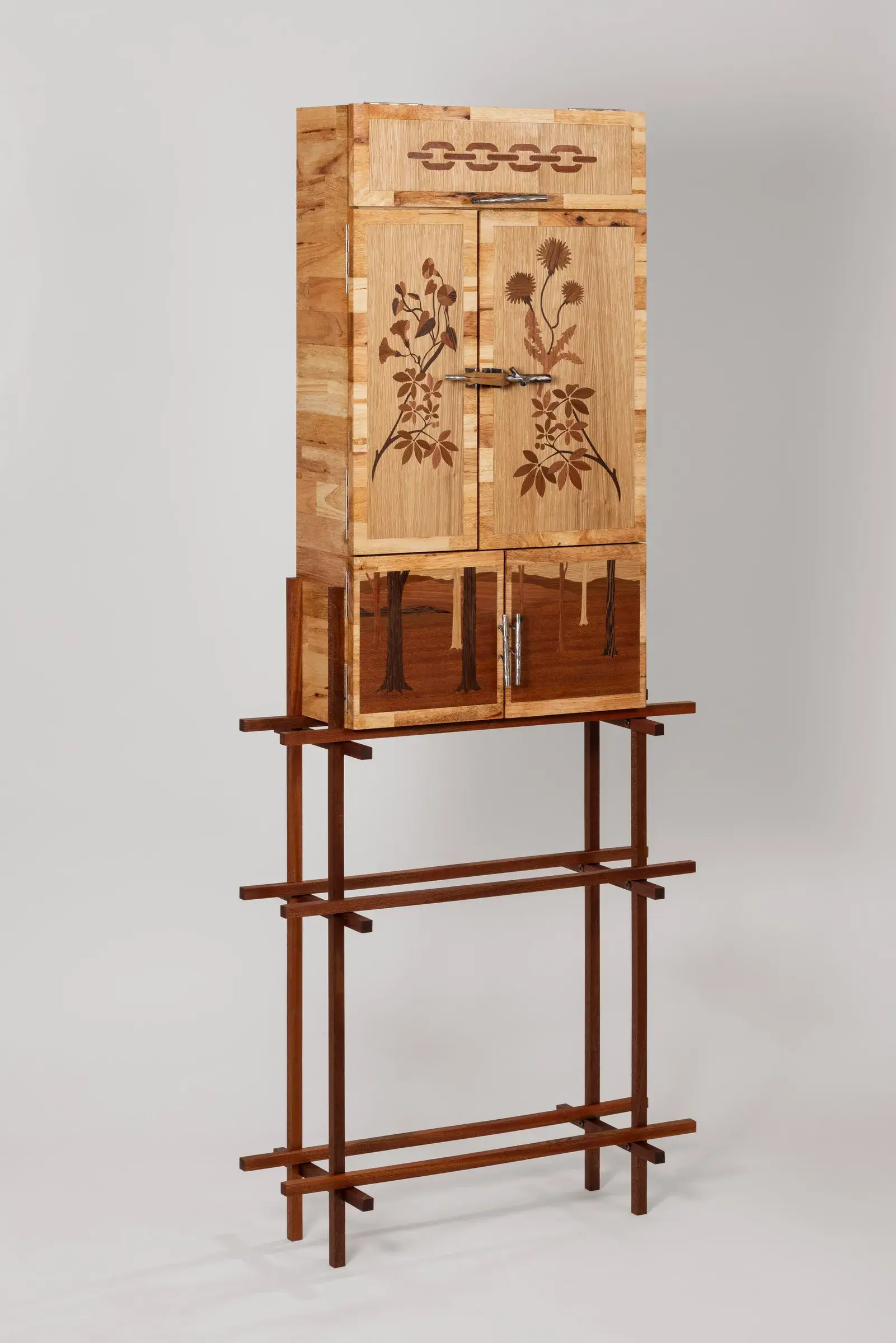
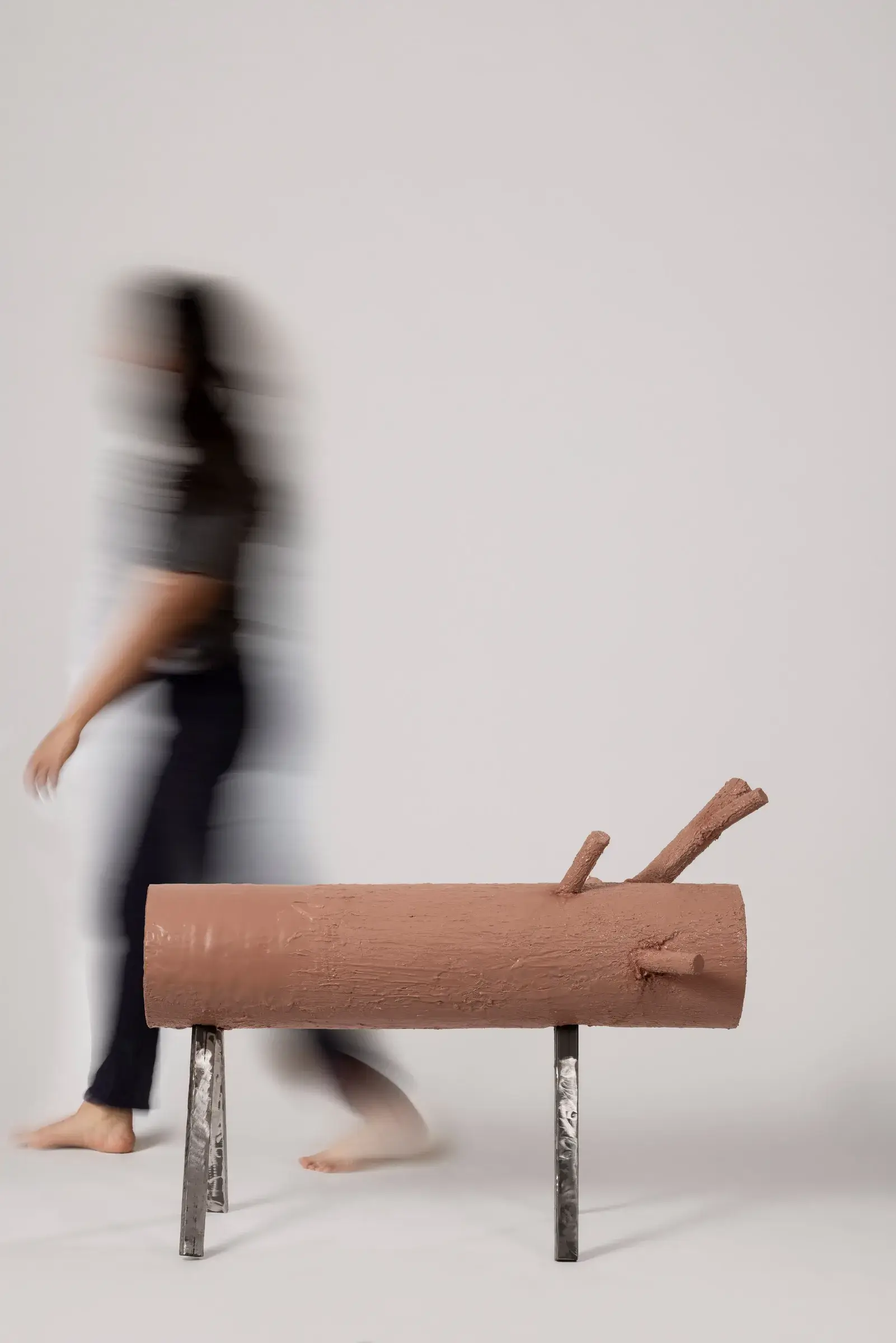
The scale is not alone. Beside it stand a cabinet covered in marquetry and a bench shaped like a log, or like a leg, depending on the angle. Three pieces of furniture, three types of rubber, two years of work. The title comes from Australian historian John Tully's 2011 book The Devil's Milk: A Social History of Rubber: for the people who worked latex at its source, that white fluid seeping from the bark earned the name devil's milk.13
"Rubber production and extraction have a long history of abuse and violence, and that is almost forgotten when we see rubber in everyday context," Livne told Dezeen. She continued: "Rubber is an essential part of many products and technologies; it has shaped human culture far more than it gets credit for."1
That sentence describes our relationship with most industrial materials, but rubber is a special case: it is everywhere under our feet, in our pockets, inside our machines, and yet nobody knows where it comes from or how it got here. A piece of furniture does not replace a history book. It can make history stand upright in a room, though, and invite you to lean on it.
Wood that weeps
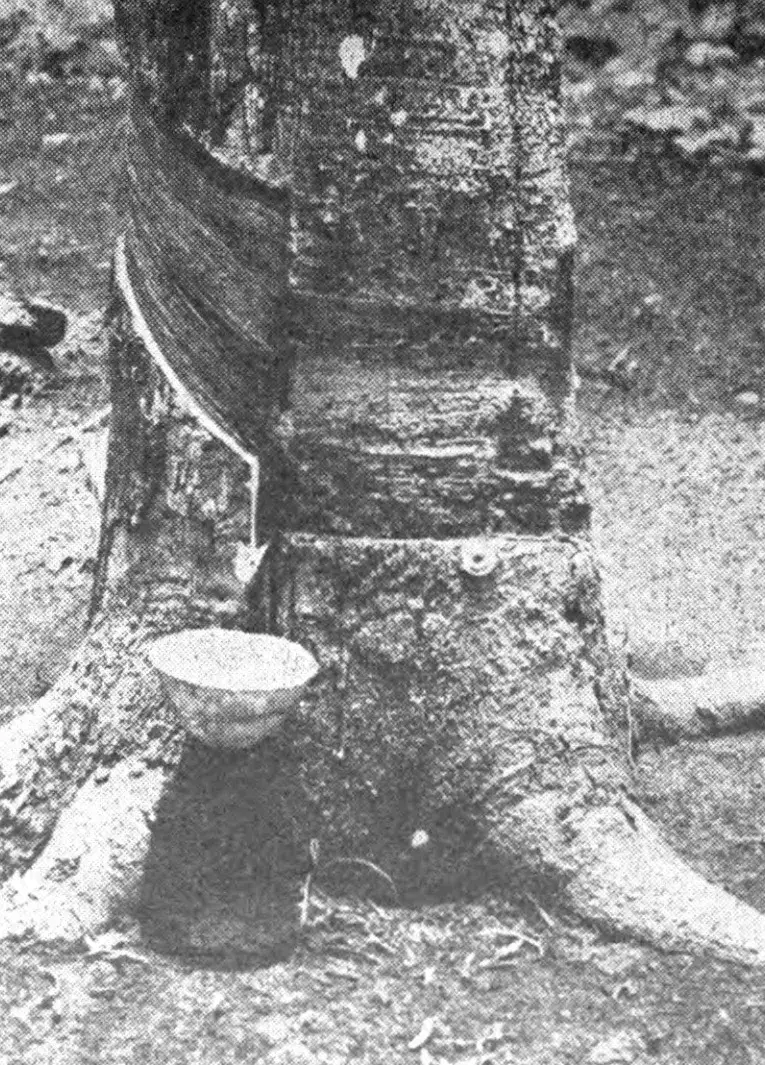
The word "caoutchouc", which French kept from an Amazonian language, is usually glossed as "weeping wood". Cut into the bark of a hevea brasiliensis tree and a milky liquid seeps out slowly, drop by drop, into a cup fixed to the trunk. Chemists call it a colloidal suspension of polyisoprene particles; collectors call it milk. Both are right.1516
Europe took a while to understand what it had. In 1735, French geographer Charles-Marie de La Condamine left for Ecuador to measure an arc of the meridian and shipped samples of this gum back toward the Royal Academy of Sciences. People learned to bounce it, waterproof clothing with it, erase marks with it: by 1752 the French Academy noted that a vegetable gum could rub lead markings off paper. In 1770 Joseph Priestley proposed the English name that stuck: rubber. French kept the other image, the weeping wood.1615
One manufacturing flaw remained. Raw rubber melts in summer, cracks in winter, sticks wherever it should not. Charles Goodyear spent five years mixing latex with everything he could find, buried in debt and lawsuits, until the 1839 accident at a factory in Woburn, Massachusetts: a mix of rubber and sulfur fell onto a hot stove. Instead of melting, the material charred and hardened, keeping its elasticity in cold and heat alike. Vulcanization was patented in the United States in 1844; in England, Thomas Hancock filed his own patent as early as 1843 after examining Goodyear's samples up close. An Englishman also chose the process's name, after Vulcan, god of fire.1314
From then on demand exploded, then changed scale. Boots, waterproof coats and hoses made the first factories rich. But wheels turned rubber into a strategic commodity: John Boyd Dunlop's pneumatic tire in the late 1880s, then the automobile. When cars became a mass product, tires became the material's largest market, a position they still hold.9
.jpg)
70,000 seeds
For most of the nineteenth century rubber grew nowhere in plantations. It was gathered wild, tree by tree, vine by vine, in Amazonia and a few neighboring basins. That organized scarcity interested the rest of the world very much, especially the British Empire, which disliked depending on a foreign monopoly for a strategic material.87
In 1876 an English adventurer named Henry Wickham shipped roughly 70,000 hevea brasiliensis seeds collected in the Brazilian Amazon and delivered them to the Royal Botanic Gardens at Kew on June 14. Kew's annual report for 1876 tells the rest: sown immediately, the seeds germinated with unexpected speed, and about 1,900 seedlings left for Ceylon in thirty-eight Wardian cases, ninety percent arriving in good condition. From there the plant spread to Malaya, Burma, Java, Singapore. Fewer than 4,000 seeds germinated; it was enough.67
Wickham was knighted in 1920 for that service rendered 44 years earlier. By his death in 1928 there were around 80 million rubber trees growing in British territories where none had grown before. He told the story as a smuggling feat against Brazilian customs; historians note that no Brazilian law prohibited seed exports at the time, and that the ship was actually a regular liner chartered in Kew's name. The heroic biography and the biopiracy reading coexist to this day; they agree on the essential, the transfer happened and it changed the world economy.7
Around 1912 the Amazonian bubble burst: Asian plantation rubber was cheaper and easier to harvest. The Amazon rainforest kept the demographic scars of two decades of intensified wild extraction. But to see the truly dark side of this economy you need another basin. There, rubber came neither from carefully tapped trees nor from patient gathering; collectors flayed it out of vines.8
Counted hands
Between 1885 and 1908 the Congo Free State was the personal property of Leopold II, King of the Belgians. The regime lived off ivory first, then, from the early 1890s, off wild rubber, once tire demand took off. The system was simple and has long been documented: the state and concession companies set latex quotas per village, the king's private army, the Force Publique, guaranteed collection, and women were held hostage until the men brought in the required quantity.911
In the concessions run by ABIR and the Anversoise, studied by economists Sara Lowes and Eduardo Montero, the quota came to about four kilos of dried rubber per man every two weeks, on top of food supplied to the posts. Since the vines were fragile and quickly exhausted, men spent up to ten days out of every fourteen in the forest to meet the number. Falling short brought chicotte whippings, hostage-taking, burned villages, sometimes death.10
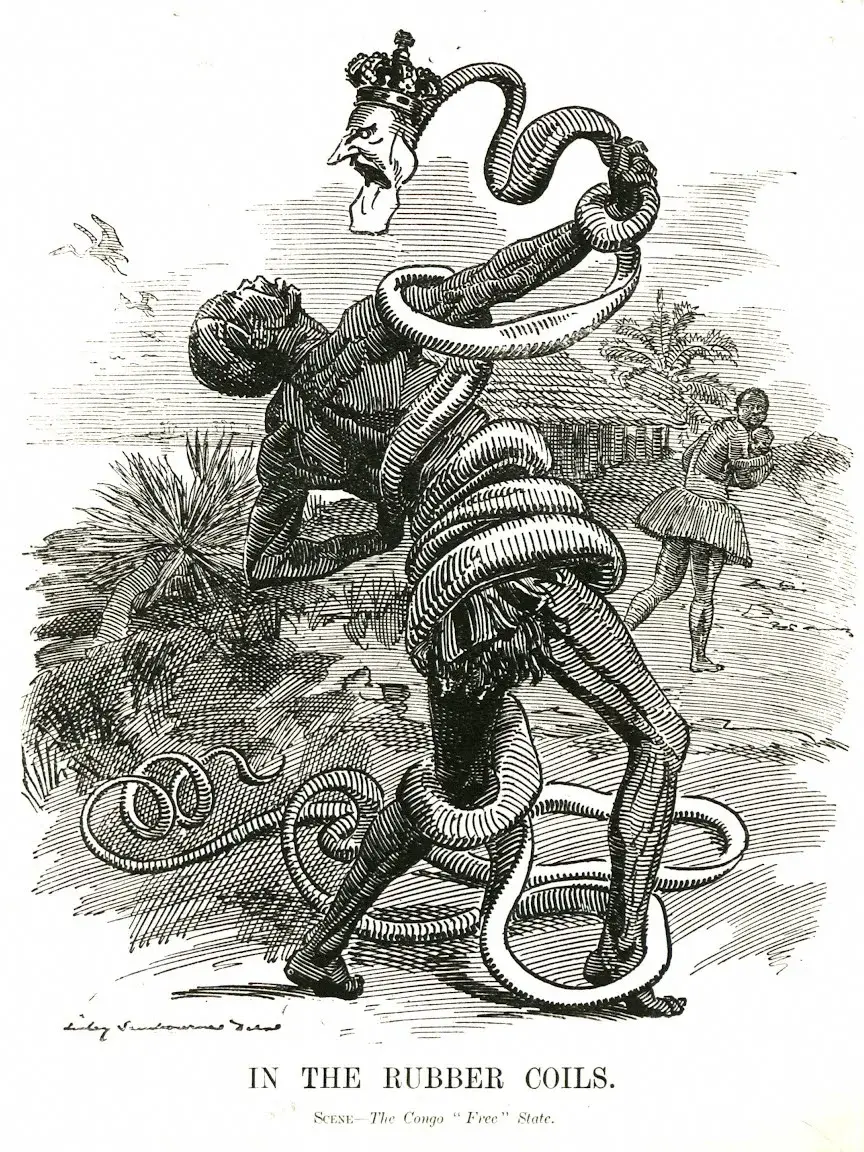

Bullets cost money, so every shot had to be justified by a severed hand, proof the cartridge had been used. Missionaries recorded direct testimony: a chief showed William Sheppard 81 right hands smoking over a fire, explaining that the state required proof of how many people had been killed. The detail is unbearable, which is precisely why it eventually worked: reported in Europe by missionaries, then by British consul Roger Casement in his 1904 report, amplified by Edmund Dene Morel, the system became the world's first great human rights scandal. Mark Twain, Arthur Conan Doyle and Conrad each played their part.119
How many deaths? The figure is still debated, and it is better to say so. Contemporary estimates spoke of half the population; Adam Hochschild and Jan Vansina defended a toll of around ten million between 1880 and 1920. Recent demographic work, lacking reliable censuses for the period, lands on lower ranges, between 1.2 and 5 million depending on scenarios, with multiple causes: famine, disease, collapsing birth rates, direct violence. The disagreement is about numbers, not about the existence of a massive demographic catastrophe.9[11](#ref-11]
The Congo is sometimes told as one king's personal aberration. Rubber's history suggests something more exportable. In 1909 a small London magazine, Truth, published revelations under the headline "The Devil's Paradise" from an American explorer about the Peruvian Putumayo: a company registered in London, the Peruvian Amazon Company, was collecting wild rubber there through methods that British consul Roger Casement, already the Congo inquiry's key investigator, would describe as slavery and extermination. The Foreign Office sent him to investigate in 1910. His 1911 report described a region with "no labourers, no industry", just a forest inhabited by Indians "hunted like wild animals" and forced to bring in rubber, "murdered and flogged" if they did not. That was the system. A House of Commons committee concluded in 1912 that Julio César Arana and his partners bore responsibility; no one was ever punished.20
This is where Livne's scale stops being decorative. "Raw yields were strictly weighed on scales to enforce strict labour quotas and control Indigenous populations," she says of the piece. The object she built from Indonesian latex is a faithful portrait of that terror's administrative instrument: what weighed on the Congo was not the knife, it was the number read off the plate.1
Wartime rubber
The collection's third piece tells another chapter, less colonial and more chemical. Its bench looks like a log, but its surface is made of a synthetic rubber designed to mimic human skin, the kind used by film special-effects workshops for prosthetics and costumes.1
That material descends directly from the biggest chemistry program of World War II. At the end of 1941 the United States consumed about half the world's natural rubber, nearly all of it from Southeast Asia. In February 1942 the fall of Singapore cut American access to roughly ninety percent of that supply. The country then held a million-ton stockpile, had no commercial process for general-purpose synthetic rubber, and fielded an army that ran, flew and floated on the polymer: a military aircraft needed half a ton, a tank one ton, a battleship seventy-five.12
The answer was the GR-S program: government, four big tire makers and Standard Oil compelled to share patents, fifty-one state-financed plants costing about 700 million dollars, close to a third of the Manhattan Project's price tag. The common recipe, frozen in March 1942: 75 percent butadiene, 25 percent styrene. American general-purpose rubber output went from 231 tons in 1941 to about 920,000 tons per year in 1945. After the war the industry never closed: today some seventy percent of the rubber used in manufacturing is still synthetic, a direct descendant of GR-S.1219
When Livne picks that film-industry material to dress a tree trunk, she connects two stories of the same polymer: the war substitute born from geopolitics, and the studio-made object of desire, from monster prosthetics to pop fetish costumes. In both cases the goal is manufacturing fake living matter. The painting and texturing gesture that moves the surface from plant to human is literal: the bench is skin stretched over a log.1
The fungus strikes back
One irony remains in this story, and it says a lot about the relationship between materials, economies and territories. A century after Wickham, hevea never reconciled with its home continent. The culprit is a fungus, Microcyclus ulei, the agent of South American leaf blight: it coevolved with hevea in the Amazon basin, causes cascading defoliation and dieback, and has so far prevented any durable commercial-scale rubber production in the Americas. In 2017 the continent accounted for only about four percent of world production. Asia and Africa, where the fungus does not exist, hold the rest.21
Asian plantations descend almost entirely from the Kew seeds, drawn from a narrow genetic base; every planted variety proves susceptible if the fungus arrives. Producer countries therefore live under permanent quarantine: phytosanitary protocols, fumigations, emergency plans rehearsed for an epidemic that has yet to happen even though the climatic conditions are already met. The 1876 transfer saved rubber from its original parasite and, in the same move, built a fragile global monoculture stripped of the genetic diversity that might have resisted it.217
I find that reversal more instructive than any gold-rush tale: biopiracy moved an entire industry across the globe, then disease froze that geography in place. Natural rubber still comes from Southeast Asia for one plain reason: it is the only large space where the tree grows without its historical enemy.
Bleeding the tree
Where do the scales' latex and the cabinet's wood come from? Both from Indonesia, says Livne. The choice is not incidental: Indonesia is the world's second-largest natural rubber producer, behind Thailand, with about fourteen percent of a planetary output that reached 14.6 million tonnes in 2024. Thailand weighs thirty-four percent, Ivory Coast twelve percent. Nearly eighty percent of the world's natural rubber now comes from family farms, not industrial plantations.113
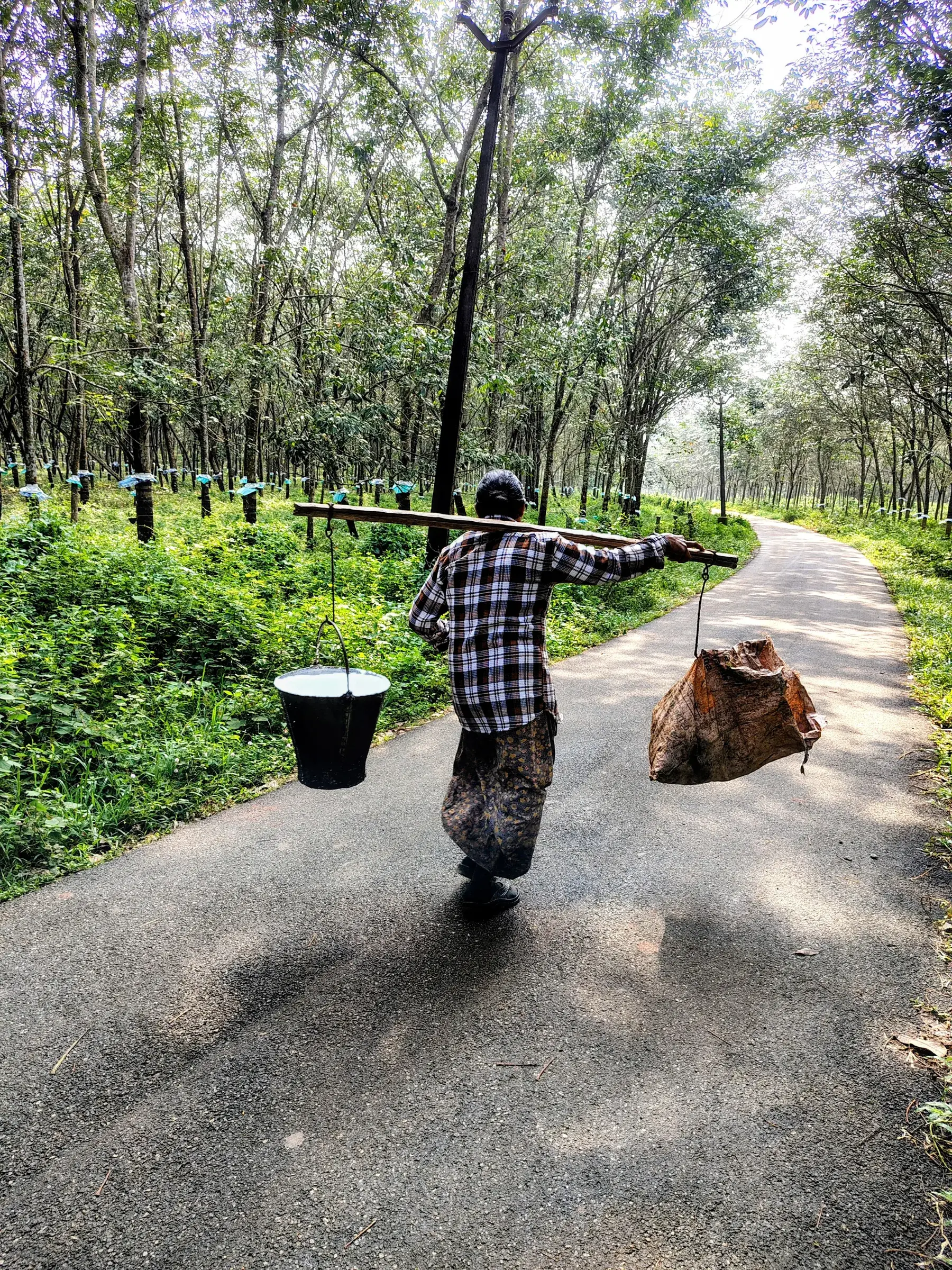
The tree's physiology dictates the model. A hevea takes six to seven years before producing, then yields between sixty and one hundred fifty kilos of rubber over twenty to thirty years. And it produces nothing without human intervention: no tapping, no latex. Every harvest morning someone cuts the trunk with a knife, just deep enough to reach the laticiferous channels without wounding the wood, and the milk flows into the cup overnight. This is one of the few major industrial raw materials still harvested by hand, drop by drop, by millions of smallholders.1317
The cabinet's wood carries its own story, quieter on the surface. Once the tree is spent, at the end of its tapping cycle, it is felled and the trunk becomes rubberwood, considered cheap timber full of imperfections, good for chipboard, pallets and entry-level furniture. Most consumers have rubberwood at home without knowing they are looking at an end-of-life latex plantation.113
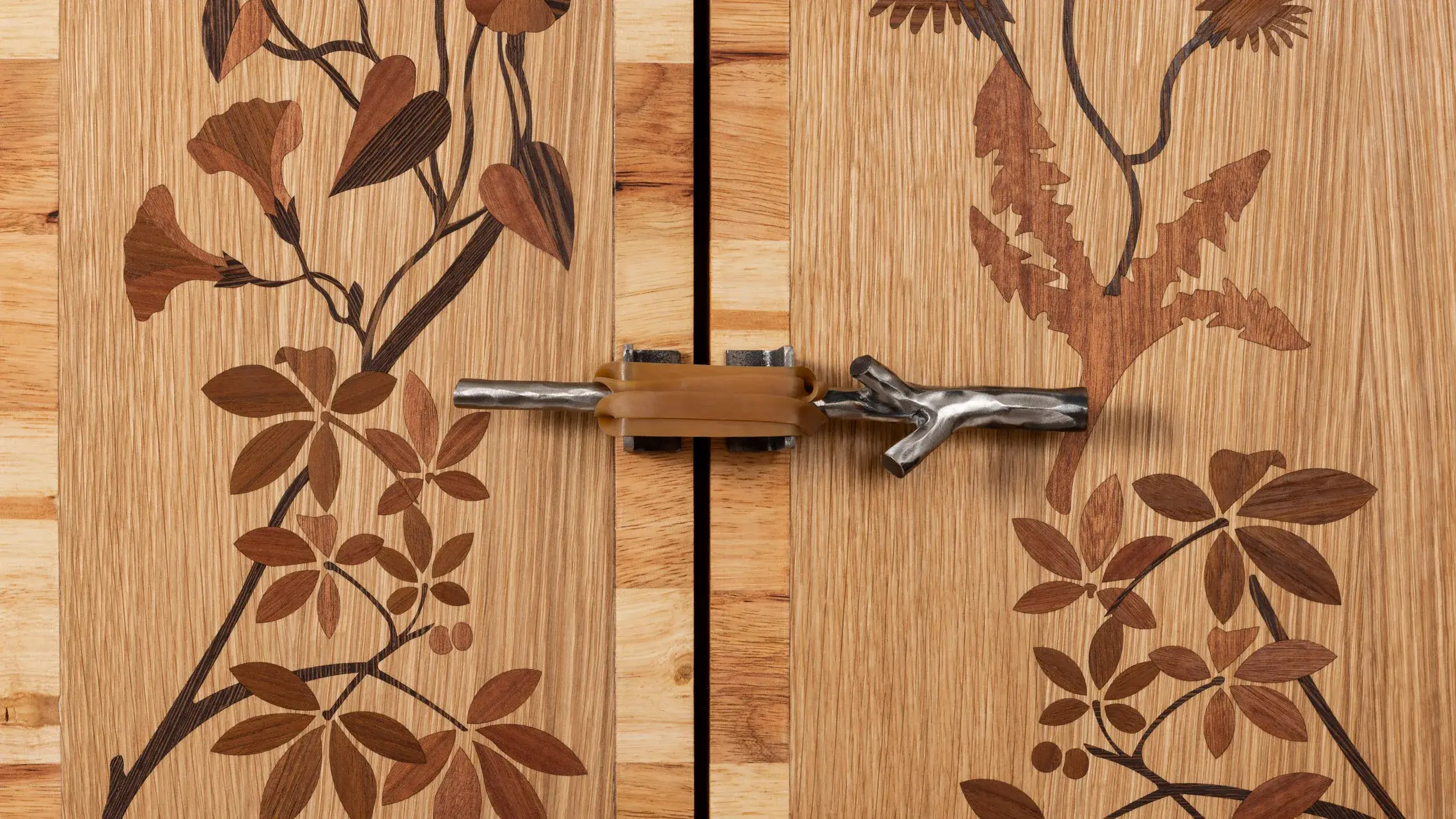
Livne flips that status. For the cabinet she kept the wood's visible scars, the dark marks left by years of cuts, and refused to sand them away. Then she inlaid the panels with marquetry of European, African, Indonesian and South American species. "All places where rubber wood was extracted from or exported to, and by embedding them in the rubber wood, they 'colonise' it," she says. The furniture becomes a map: the periphery at the center, former empires inlaid into the raw material.1

Scale, cabinet, bench
Taken one by one, the three pieces work like linked chapters. The scale speaks of economics and coercion: it is the tool of the quota, the instrument that turns a fluid into a number and a number into punishment. It is built from solid latex, made of the exact substance it once weighed.1
The cabinet speaks of geography. Its wood comes from Southeast Asian plantations descended from the 1876 transplant; its marquetry traces the map of extraction and export, Europe to the Americas through Africa. It is the most literary piece of the trio, almost a thesis: it shows that raw material and empire were always manufactured together, and it makes the argument physical without needing a caption.1
The bench speaks of bodies. Covered in that skin-like film rubber, modeled to create a transition from vegetal to human, it carries what Livne calls botanical kinship: the idea, borrowed from the cosmologies of regions where the tree grows, that plants are biological and spiritual relatives rather than resources. "In the many places where the rubber tree grows naturally, such as in the Congo, Borneo and the Amazon, the relationship with the forest is historically spiritual," she explains. She explicitly opposes that reading to colonial "plant blindness", the Western hierarchy that sees nature as passive.1
You can find the vocabulary grandiose, I partly do, and still be unsettled by the object. A bench with the texture of skin invites touch, then reminds you that latex was called milk, that a tapped tree resembles a bled body, and that harvesting cultures thought of that analogy long before designers did. The parallel between the botanical body and the human body is not Livne's poetic invention; she says she kept encountering those parallels during her two years of research.1
Ordinary invisibility
What this project offers that an essay cannot comes down to a simple displacement: it puts history onto an object you can buy, use, keep at home. Rubber may be the world's best-hidden industrial material. It is in the two billion tires manufactured every year, in gloves, condoms, seals, cables, shoes, and it never shows a face. About seventy percent of natural rubber still goes into tires and thirteen percent into gloves and other medical products; for aircraft, truck and bus tires, the synthetic substitute remains incomplete.1318
The chain stays long and barely visible too: six million smallholder farmers, collectors, traders, processing plants, tire makers, in a market where China absorbs nearly half of global consumption. None of it appears when you look at a tire, the way Congolese history did not appear in the tires of 1905.17139
Livne is now preparing a publication of her research with curator Yev Kravt and design studio Droog, which hosted a rubber symposium with her in late November 2025, featuring rubber historian John Loadman, anthropologist Eduardo di Deus and chemist Anke Blume among others. The project continues across several formats: furniture, text, shared research.12
For a designer previously known for slaughterhouse-blood sneakers and ocean-plastic jewelry for Balenciaga, rubber is a logical next step: since graduating from Design Academy Eindhoven in 2017, Livne has mostly worked to make visible the political histories locked inside ordinary materials.4 Born in Israel in 1989 and based in Eindhoven, named emerging designer of the year at the Dezeen Awards 2020, she built an entire career on that single gesture.15
Tully opens his book with Marx's line about capital coming into the world "dripping from head to foot, from every pore, with blood and dirt", and adds that Marx might as well have been describing rubber. A century and a half after vulcanization, the devil's milk still flows through our tires, our gloves and our gaskets. The difference is that three pieces of furniture now exist to remind us: a scale that weighs, a map that crusts over, a skin waiting for a hand.3