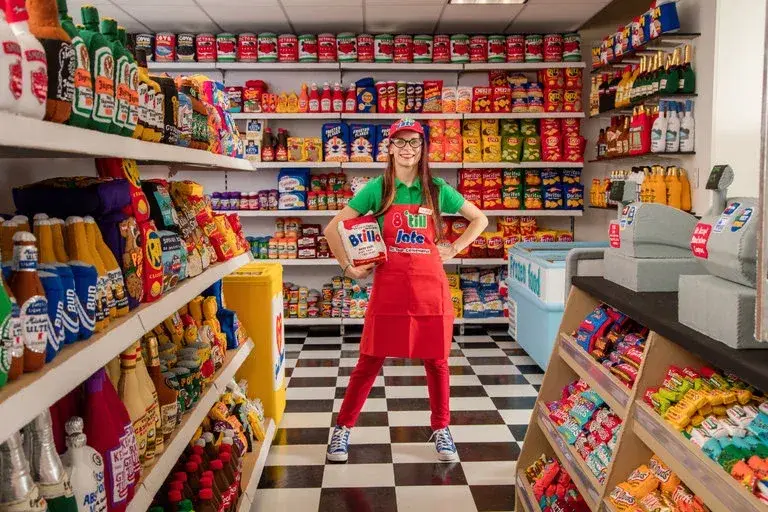
A cereal box is designed to be reproduced by the million. Lucy Sparrow does the opposite: she sews it again by hand.
For The Beginning of Convenience, which opened at The Momentary in Arkansas on 18 July 2026, the British artist rebuilt an American supermarket inspired by the 1980s and 1990s entirely in felt. Her site lists more than 20,000 handmade artworks across roughly 4,000 square feet of gallery space.1
The shelves contain familiar food, drinks, household products and appliances. The repetition matters. One soft cereal box could be a funny sculpture. Thousands of sewn objects reconstruct the logic of an industrial system using a method that fundamentally cannot match industrial speed.
Sparrow has worked with this idea for more than a decade, turning supermarkets, pharmacies and corner shops into complete textile environments.1 Felt removes the shine, rigidity and commercial efficiency of packaging while preserving its colours, logos and ability to trigger recognition.
There is a practical lesson about serial production buried inside the joke. Repeating a form is not the same thing as industrialising its production. Sparrow chooses repetition without automation, so every copy retains the human labour that the original packaged product usually tries to hide.
The result looks like a shop but behaves like an inventory of gestures: cut, assemble, sew, paint, repeat. Twenty thousand times.
The installation is scheduled to remain on view until 11 July 2027.1 It can be read as nostalgia for 1990s packaging. It also works as an extremely labour-intensive joke about the very idea of convenience.