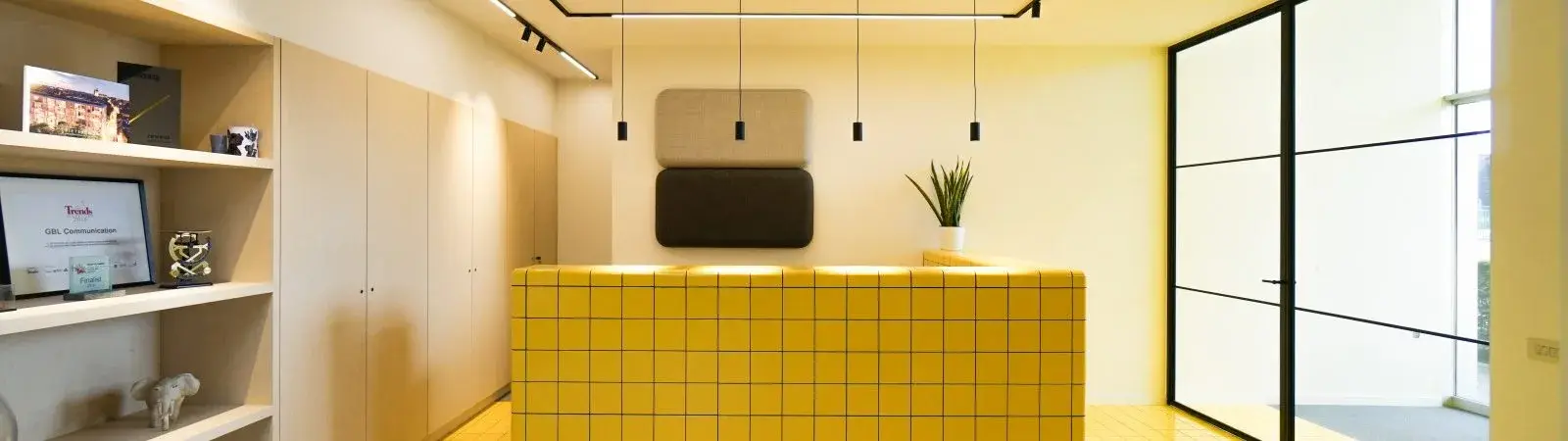
Nothing in a house is as flat as a tile. It covers, it protects, it sets a neat checkerboard. Then a wall meets a corner, a counter bends toward a sink, and the neatness falls apart. The tile stops and the patchwork starts: a plastic trim, a hacksaw cut, a gap nobody planned. Three Dutch designers decided the patching was the problem worth killing.
A grid that refuses corners
Arnout Visser, Erik Jan Kwakkel, and Peter van der Jagt trained as industrial designers, so they instinctively think in systems, not single objects. Their early idea, from the late 1990s, sounds almost naive: if the tile is the smallest unit of a grid, why does the grid have to stay flat?2
The trouble is that a flat tile does not bend. It runs out of road at the edge. Visser, Kwakkel and van der Jagt responded with a family of parts — outer and inner corner tiles, half-tubes, transition joints — that let the grid carry on around a curve instead of stopping.13
The DTILE system is organised around a 15-centimetre module. Inside that theoretical cube you can fit a flat tile, a rounded corner, a functional niche, or several at once. A finished surface then flows over a countertop, climbs a wall, rounds a sink, and drops into a cabinet without one visible break.
Not just pretty
What lifts DTILE above a stylish gimmick is the range of function tiles. The system bakes everyday objects straight into the ceramic: a ventilator grille, a towel hook, a shelf to prop a cookbook. The faucet runs through a hollow tile; the electrical outlet gets its own dedicated one.2
The goal is to do away with "wall furniture". No more suction-cup shelves and bracket-mounted hooks that sit uneasily on a tiled wall and break the grid. Instead the surface carries its own function, cast into the ceramic.1
Twenty-five years of factory
The first version of the project was shown in 1997 through Droog Design's Dry Tech programme, named "Function Tiles": a run of tile-hooks, tile-shelves and tile-ventilations.4 The full system, curved pieces and corner tiles included, followed in 2001.5
Design, then, was never the sticking point. Manufacturing was. Visser and Kwakkel scoured the world for a factory that could press tightly curved shapes in glazed ceramic. None could. In 2010 they bought the machinery and opened their own.2
A year of trial and error later, the workshop in Velp, the Netherlands, moved into series production. It is deliberately small — somewhere between five and ten people depending on the job. A tile is still shaped by hand from dry clay, glazed, and fired in kilns under the watch of a crew that can name every piece it has made.2
Today DTILE sells in more than 50 countries on four continents, in twenty colours, combining six construction tiles with ten function tiles.12
What it actually changes
DTILE does not reinvent tiling. It loosens a constraint everyone had quietly accepted: the grid ends where the surface curves. Once that rule falls, so does a whole wall of assumptions about what a tiled room can hide and what it has to sacrifice.
For anyone who makes something, the takeaway is blunt: sometimes the bottleneck sits downstream of the idea, in the factory that does not yet exist to produce the missing part. When no manufacturer can make what you design, the answer is not always to simplify the design. Sometimes it is to build the factory.
Illustrations: images from the official DTILE website and Droog Design portfolio.