The story is almost too perfect: a quilt hanging from a window, patterns known only to enslaved people, and a route to freedom encoded in blocks of cloth. Its neatness is exactly what should make us cautious, because the historical documentation behind it is extremely thin.
The National Park Service now puts the problem plainly. No known first-hand account describes an Underground Railroad “quilt code,” and several patterns later associated with the supposed code do not appear until after the Civil War.6 The Smithsonian traces the modern spread of the story to Hidden in Plain View, published in 1999, and to its rapid adoption by museums, media and schools despite objections from textile historians.7 NPR revisited the controversy in 2024 and reached the same distinction: the story continues to inspire quilters, while historical evidence for the code itself remains absent.8
Correcting that claim can sound as if something is being taken away from Black American quilts, although the objects already carry a remarkable amount of information without an invented navigation system.
Stories in the Seams: A People’s History of Black Quilts and Their Makers, the book scholar and artist Sharbreon Plummer will publish with Chronicle Books on October 6, 2026, approaches the subject through that richness, moving from quilts produced under slavery to contemporary artists while following labor, materials, communities and use.12
The book itself is not yet out, so the safer route is to test its premise against museums, archives and institutional records. Those sources already show quilts preserving evidence of how, with what, and for whom they were made.
The false code
The secret-code story is compelling because it turns every pattern into information immediately: Flying Geese can become a direction, Log Cabin a safe house, another block a stage in a journey. The system feels legible in retrospect precisely because every graphic decision becomes a signal.7
What is missing is contemporary evidence. The NPS knows of no account from a freedom seeker or ally describing such a system, even though many surviving accounts do describe other coded language used around escape.6 The Smithsonian also notes that some patterns later folded into the supposed code were not yet in use during the years when they would have needed to convey those instructions.7
None of that makes the story culturally meaningless. Contemporary makers now produce real quilts inspired by the code narrative, giving the myth a material history of its own.78 What matters is keeping two claims separate: quilts can carry this story today, while evidence for a standard secret-sign system in the nineteenth century remains absent.
Hybrid stitching
Harriet Powers's Bible Quilt is much less mysterious and much more precise. Powers, born into slavery in Georgia in 1837, exhibited the quilt in 1886. Eleven panels depict Biblical stories including Adam and Eve, Cain and Abel, Jacob, the baptism of Christ, the Crucifixion and the Last Supper.3
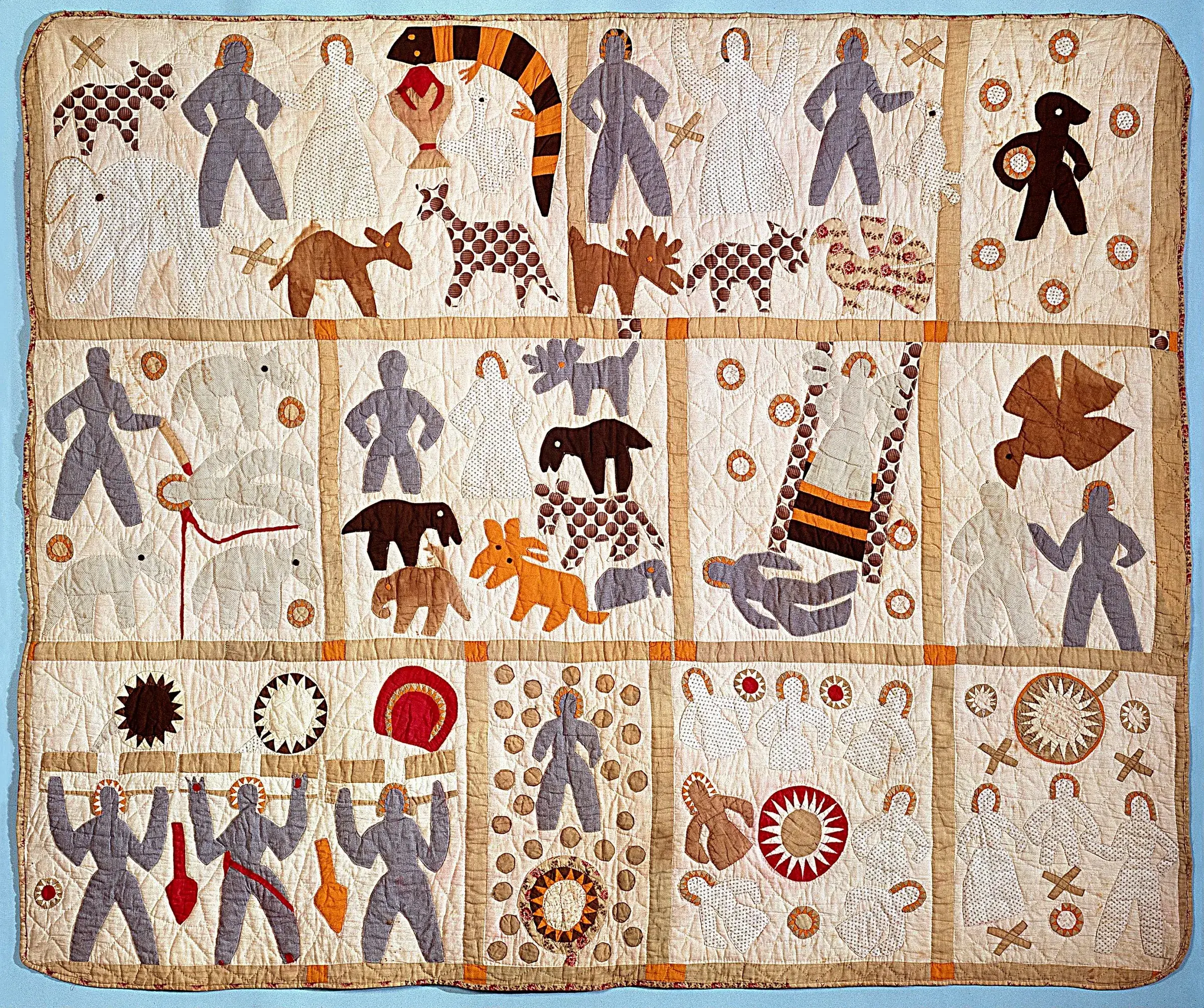
The Smithsonian catalogue almost reads like a manufacturing scan: blocks combine hand and machine stitching, most appliqué is machine-sewn, and details such as animal eyes, halos and suns remain hand-pieced and hand-stitched. Lining, filling and thread are cotton; quilting follows outlines and then crosses open areas with straighter lines.3
That mixture matters because it complicates the idea of an old handcraft preserved unchanged: a Black nineteenth-century quilter already divided work between hand and sewing machine according to the part being made. Technology enters the craft without flattening it into one process.
Nor does the meaning of its panels need to be guessed. When Powers eventually sold the piece to Jennie Smith, she insisted that the buyer record exactly what each scene represented.3 The archive therefore has two layers, with the textile preserving method and contemporary testimony preserving intention.
Visible labor
In 1934, Ruth Clement Bond designed another work that connects textile, economics and politics without requiring a hidden legend.
The piece now known as the TVA Quilt or Uncle Sam’s Helping Hand was designed by Bond and quilted by Rose Lee Cooper. Their husbands were then connected to construction work at Wheeler Dam in Alabama for the Tennessee Valley Authority.4
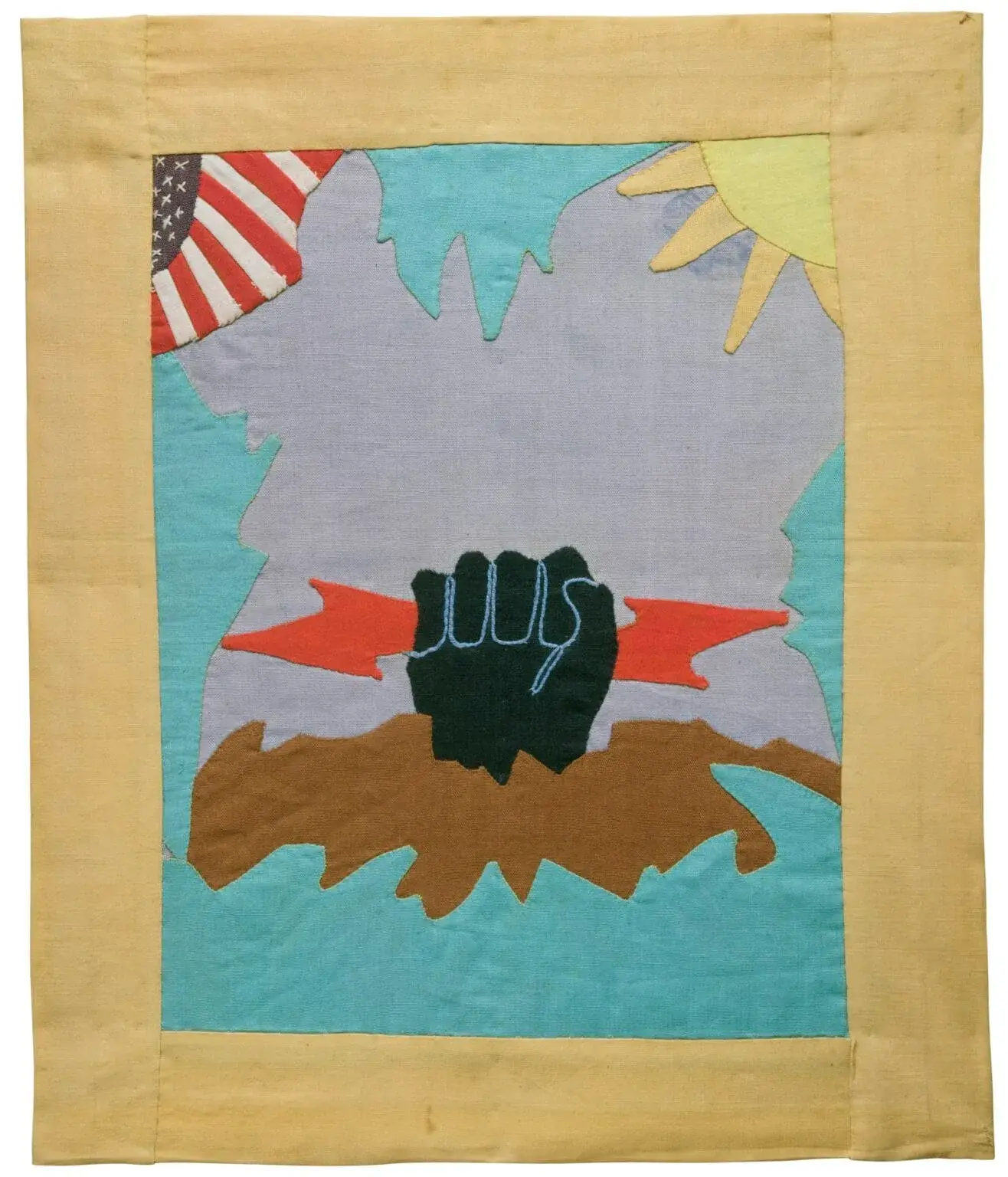
The TVA also preserves its institutional setting. J. Max Bond, Ruth's husband and the agency's highest-ranking African American officer at the time, presented the quilt to TVA president Arthur E. Morgan in 1935 and described workers' wives organising clubs where craft projects kept techniques associated with Black history in use while expressing the role Black workers were playing in a changing South.4
That record shifts the reading again: the textile is more than a political image, since it comes from an organisation of women around a huge public-works project at a moment when federal employment, segregation and industrial modernisation overlapped. Names, work conditions and the object's circulation carry as much historical information as its motifs.
A craft history that looks only at the surface loses exactly this layer.
A cooperative
At Gee’s Bend, Alabama, the economics of making become particularly visible. Women in the community worked for generations with worn clothing and available scraps, developing improvised compositions passed through families.5 Material limits directly affected the scale of pieces, available colours and ways of assembling them; they were conditions of the work rather than a romantic footnote added later.
Then, in 1966, more than sixty quilters from Gee’s Bend and nearby communities founded the Freedom Quilting Bee. The cooperative won contracts with New York decorators and Bloomingdale’s, built its own sewing centre in 1969, and from 1972 worked with Sears on corduroy pillow covers. At its height it had about 150 members and became an important local employer.5
That shift matters when reading textiles as records. A piece of corduroy in a 1970s quilt can connect to a supply chain and industrial contract rather than merely a colour choice; reused clothing carries an earlier history of wear, and repeated techniques can indicate family or collective transmission. Material, in other words, has provenance.
Material archive
Stories in the Seams is presented as a survey of Black American quiltmaking from the 1700s to the present, stressing a practice that can be distinctive while remaining extraordinarily diverse.1 Colossal's preview moves between Ruth Bond, the quilters of Gee’s Bend, Faith Ringgold, Bisa Butler, Basil Kincaid and Viola Burley Leak.2
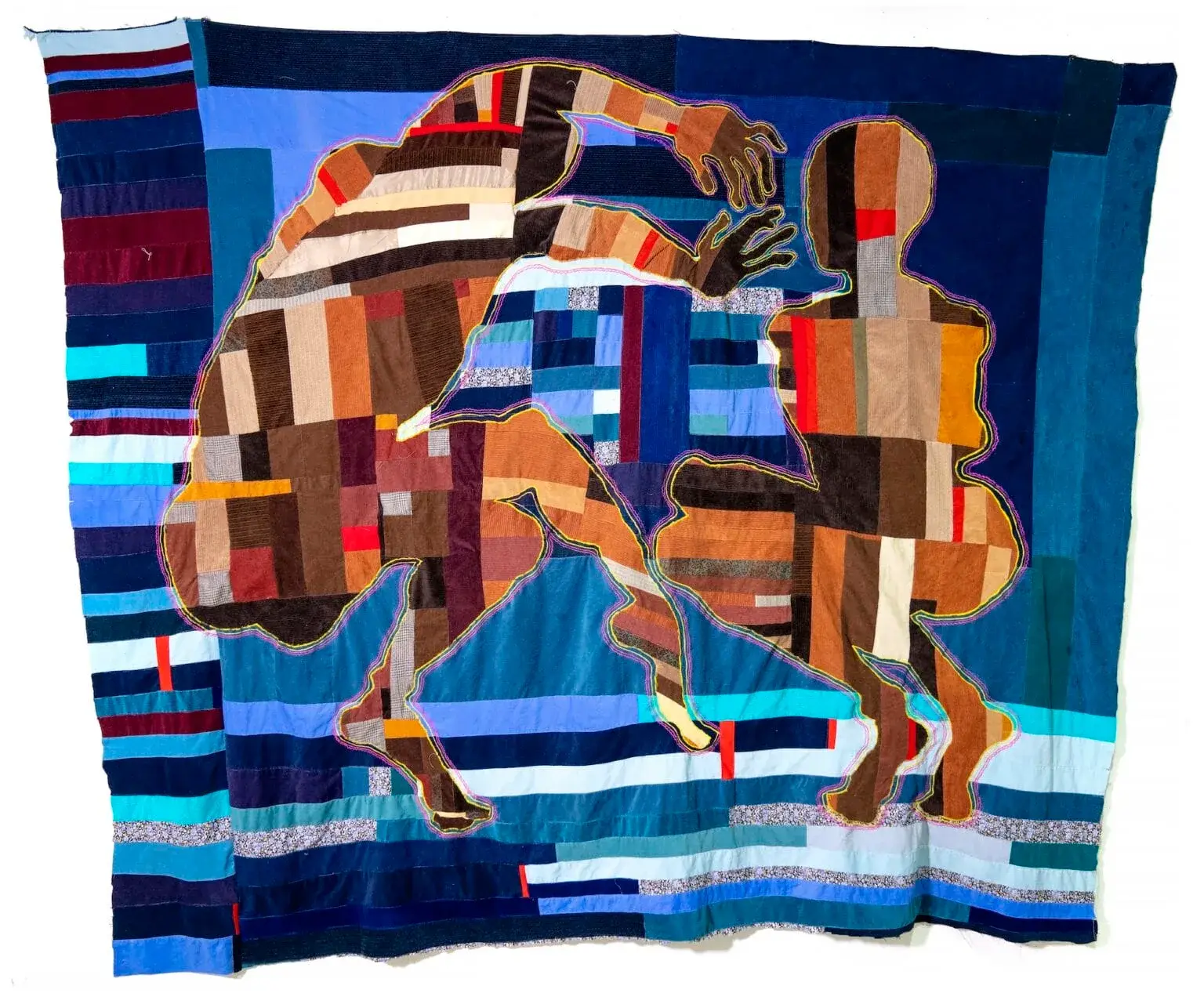
That diversity makes a single visual definition of “Black American quilting” impossible, just as it rules out a universal secret grammar waiting to be learned. Conditions shift across slavery, Reconstruction, domestic economies, cooperatives, commissions, museums and contemporary art practice. Across those settings, textiles repeatedly accumulate relationships: who stitched, who taught whom, which materials were available, which machine entered the workshop, what labor paid for the object, which story the maker intended to keep, and which market later changed its circulation.
For makers, the useful part is concrete: a manufactured object often documents far more than what appears on its surface. A screw, machine stitch, reused cloth or repair can point to an economy, access to tools, a moment in time and sometimes a line of transmission.
The quilts in Stories in the Seams do not need a second layer of invented hidden information; their seams already hold plenty.