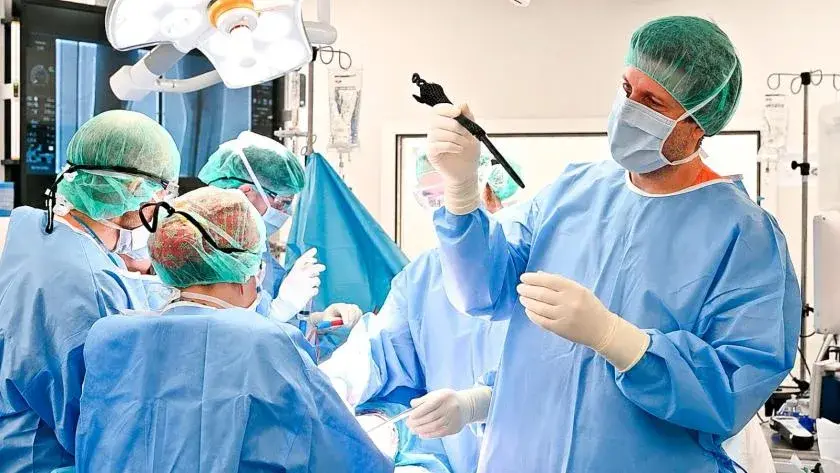
In the photo released by the hospital, a surgeon lifts the part between two gloved fingers. A small black block, open like woven lace. It weighs 300 grams. This titanium lattice is, according to Madrid's public Gregorio Marañón hospital, the first personalized metamaterial bone prosthesis ever implanted1. Almost a year after the operation, its wearer, a 38-year-old man treated for a high-grade bone sarcoma of the tibia, walks again, in many cases without crutches1.
The detail that makes the object strange sits in its design: the prosthesis does not replace the bone, it imitates it1. And in this specific case, it was packed with cancellous bone taken from the hospital's own bone bank, a graft that wove itself into the metal1.
The bone that melts
The patient had first suffered an infection, then a severe loss of bone density in the tibia. At that point, no prosthesis on the market could save his leg without compromising knee mobility, the hospital's oncological surgeons explain1.
The problem reaches past this one case. A stiff implant takes over the mechanical loads from the tissue around it. Living bone follows a simple rule: what stops working gets resorbed. The phenomenon, known as stress shielding, has been documented for decades around hip replacements and reconstruction plates: bone sheltered by a part that is too solid thins out, which destabilizes the implant and sets up a revision surgery7.
Mechanical metamaterials are one of the answers studied in recent years: internal structures, often periodic gyroid lattices, whose effective stiffness is tuned through geometry rather than material. Work on mandibular reconstruction plates shows a load transfer closer to that of healthy bone, with a costly caveat: on the test bench, the lattice plate fails at 775 newtons where the solid part holds 1,8007. A study published in July 2026 in npj Metamaterials adds a useful guardrail: swapping a solid part for a uniform lattice does not necessarily reduce stress shielding. It is the zone-by-zone optimization of the microstructure that makes the difference8.
That is exactly the Madrid bet: tune the stiffness of every region of the part instead of printing a decorative bone.
Lattice, not slab
The prosthesis was designed and manufactured by the hospital's UPAM3D unit, within an alliance between the Gregorio Marañón health research institute and the Polytechnic University of Madrid1. The material is a titanium alloy, 3D printed inside the hospital itself. The structure borrows technology from aerospace: millimeter-scale rods able to reproduce both the shape of the missing tibia and its mechanical function1.
The numbers released by the team sum up the gap with conventional orthopedics. A conventional prosthesis of this type weighs several kilos and, according to the researchers' simulations, carries between 100 and 150 kg2. The Madrid lattice weighs 300 grams and, again in simulation, withstands more than 500 kg12. The apparent paradox, lighter yet stronger, resolves in geometry: empty the material where the load does not travel, concentrate it where it does. Research on printed porous implants backs the order of magnitude: a well-chosen lattice can cut the effective modulus of solid titanium by tens of times, approaching the stiffness of cancellous bone9.
Load by load
The design method is documented step by step in the press release1. From the patient's radiological images, the team built a digital twin of his healthy leg. On that model, they simulated the real loads a tibia carries while walking, climbing stairs or stumbling. With that data, they computed the density of the internal lattice point by point, so that weight would travel exactly where the remaining bone could bear it. The fixation screws were aimed at the areas of best bone quality, and the surgery was planned to the millimeter1.
None of this is workshop magic: it is the standard vocabulary of structural engineering, topology and finite elements, applied to a living body. The team also reports an operating-room benefit: surgery times cut to practically half, hence less bleeding and less infection risk2.
Packed with bone
The real singularity of the case fits in one sentence of the press release: the prosthesis was filled with cancellous bone from the hospital's bone and osteotendinous tissue bank1. The graft grew inside the metal structure, which favors bone integration and implant fixation, and follow-up imaging confirmed the favorable adaptation1.
Oncological surgeon Rubén Pérez and Polytechnic University engineer Luis Sacedo sum up the stakes: "This type of aerospace engineering turned clinical engineering is a scientific, clinical and hospital milestone. We avoided the amputation of the patient's leg or a knee implant, which would have sacrificed the whole joint"2.
The patient himself has been bearing weight again for a few months. "Amputation was ruled out and the 3D prosthesis option came up. Everything went well, which is what matters. For a couple of months now I can start putting weight on the leg and, at last, I'm going to walk again after almost two years without stepping on it", he says2. The implant even survived a spectacular fall after the operation, described by his surgeon as an ordinary incident2.
The factory upstairs
This case did not come out of nowhere. The UPAM3D unit has run since 2015 and claims more than 1,000 clinical cases treated with 3D printing4. In October 2020 it became the first unit of a Spanish public hospital certified ISO 13485 for medical devices, the quality standard of device manufacturers5. The same year, the hospital obtained a custom medical device manufacturing license, extended in 2023 to point-of-care production, covering anatomical models, surgical guides and non-active implants4. In December 2023, Gregorio Marañón opened the world's first operating room with an integrated 3D printing room, sized for 10 to 12 procedures a week6.
The rest of the Madrid health system is following. The 12 de Octubre hospital also runs a certified unit that designs and manufactures custom devices, and a national network is taking shape under the coordination of the Instituto de Salud Carlos III10.
For anyone who makes things, that is the deeper story. The whole loop, imaging, design, printing, quality control, implantation, now fits inside a single public building. Point-of-care manufacturing has become a certified chain, with a manufacturer located next door to the operating room.
What it doesn't prove yet
Enthusiasm still needs a governor. The record so far rests on one patient followed for a year. The case itself has not, to date, been published in a peer-reviewed scientific paper; the figures come from a hospital press release and simulations, including the 500 kilos1. The "world's first", claimed by the hospital and echoed by media, cannot be verified from the outside13.
Generalization will also run into the known metamaterial trade-off: gaining mechanical compliance means losing failure margin, and every anatomy forces the optimization to be replayed78. That is a real engineering cost, not a formatting detail.
The team, for its part, keeps going. A second patient has already received a similar implant, and two more prostheses are in development, one for a wrist, one for a sternum23. The stated goal fits in one phrase from Rubén Pérez: that in the future every patient in public healthcare may be entitled to a custom-made solution2.
If the phrase holds, the next lattice part will come out of the same Madrid building, computed for a bone that no longer exists, filled with bone that was waiting in a bank.