Before firing, a porcelain slab may look finished. Sand it smooth, check the edge, put it in the kiln. Hours later a line from the roller is visible again, an upright wall has moved, or glaze has gathered in a place that looked unremarkable when the piece went in. Emmanuel Boos has spent enough time with porcelain to expect this kind of treachery, and enough time with glaze to know that correcting every trace would remove part of what he wants to see.
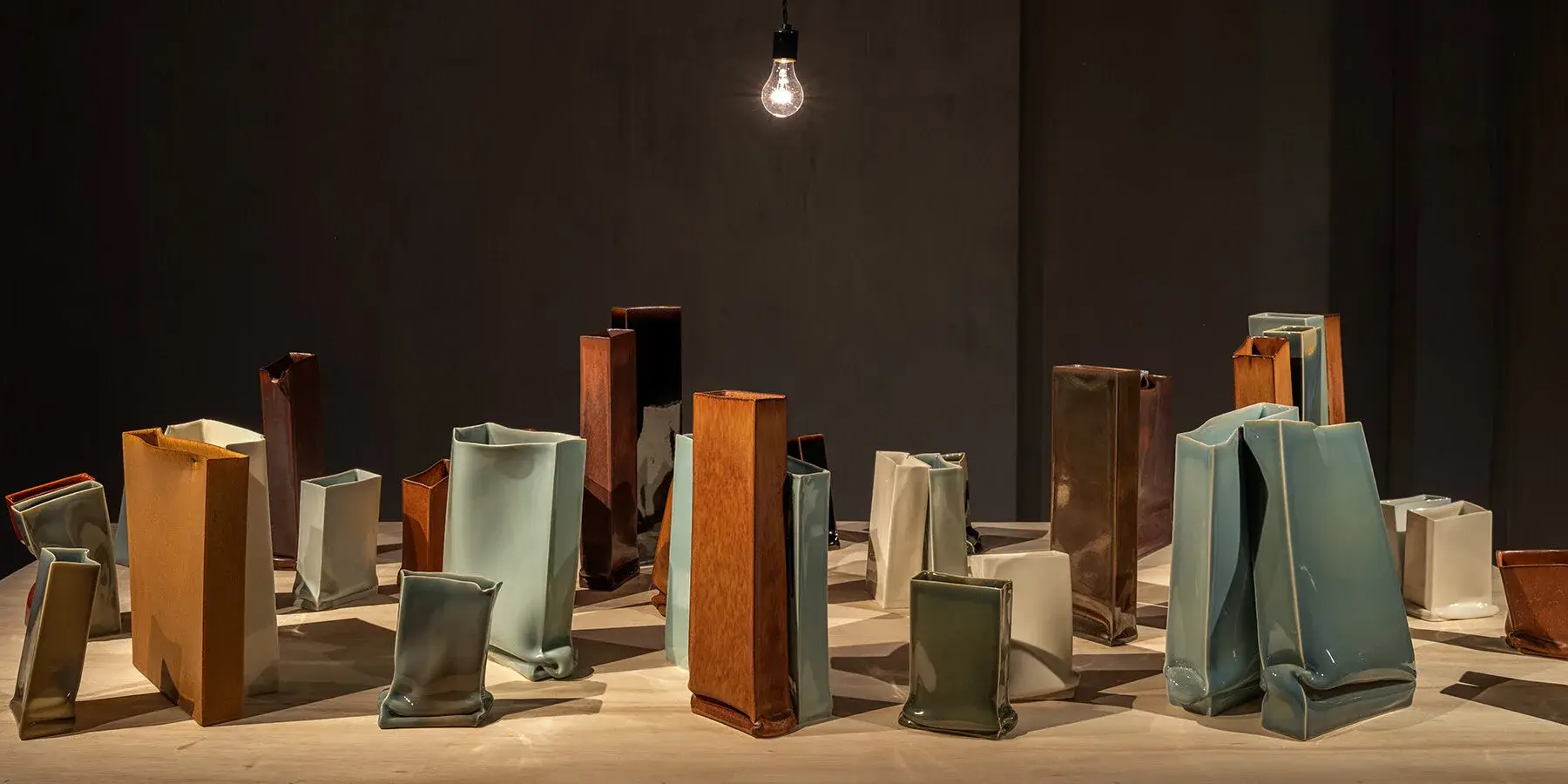
That tension runs through Noir C'est Noir, his first solo exhibition in the United States, which opened at Raisonné in New York in April 2026. Designboom counted more than 70 unique works, from tables and stools to vessels, bricks and compact geometric objects, with black and brown Tenmoku glazes alongside celadons and kakis.1 A photo by Zach Pontz of the installation makes the imperfections easy to spot, and Designboom writes about them as part of the exhibition's argument.1 Boos's own explanation is less romantic and more useful: he keeps some irregularities because years of practice let him tell a productive trace from a result that simply failed.
The defect returns
Boos calls one of porcelain's habits “memory”. Pressure applied while a piece is being formed can appear to vanish during scraping and sanding, then show itself again once the piece has been fired.1 Aalto's ceramics teaching gives the phenomenon a less poetic vocabulary. Forming can orient particles and leave internal stresses behind; during sintering, and while the body is soft enough at high temperature, those stresses can contribute to distortion together with gravity.4
His example with rolled slabs is almost annoyingly simple. The rollers leave lines, so he removes them. The surface looks clean. The kiln brings the lines back. After seeing this happen repeatedly, Boos began allowing the mark to remain on certain works because it records the route by which the slab was made.1 A line like that can still be ugly, badly placed or irrelevant; what interests him is that the firing has recovered evidence that finishing tried to erase.
Geometry as witness
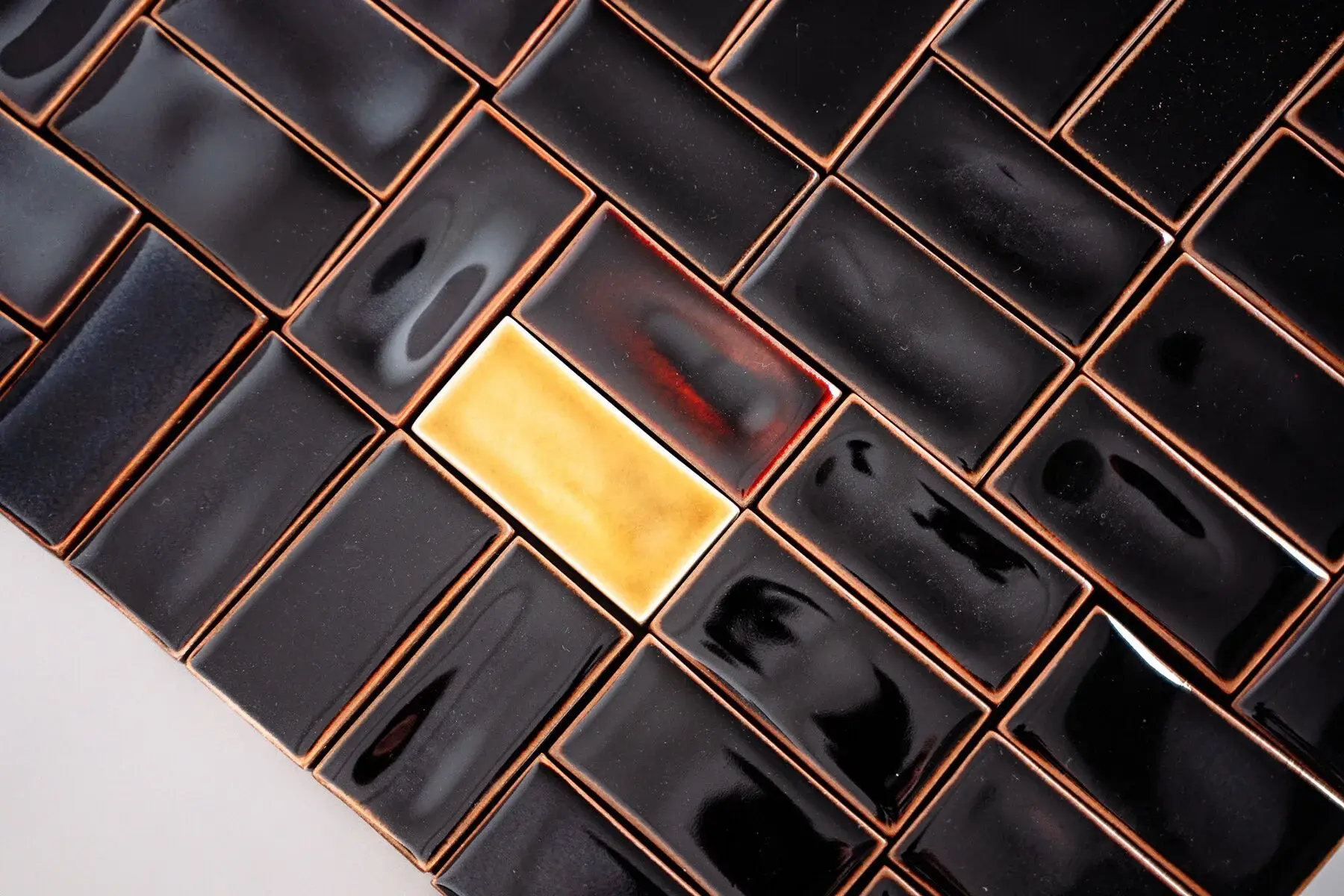
The cube appears repeatedly in Boos's work, which makes sense once it is treated as an instrument rather than a neutral style choice. Sèvres describes the cube as a generic unit for his glaze research: glaze lying across the top face behaves differently from glaze moving down a vertical one, and the edge gives it another place to thin, gather or change appearance.3 With such a blunt geometry there is nowhere for the effect to hide. If two faces finish differently, the material and the firing are implicated immediately.
Boos has been following that problem for years. His practice-led doctorate at the Royal College of Art, submitted in 2011, was titled The Poetics of Glaze: Ceramic Surface and the Perception of Depth.5 In 2016 he began a residency at Sèvres, where the long history of ceramic bodies, glaze recipes and firing knowledge gave him another setting in which to pursue the same question.2 A cube is useful there precisely because it is boring: instead of asking the eye to decode an elaborate silhouette, it gives glaze a few clear surfaces on which to show what it does.
By contrast with geometry used to enforce a precise silhouette, Boos's simple form becomes a reference against which variation can be read. The cube guarantees nothing about the result; its job is to make changes easier to see.
Glaze moves down
Glaze makes that variation particularly visible. Once heated, it melts and moves; thickness, height, temperature and kiln atmosphere all affect the surface that eventually comes out. In the Designboom interview Boos discusses knowing where a glaze tends to run, where it will become thinner and how a small height difference can alter its colour.1 The knowledge matters because chance arrives after a lot of preparation, not before it.
One of the quieter examples is the spray gun. Tiny dots left during glazing remain on some surfaces, and Boos tells Designboom that he likes them as a memory of the process.1 Nothing about the dots is technically mysterious. Their value comes from the decision to stop treating every sign of application as contamination and to let the finished piece disclose how the coating arrived there.
That choice also changes the chronology of design. The object is planned before firing, certainly, but the last meaningful judgement happens afterwards, when the real piece can be compared with what the maker expected and the unexpected parts can be assessed rather than erased by reflex.
Informed chance
Boos's biography makes the word “chance” slightly misleading. He apprenticed with ceramist Jean Girel from 2000 to 2003, completed a practice-led doctorate focused on glaze, and later began his Sèvres residency in 2016.26 Designboom's interview is similarly specific about the knowledge behind the work, mentioning glaze flow, changes of tone, firing atmosphere and the effect of height or thickness.1 Over the last two decades, Boos has learned many of the predictable parts of firing well enough to spend his attention on what remains outside them. The uncertainty comes late in the process, after a large amount of technique has already narrowed the range of outcomes.
That distinction prevents every defect from being promoted into an artistic event. A crack that ruins a functional piece, a warp that stops two parts fitting or a glaze that is technically unstable can remain a straightforward failure. By contrast, another deviation may add useful evidence or form: the roller line can expose manufacture, a run can emphasize an edge, and two bodies can slump until each one physically changes what the other is able to do.
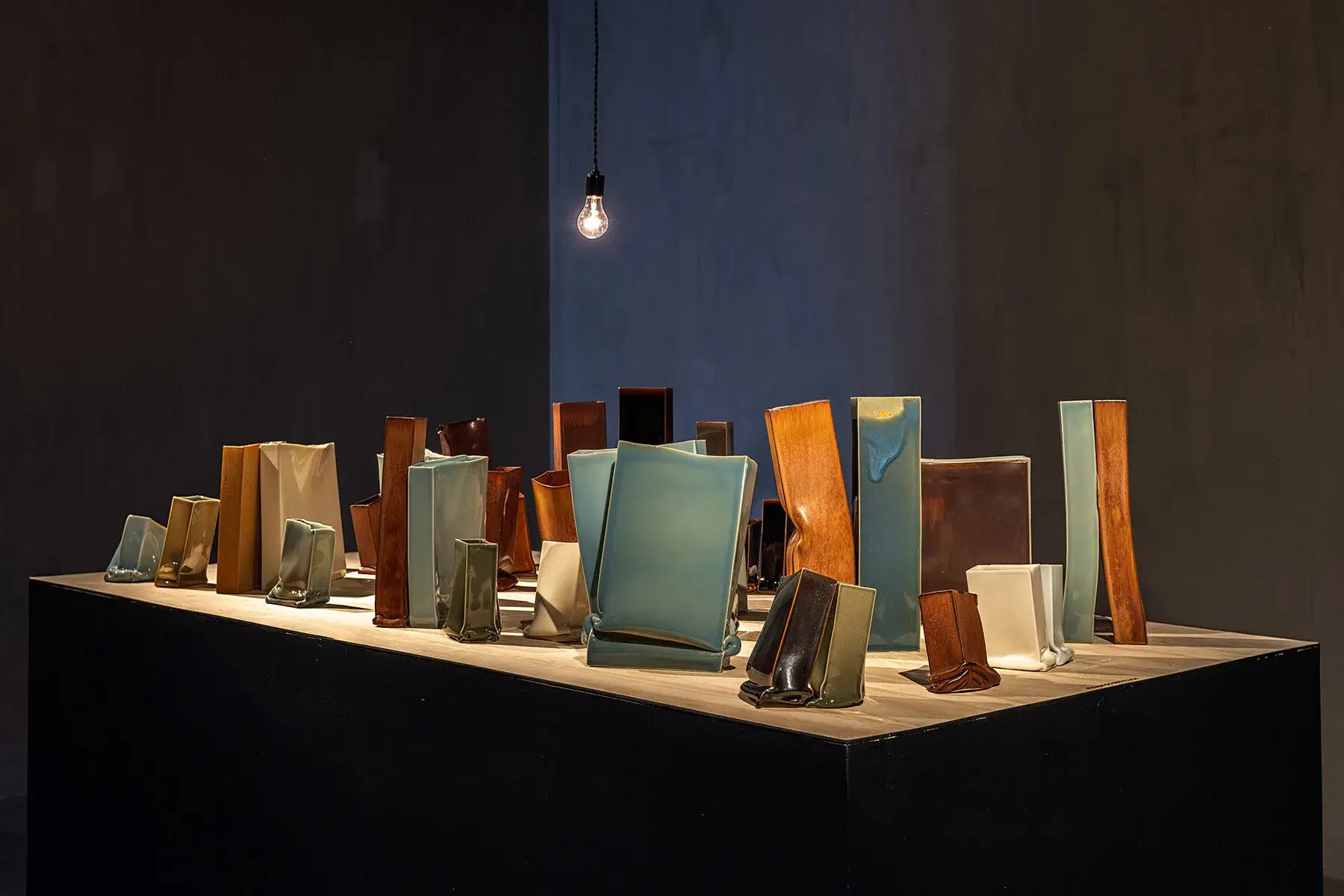
Boos describes paired pieces whose tendency is to slump towards one another. He places them so firing can bring them into contact and, in some cases, let them end up supporting each other.1 The exact deformation is unknown when the pieces enter the kiln, although the conditions are hardly random: distance, geometry, material and firing have all been chosen beforehand, and the result remains readable relative to those choices. He is designing the range within which an accident can occur, then judging the particular answer he gets.
After the kiln
Sèvres also taught Boos something about perfection after the fact. He watched pieces being polished, corrected and retouched after firing, a sequence capable of removing visible evidence of trouble and restoring the impression of an immaculate object.1 That experience complicates any easy opposition between a perfect piece and a failed one, because perfection may simply contain more invisible repair work.
Boos sometimes leaves the repair undone when the trace gives him something he wants to keep. There is no rule here requiring damage, wobble, or glaze marks on every object. The interesting part is the extra decision point: after firing, instead of asking only how closely the object matches the plan, he can ask what the process has added and whether removing it would actually make the piece poorer.
The same question is part of less artistic workshops too, only with different stakes. Manufacturing normally spends enormous effort suppressing variation through calibration, machining, surface correction and tolerances, and those controls are non-negotiable whenever safety, fit or repeatability depend on them. Yet a maker still has to distinguish a variation that destroys the job from one that reveals something useful about how a material behaves.
Boos works exactly on that boundary. His control is visible in the way he reads porcelain when it disobeys: he compares the result with what he knows about the process and chooses whether the difference belongs in the finished work. The kiln gets a reply into the conversation; the artist still decides what leaves the studio.