Mute APPARATUM for a moment and the machine still explains itself. Tape travels past a head; a black-and-clear disc crosses a lamp; motors start and stop. The person standing beside it, however, is working on a screen because that is where the composition begins.1
The 2018 installation, made by Warsaw studio panGenerator when its team was Krzysztof Cybulski, Krzysztof Goliński and Jakub Koźniewski, plays a useful trick on the eye. All that exposed hardware suggests mechanical performance, although the score is digital first: symbols become commands and only afterwards do tape mechanisms and optical generators turn those commands into sound.12
So where is the instrument? Somewhere along the route between notation and the white cabinets, where an abstract symbol acquires enough machinery that its consequences can be watched.
Score to machine
APPARATUM was commissioned around the heritage of the Polish Radio Experimental Studio, founded in 1957 and active until 2004,3 and one of panGenerator's central references is Bogusław Schaeffer's 1964 Symphony — electronic music. Schaeffer's graphic language supplied cues to the engineer responsible for realising the piece, rather than merely telling a performer which notes to play on an instrument whose behaviour was already fixed.13
In Schaeffer's studio the engineer sat between notation and machinery, deciding how a symbol might be realised with the equipment at hand. APPARATUM keeps that middle layer while moving part of the translating work into software, a more specific homage than simply copying an old control room.
Visitors assemble graphic forms on the interface; the system converts them into instructions for electromechanical generators, a relationship both ZKM and Digital Cultures describe directly when they call the interactive score a control system for magnetic tape and moving optical elements.25 Conceptually, the score behaves rather like a tiny program whose outputs happen to be motors and sound.
No visitor has to learn the old studio's operating procedures, and nobody is pretending that the year is 1964. What survives is the more interesting part of Schaeffer's setup: a score can describe how sound should be produced, leaving another layer of the system to work out the execution.
Real tape
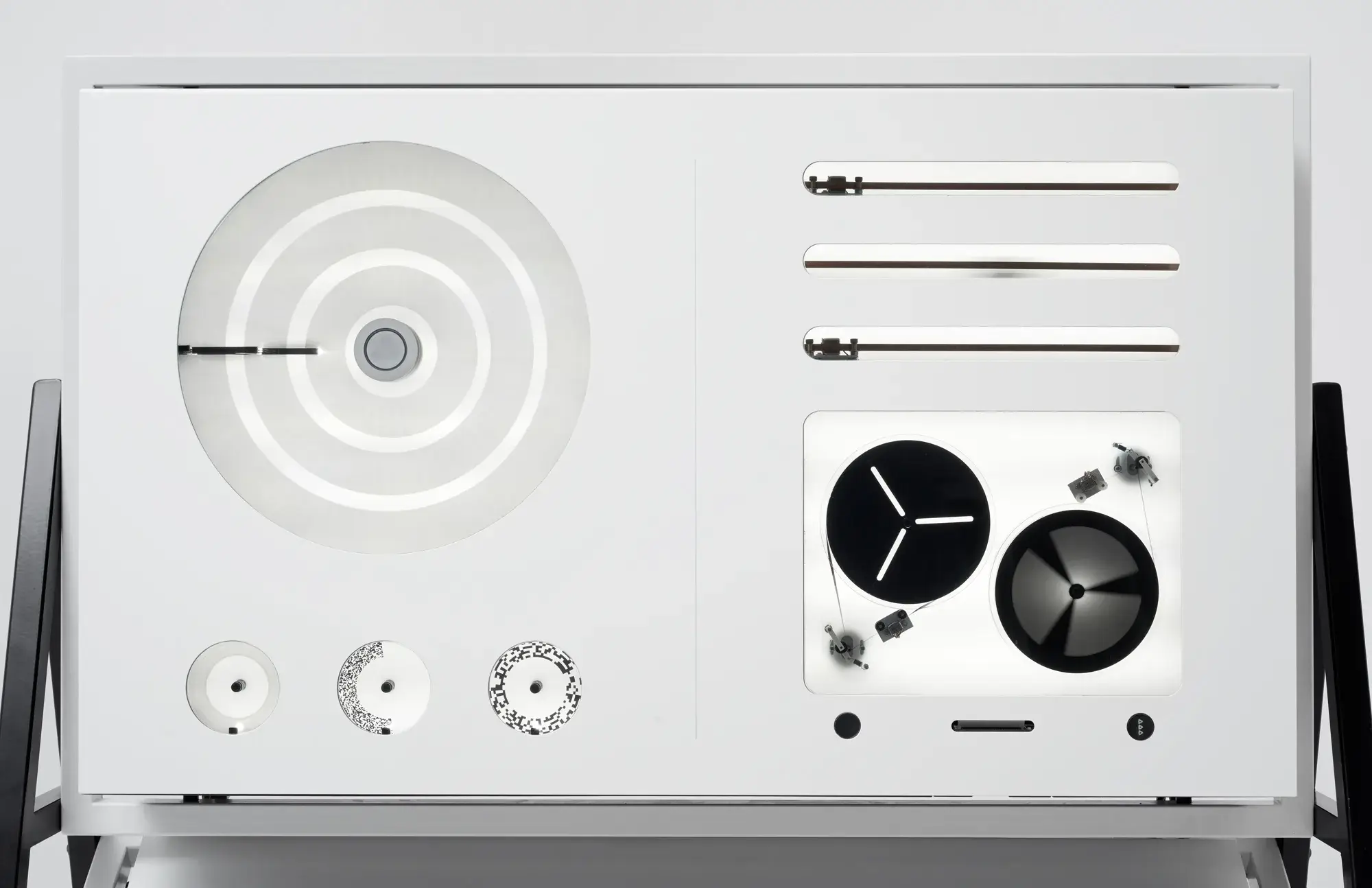
Magnetic tape is not decorative vintage texture. panGenerator lists two two-track loops and three linear one-shot samplers,1 while Peter Kirn's technical account describes loops of roughly two to three seconds with variable-speed playback and three other devices whose heads travel along the tape, with pitch changing as part of that physical movement.4
To be sure, as production equipment this is gloriously inefficient. Five audio files would have occupied almost no room in 2018, whereas APPARATUM gives a loop actual length: the strip has to come back past the head, and a speed change means that the medium itself really moves faster or slower.4
The cost of all that machinery buys legibility. Modern audio software has excellent reasons to hide this causal chain; an exhibition about electroacoustic history has equally good reasons to drag it back into view.
Light makes tone
The optical side gets stranger. panGenerator says its basic tones and noise come from spinning discs covered with graphic patterns,1 while Peter Kirn's description at Create Digital Music gets pleasingly literal: a DC motor turns plexiglass partly covered by black foil, an LED illuminates it and a photoresistor reads the changing light as an analogue signal for the mixer.4
The drawing does not merely illustrate a waveform afterwards. It materially participates in making one: opaque and transparent areas pass light differently during rotation, so the sensor's electrical output follows the pattern.
panGenerator calls the arrangement “digital interface meets purely analogue sound,” and here that line can be taken almost literally.1 Software schedules the action upstream; downstream, the signal comes from moving tape, changing light, a photoresistor and magnetised material rather than a model of those things running inside the processor.
Gesture translated
One correction to the original story matters here. Visitors are not grabbing tape or pushing motors around; the screen remains the point of entry.15 The unusual part comes afterwards, when an abstract gesture is allowed to leave the display and acquire visible mechanics.
Trigger a symbol and something starts inside the cabinet; alter a parameter and a mechanism visibly changes with it. The visitor keeps the simplicity of a graphic vocabulary while gaining a consequence whose geometry, speed and sometimes inertia are real, which makes the relationship easier to inspect even though control itself stays digital.
Put this behaviour into an ordinary DAW and it would be absurd; nobody needs a motor to turn whenever Ableton repeats four bars. APPARATUM has another job, willingly spending extra hardware to expose the technical route between a musical decision and the event we finally hear.
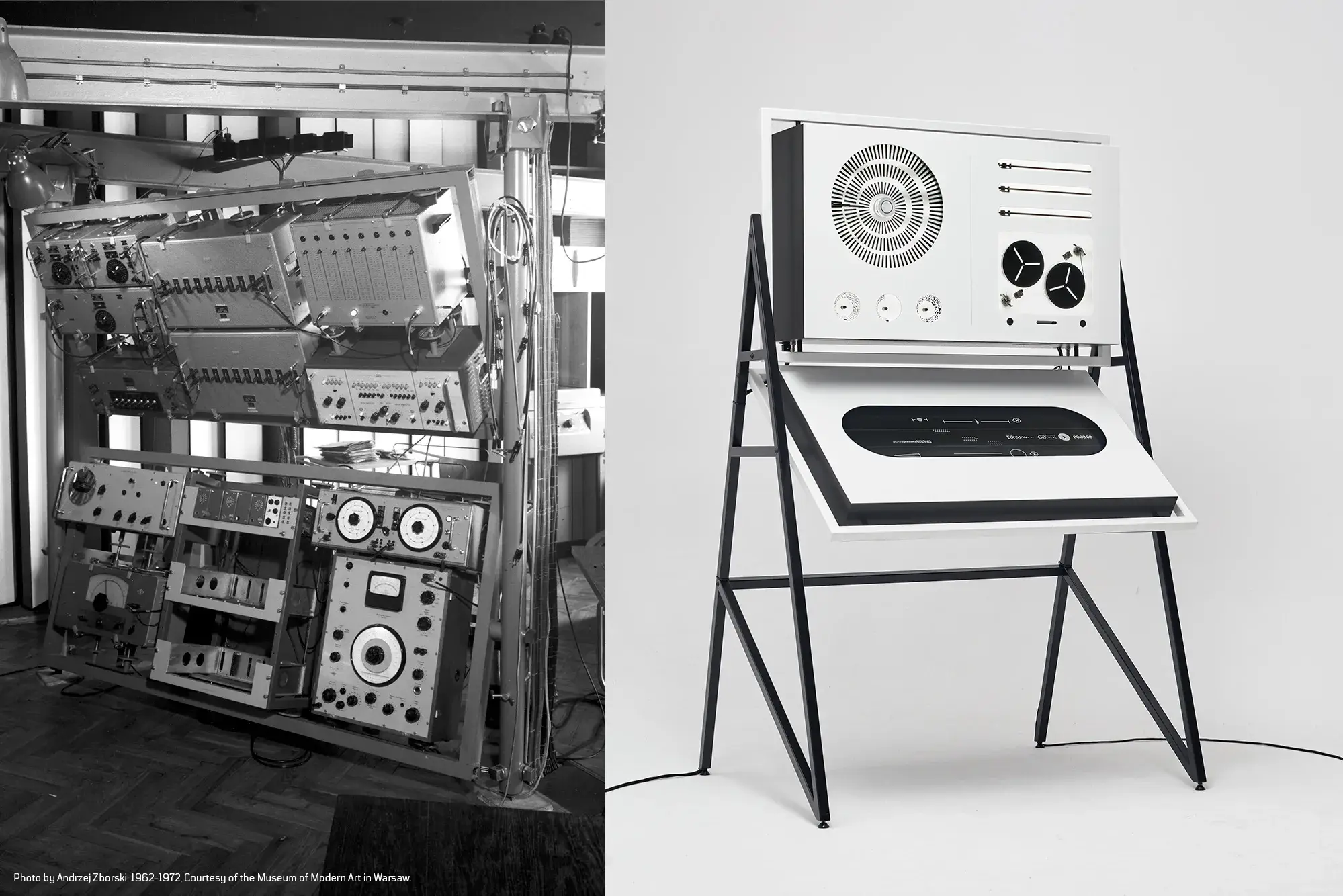
The furniture carries the same argument. panGenerator points to the Experimental Studio's famous Black Room, where generators and filters occupied modular steel frames, and credits Oskar Hansen; Culture.pl supplies the fuller attribution to Oskar and Zofia Hansen.13 APPARATUM borrows the exposed modular logic without pretending to be a literal museum replica.
Score printed
The chain ends almost comically: after screen, motors and tape, a printer returns the composition to paper. ZKM, Culture.pl and Create Digital Music all describe visitors leaving with the graphic score while a digital recording of the resulting piece was saved as well.234
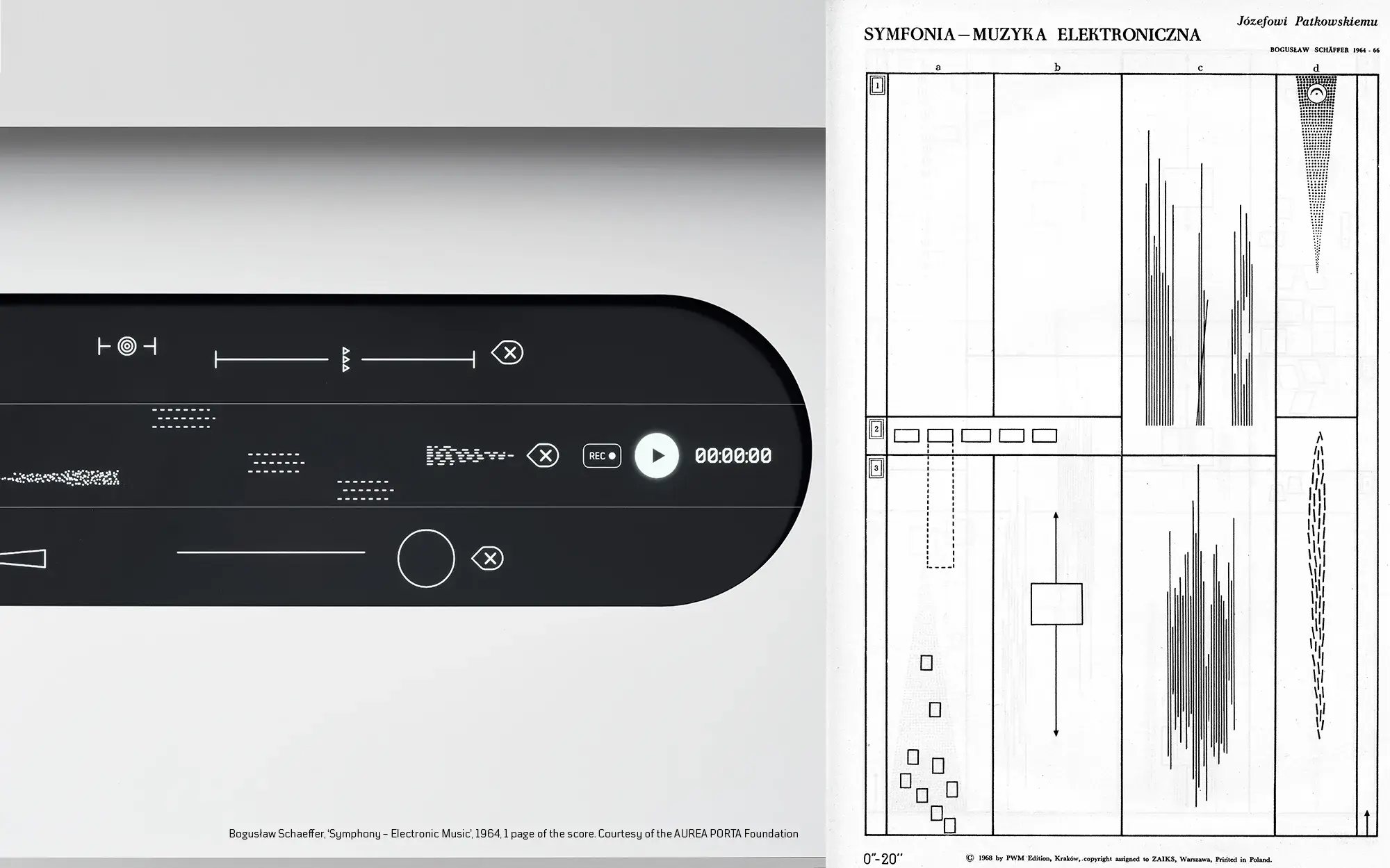
Those two archives describe different things. The audio keeps an execution with whatever happened during that run, whereas paper keeps its compositional logic, echoing the separation found in the historical studio with one crucial difference: Schaeffer wrote for a human engineer who could interpret ambiguous cues, while APPARATUM must formalise enough of the vocabulary for an interactive system to decide what action follows each symbol.
Some of Schaeffer's ambiguity necessarily disappears along the way because a computer cannot improvise around an instruction in quite the same way as a studio engineer. The gain is obvious at exhibition scale: somebody with no electroacoustic training can still make a piece within minutes.
Not retro
Over the last few decades, tape, optics and steel frames have become such strong period markers that APPARATUM practically begs for the word “retro-futuristic.” The rise of software instruments makes the contrast even sharper: a contemporary computer could reproduce most of these audible results with vastly less machinery, which panGenerator surely knew while deliberately building the cumbersome version. The label fits the photographs better than the argument.
What all the extra apparatus buys is visible causality: a sign turns into an instruction, an object moves, a signal appears, and afterwards the recording and printed score preserve two different traces of the same event.
ZKM presented APPARATUM as an accessible route into the heritage of the Polish Radio Experimental Studio.2 For that purpose, mechanical complication becomes an advantage: before deciding whether the resulting track is any good, a visitor has already seen that electronic music never simply appears “inside a computer.” It comes through a chain of instructions, media and transformations; APPARATUM chooses to put that chain back where the audience can see it.