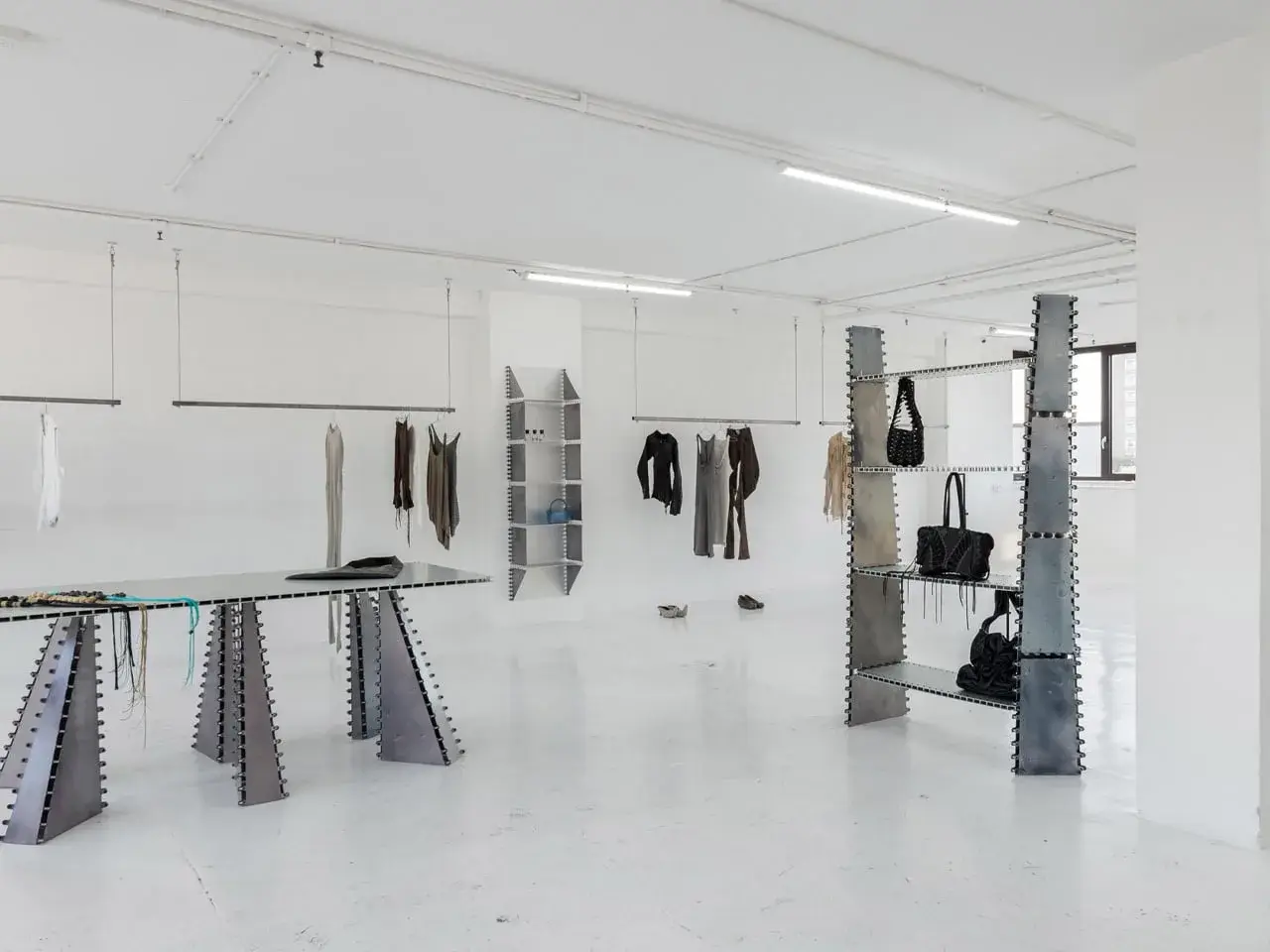
The title promises 10,000 rivets. Tom Pearson's furniture shown during London Design Festival actually contains 6,264. Pearson says he ordered ten thousand and jokes about where the rest went.24
The count is good theatre. The dimension that actually shaped the furniture is less glamorous: the size of Pearson's anodising tank.
Pearson built his own anodising setup in his Lewisham workshop because he wanted control over aluminium colour. Instead of the flat uniform finish normally expected from industrial anodising, he applies dye himself using brushes, airbrushes and pipettes.234
Then the tool imposed a rule of its own: a sheet larger than the tank simply does not fit.
That awkward physical limit ends up doing a surprising amount of design work.
The tank decides
Pearson's anodising line is not a magic new chemistry. He describes the familiar sequence of acid and boiling water; the unusual part is what he does with colour once he controls the process himself.4
Brush, airbrush and pipette leave different traces. Some areas pool, some fade, some look almost wet. Pearson keeps those differences instead of correcting them into a factory-even finish.
Then comes the annoying workshop question: what happens when the object needs to be larger than the bath?
Pearson's acid tanks accept only a certain panel size. He could treat several parts and weld them together, but he says welding already anodised aluminium is feasible but messy in this context.4
So the order becomes non-negotiable: finish first, join later.
The rivet becomes the hinge between two operations that can no longer swap places.
This is the useful bit. The finish process is no longer an afterthought; it has started dictating construction.
One boring workshop measurement now travels all the way through the object. Tank size limits the panel; the panel needs a post-finish joint; that joint becomes a row of rivets; the row becomes the collection's visual signature.
Show the joint
London Design Festival describes the pieces as planes of aluminium sheet held together by precise lines of rivets. Pearson places tubular spacers between them, creating separation and shadow along each seam.1
Pearson does more than tolerate the rivet. He gives it room. The gap, shadow and repeated spacing make the fixing read from across the room.
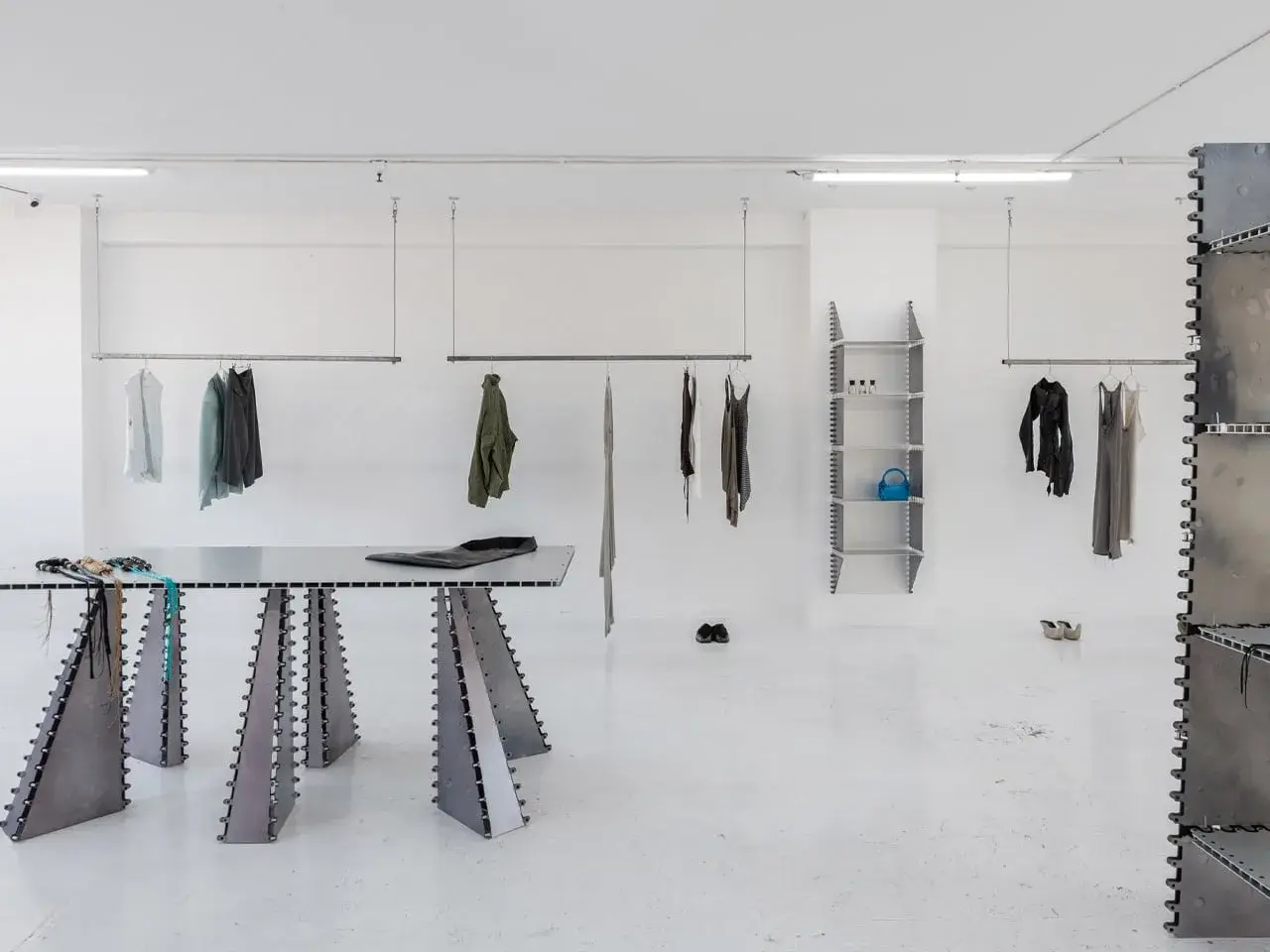
A lot of furniture works very hard to pretend that nobody assembled it. These pieces do the opposite.
Follow a rivet line and you can see where one panel ends, where the next begins and how the object was put together. The construction diagram is sitting on the surface.
There was every opportunity to apologise for the fixing. Pearson does the less timid thing and repeats it until the eye starts reading rhythm instead of hardware.
Nothing has been magically 'resolved'. The troublesome joint has been repeated until it reads as a rule.
Colour first
There is another useful reversal here: the collection did not begin only with a silhouette. It also began with the nuisance of finishing aluminium well.
Pearson says aluminium finishing had become a nuisance: keeping it pristine was difficult, and commercial suppliers were not eager to entertain his hand-dye experiments. Building the process in-house gave him room to make mistakes on purpose.4
Commercial finishing generally sells repeatability. Pearson wanted the bits a specification sheet would normally call variation: drips, soft edges, uneven density and results that refuse to clone themselves exactly.
Hypebeast compares the finish to beaded water on aluminium.3
Put the two together and the tension is obvious. The dye wanders. The rivet line absolutely does not.
Much of the collection lives in that tension.
6,264, not 10,000
The rivet count is more than a title gag.
London Design Festival presents 10,000 Rivets as Tom Pearson Studio's debut collection of furniture, lighting and objects.1 Hypebeast reports that pieces are named after their number of rivets, from a small candlestick to a cabinet.3
The count is unusually literal branding. A name can tell you roughly how much fastening, repetition and hand work is sitting in front of you.
Pearson nevertheless confirms that the works on show contain 6,264 rivets rather than ten thousand.4
So the title is lousy accounting but decent description. Ten thousand is what the repetition feels like; 6,264 is what Pearson actually used.
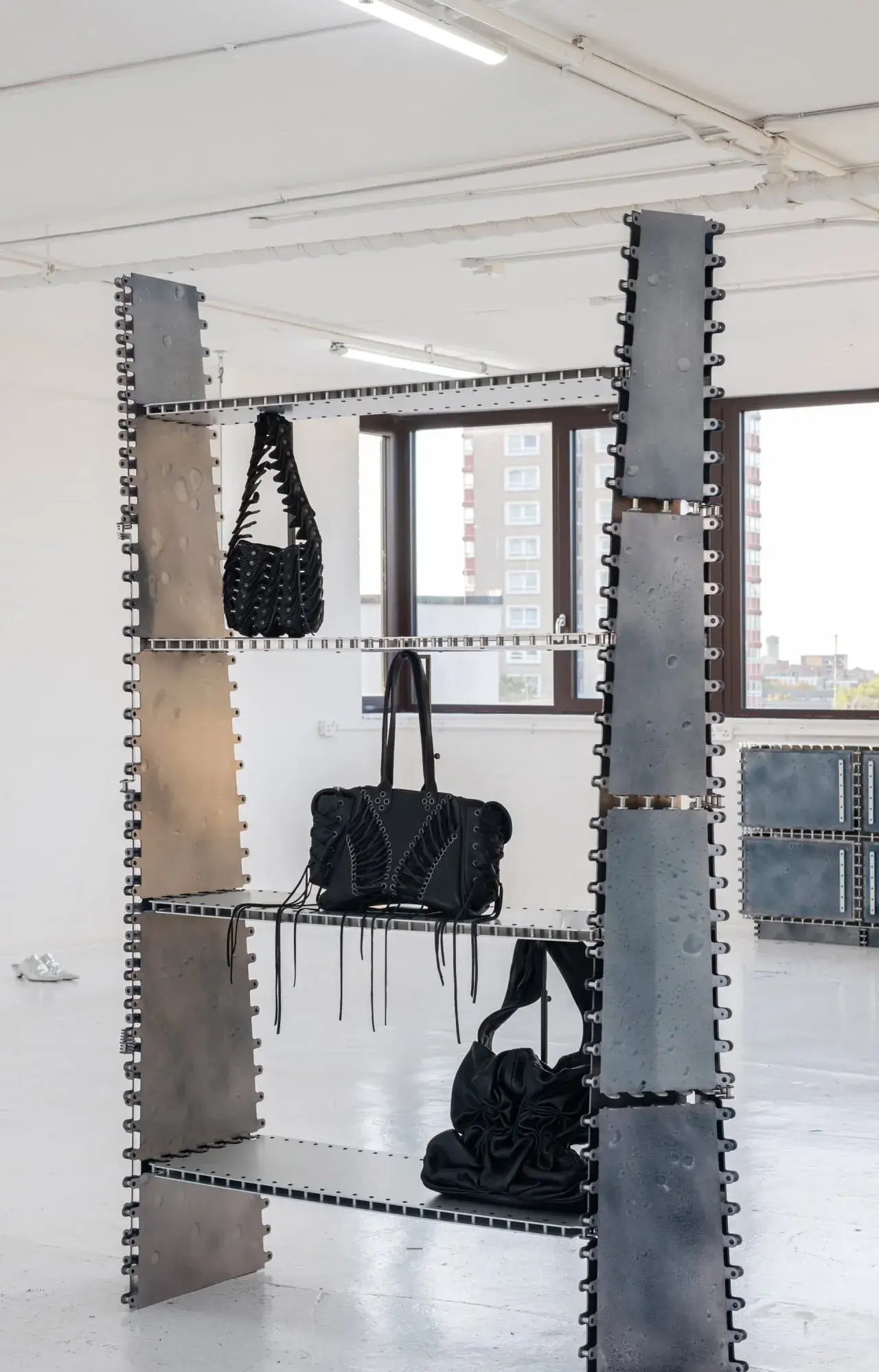
Nothing here pretends to have arrived seamless from a mould. The seams keep score of the little operations required to turn bath-sized sheets into furniture-sized objects.
The workshop draws
We tend to talk about workshops as obedient places: send in a drawing, receive an object. Real workshops are rarely so polite.
Pearson's setup pushes back.
Instead of drawing a finished object and bullying the workshop into reproducing it, Pearson lets the workshop answer back. Tank size sets the module. Modules need joints. Joints create rivet lines. Those lines end up looking deliberate enough to carry the collection.24
The bath did not design the collection by itself, obviously. Pearson still decides the geometry, spacing, colour, exposed hardware and tubular spacers. But he does not spend those decisions pretending the original limitation never existed.
He makes the limitation visible and useful.
That is the transferable idea here: the size of a machine can become a design dimension. Tooling is not neutral scenery.
The anodising bath never appears in the finished room, but its footprint does. It is there in the panel sizes, every seam and, eventually, the thousands of little metal dots that gave the collection its name.