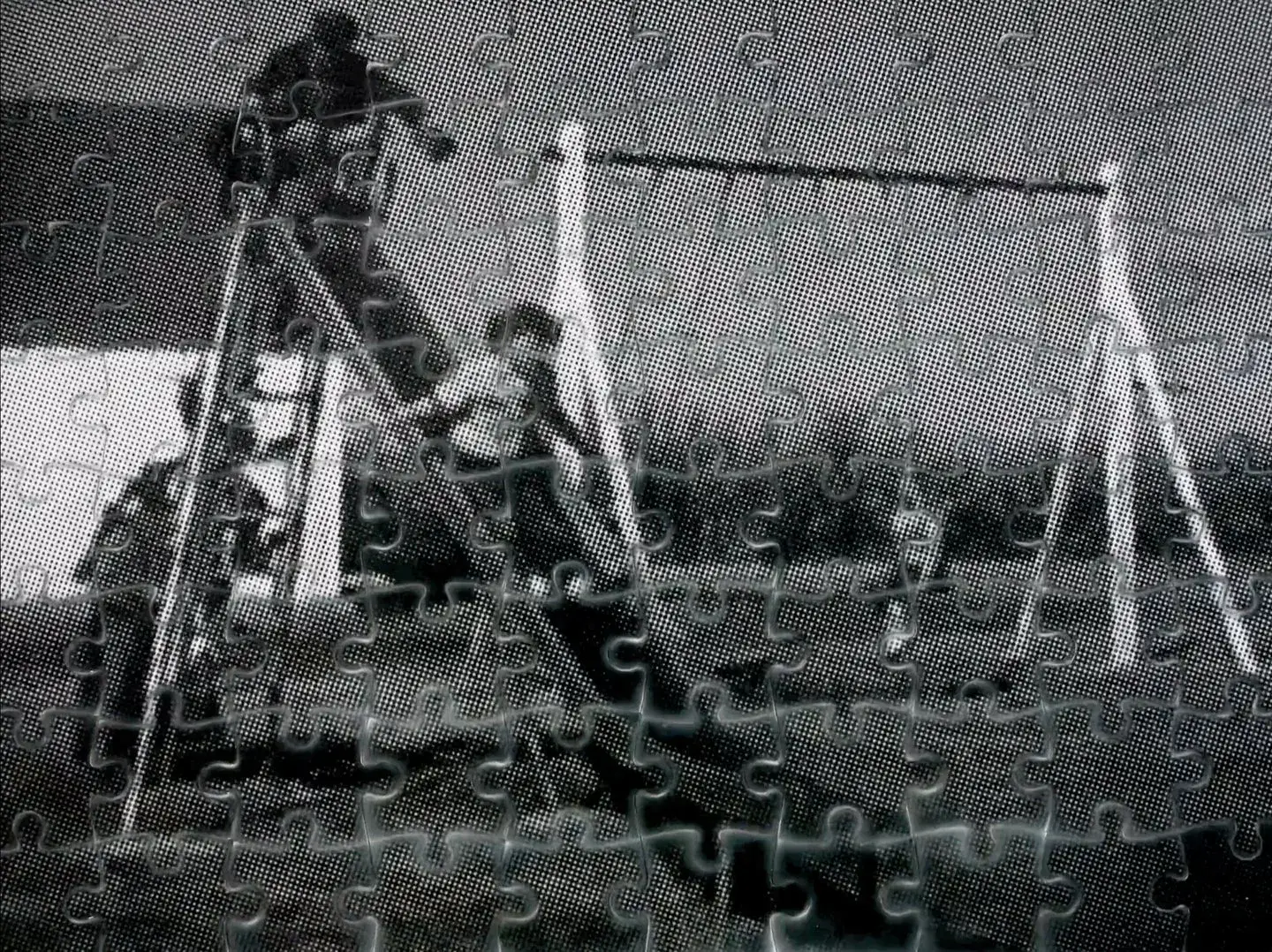
Alèxia Ponce does not always start an animation by opening software. She might start by wetting a sheet of paper, crumpling it, printing an image with sunlight, or deciding that an entire puzzle will be the surface.
That is the interesting shift in her work: the material does not arrive after the idea to add texture. It becomes part of the rule that creates motion.1
In an interview published by It’s Nice That on August 12, the Barcelona-based audiovisual designer describes a practice where moving images are treated as physical objects before they become a sequence. She mentions fabric, paper and even stone as possible surfaces.1
Frames with thickness
Digital animation has trained us to think of a frame as a perfect abstraction: a rectangle of pixels replaced by the next one.
For Ponce, a frame can be a wet or crumpled sheet. A sun print depends on the physical process used to make it. A puzzle piece imposes its own shape and order.
Those imperfections are not necessarily corrected. They become part of the movement.
Ponce says she likes visible texture and imperfection. Some sequences still require hundreds of frames and extremely precise execution.1 It creates a useful contradiction: the process is laborious, while the result keeps the feeling of an experiment that could still slip sideways.
Unnamed tools
This is not simply analogue work for nostalgia’s sake.
Software offers tools that are already named: mask, blur, interpolation, displacement, particles. Physical materials offer behaviours instead. Paper tears. Water spreads. A puzzle forces a grid. Light marks some surfaces differently from others.
You are not only choosing an effect. You are discovering what the support is willing to do.
Ponce describes this very literally: she wants to make moving images outside a screen, frames that can live on fabric, paper or stone.1
Her own site moves between film, stop motion, print and object-based work.2 The technique changes, but the support keeps being treated as something to manipulate rather than a neutral background.
Borrowed proportions
Her 2026 film Qui trepitgi la ratlla pushes the same logic further.
The project explores a child’s imagination. To construct those worlds, Ponce uses drawings made by children themselves.1
That choice avoids a familiar trap: asking an adult to draw “like a child.” The visual material already arrives with its own proportions, shortcuts, awkwardness and decisions. The animation has to work with them.
Ponce cites Hirokazu Koreeda and Francis Alÿs as close references for the film, alongside artists and filmmakers such as Jan Švankmajer, Michel Gondry and Venera Kazarova whose work also lets objects, materials and animation contaminate one another.1
Start with matter
You do not need to copy her techniques exactly.
The useful lesson is smaller: before asking how to simulate a texture, ask what the real material would do to the project.
A graphic designer can print and rescan. A motion designer can build a sequence out of folds. A tattoo artist can test how a motif survives on a moving surface instead of only working on a flat silhouette. A creative developer can treat a sensor or mechanical constraint as the beginning of the visual system.
The support stops being the final aesthetic layer.
It becomes the first rule.