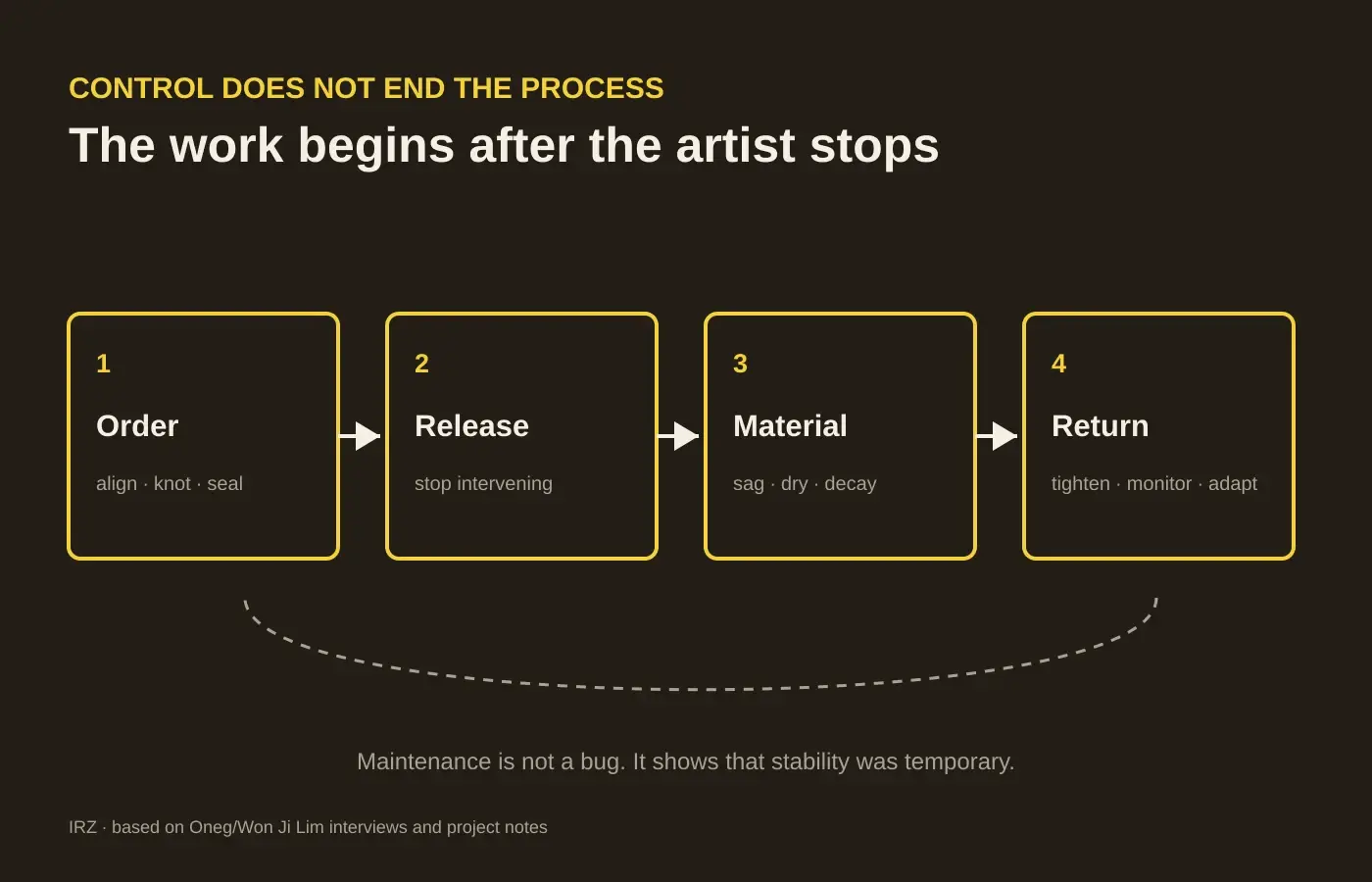
Won Ji Lim begins by doing exactly what a well-behaved system is supposed to do, aligning, fastening, tensioning and containing, until she reaches the point that would look like a maintenance error anywhere else: she deliberately stops.
From that point, weight pulls downward, hog casing dries, rope moves and organic matter changes colour or volume, while the artist, who also works under the name Oneg, resists returning every element to its original state; instead, she builds conditions in which order has to negotiate with whatever escapes it.15
These sculptures are carefully prepared rather than abandoned to chance, but that preparation includes permission for the form to deform after her hands leave it.
Stop helping
In an interview published on 13 August, Lim describes a repetitive method of knotting, tying, weaving and securing, pushing organisation as far as she can. Once the structure is complete, she deliberately stops intervening and lets the material move, resist and reshape the system.5
Her official statement connects that mechanism to her own experience of hypervigilance and a desire for control, so the gestures do not merely manufacture an image of stable order; they replay the work required for a system to appear stable.1
The idea becomes much less abstract once you look at what she actually puts into these systems, because Lim has chosen materials with no particular interest in staying put.
Threaded casing
Held at the Edge, made in 2026, combines hog casings with wire mesh through a methodical starting action in which the casing is repeatedly pushed and pulled through uniform openings, letting the grid organise the material while it is still soft enough to comply.2
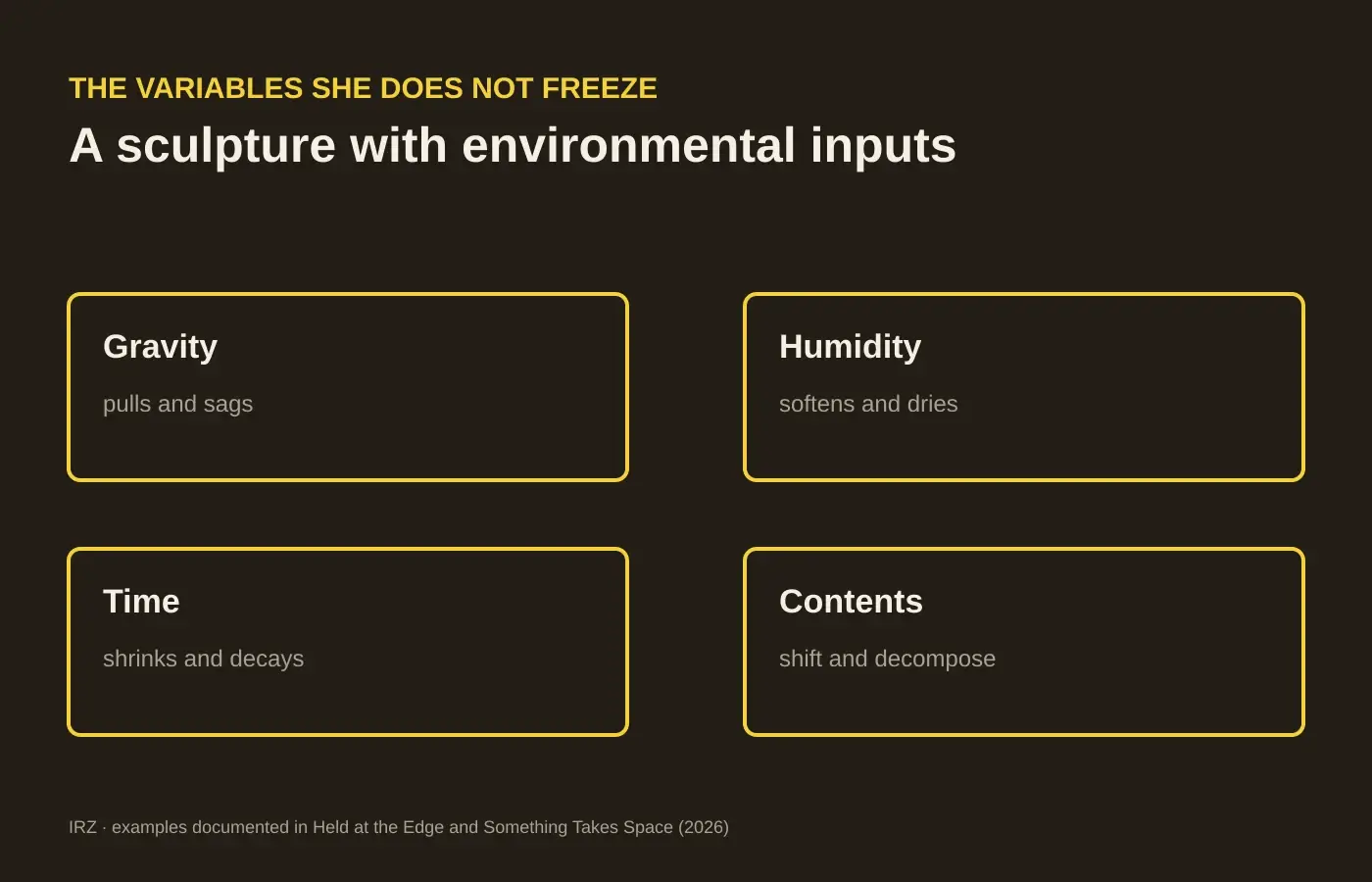
After that the environment resumes work: the casing stretches, sags, dries and deforms under gravity and time, then tightens around the wire as it shrinks and becomes more entangled with the structure meant to contain it.2
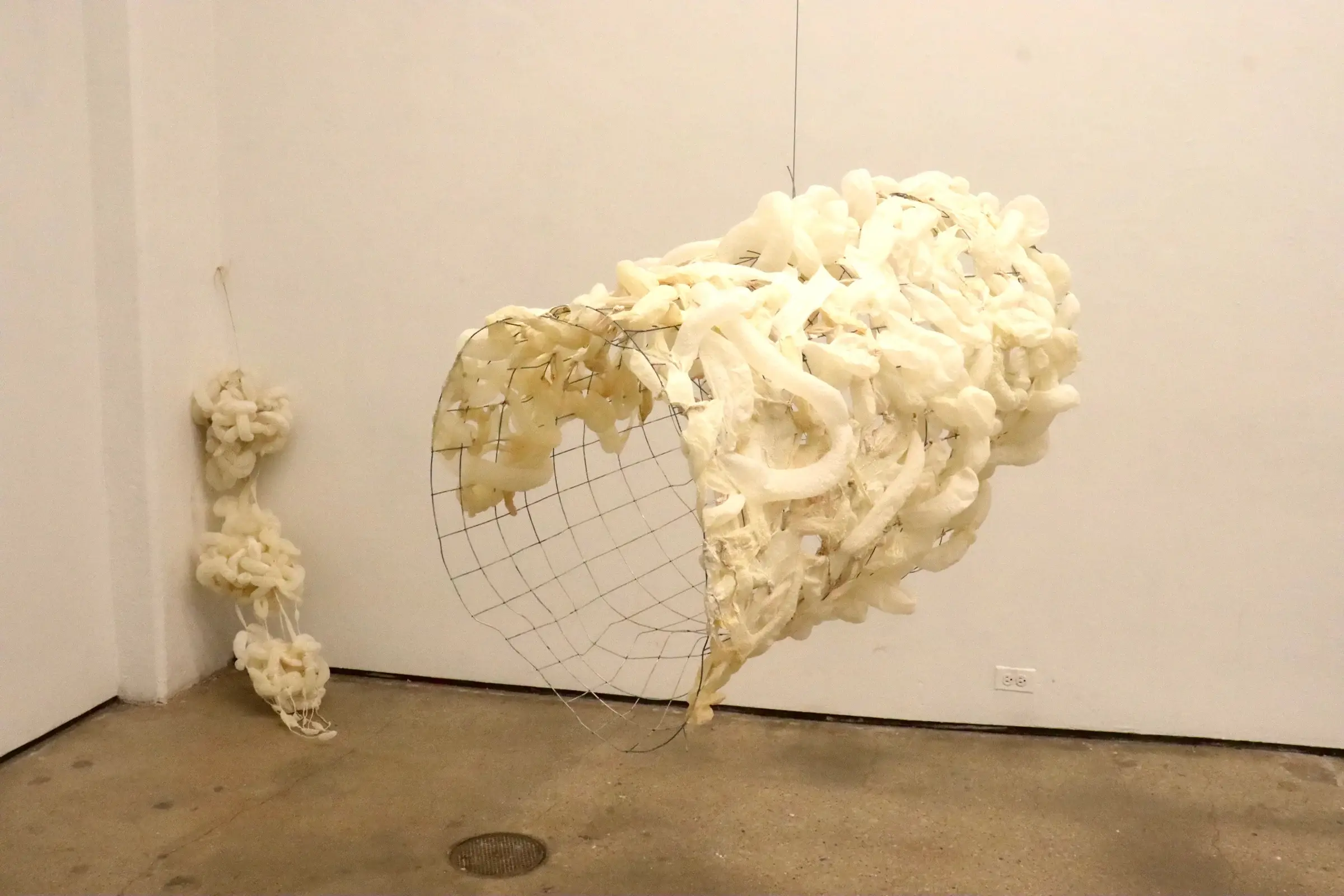
Calling the material a co-author can make the mechanism sound more mystical than it is, since the casing offers no idea to Lim and simply retains properties that her setup refuses to neutralise: its diameter changes, moisture leaves and gravity pulls, which means some parameters remain active after installation and the final form cannot be fully drawn beforehand.
Under vacuum
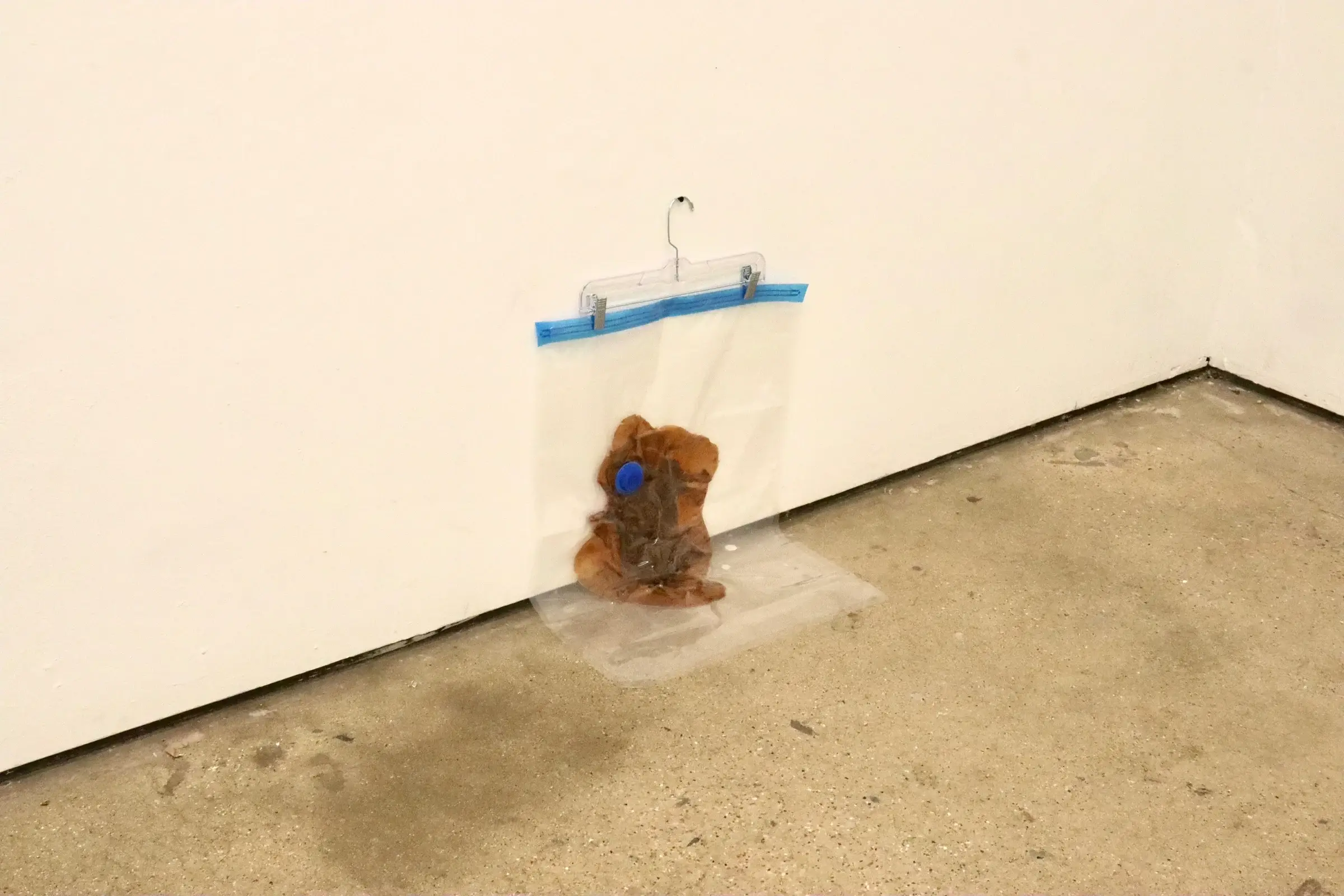
Something Takes Space pushes the contradiction further. The installation uses a garment rack, hangers, pulleys and a network of knots. At its centre, hog casings filled with soil are sealed inside vacuum bags; another bag mounted high on the wall contains casing filled with banana and saliva.3
The vocabulary of preservation is everywhere, from packaging and sealing to suspension and immobilisation, yet the contents continue to shift and transform, turning a bag that appears to preserve matter into a frame for its decay.3
Visitors can walk beneath the suspended bag, a position Lim says poses no actual danger but still produces a mild bodily tension because the mind understands that the object is secure while the body registers an uncertain mass overhead.3
Tighten again
Leaving a work unfixed does not mean never touching it again: Point Pleasant Publishing describes Between Knots as a rope structure that needs periodic tightening to remain cohesive, so maintenance becomes a way of observing the instability rather than cancelling it.7
For design, that return may be the most useful detail, because a connection that needs periodic tightening would normally look like a defect in an industrial object whereas here it exposes the actual condition of the system: stability exists only through maintenance.
Lim herself describes installations that look rational while their balance depends on knots, tension, gravity, repeated adjustment and continual upkeep, leaving the cost of stability exposed instead of burying it under a shell or finish.6
From the kiln
Her interest in change predates these organic systems: Lim studied ceramics and glass at Hongik University before entering the sculpture MFA at the School of the Art Institute of Chicago, and recalls experimenting with found objects coated in clay slip and glaze while materials burned away, twisted or collapsed in the kiln.46
Firing eventually imposed a limit because, however dramatic the transformation, the kiln fixes the material into a state; biological matter offered her a way to keep the process open after installation.6
That continuity also helps explain her harder series, including Untitled, Anima-in anima and We are living in a room, presented by designboom on 21 August with glass, cement and ordinary objects; the materials change, yet a similar question remains about how a body or structure holds itself, carries weight and opposes a hard exterior to a softer interior.8
Provisional system
The lesson is certainly not that chairs should rot and bridges should sag for the sake of character, an interpretation remarkably efficient at ruining both art and civil engineering.
Lim's method makes a narrower point visible: designing a system does not always require a final geometry defended against every variation, because it can instead mean choosing constraints, materials, allowed movement and the moments when someone will return to intervene.
Many less poetic objects already behave this way, as buildings move, ropes relax, seals dry, wood swells and batteries age, although design usually tries to hide that temporality while Lim puts it directly in front of the viewer.
Her work gives unusually literal form to an awkward idea: order has to be maintained rather than simply achieved, and once the knots are tied and the grid is installed the physical world keeps working, with nobody asking it to stop.