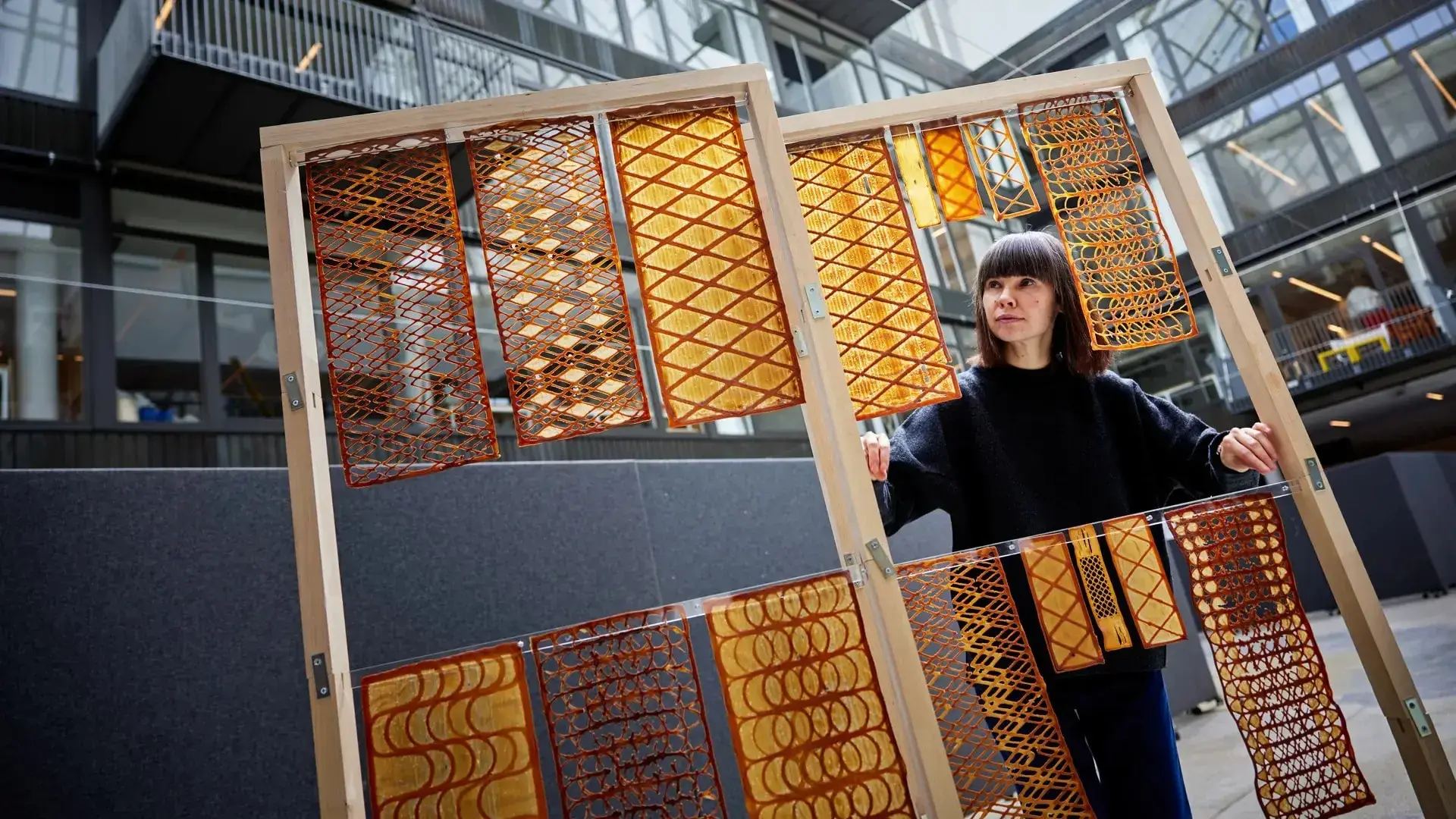
The oddest part of this yeast-based material comes before the printer moves at all: the researchers deliberately deactivate the baker’s yeast that gives the project its name.
At Chalmers University of Technology, Malgorzata Zboinska’s team heats the yeast first, then mixes it with microfibrillated cellulose, alginate, glycerol and water before pressure-printing the paste at room temperature.1 Nothing is expected to ferment inside the finished panel, and nothing needs to stay alive after printing.
I think that makes the project more interesting, not less, because the yeast is treated as ordinary material rather than as a biological special effect.
Dead on purpose
When biomaterials are shown in exhibitions, “living” can become the whole story, yet a building component has a much duller list of obligations: it has to be printable, dimensionally predictable, stable enough to handle, and boring enough to behave again tomorrow.
The Chalmers paper reports an optimised recipe containing 3% yeast solution, 13% microfibrillated-cellulose solution, 1% sodium alginate, 5% glycerol and water.2 Those ingredients share the work between them, with cellulose supplying structure, alginate helping dimensional stability, glycerol softening the dried material and yeast contributing viscosity and cohesion.1
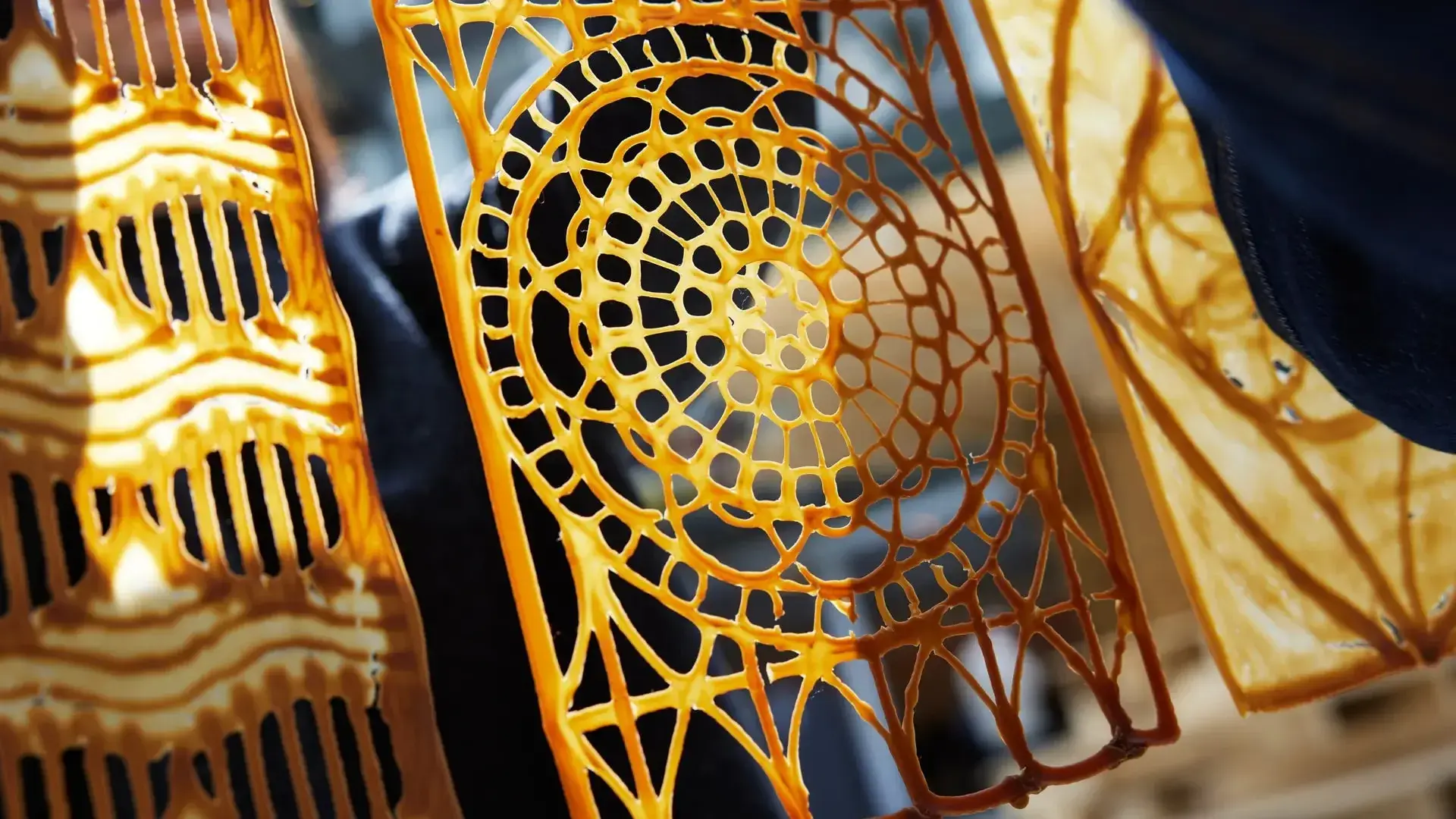
The mixture behaves as a viscoelastic solid, with the storage modulus remaining above the loss modulus in the reported tests, so a deposited line can hold its shape instead of immediately slumping into a puddle.2 It sounds mundane, which is exactly why it matters: this is the sort of property that decides whether a new material ever escapes a sample jar.
The recipe
Printing uses pneumatic extrusion rather than a hot thermoplastic process, and the pieces are left to dry at room temperature without additional support structures.1 The researchers are therefore designing the material and the manufacturing method together, which matters because a renewable paste that clogs the nozzle or shrinks unpredictably is still a bad feedstock.
To see whether the recipe survives that transition, the team measured rheology, tensile behaviour, elongation, shrinkage, deformation, light transmission, colour and porosity.2 The best average tensile strength they report is 2.7 MPa, while elongation at break reaches 25.2% in the strongest formulation.2
Those numbers describe a lightweight sheet material, not a yeast-flavoured replacement for concrete, and the researchers themselves focus on interior applications such as screens, partitions and wall panels.1
Twenty by fifty
The largest tile prototypes described in the paper measure 20 × 50 centimetres, which is big enough for shrinkage, pattern and light to become architectural problems rather than microscope problems.2 It is still, thankfully, a long way from a licence to announce that complete buildings will soon be piped out like cake frosting.
Across the reported samples, linear edge shrinkage sits between 2 and 10%, while light transmission ranges from roughly 5.6 to 31.6%; the team also printed solid, perforated and hybrid structures.2
This is where the project starts to look like architecture rather than material science with a decorative pattern on top, because porosity, texture, light and geometry can all be changed through the deposition path itself. A related “digital crafting” study tests path geometry, spacing, symmetry, connection angles, intersections, blend combinations, deposition methods and layer sequences as design variables.3
In other words, the nozzle path is not merely transporting a finished material into a prettier shape; part of the final behaviour is being negotiated while the object is printed.
Not a wall yet
The language around experimental building materials can become heroic very quickly, so the scale of the next project is useful context. Chalmers lists daylight screens, partitions and wall panels among the current targets, while the MycoCellular programme running from 2025 to 2029 aims to build modular interior panels and install a demonstrator at the HSB Living Lab in Gothenburg.14
That same programme describes the starting technology-readiness level as roughly TRL 1–3 and wants to push it beyond 4.4 To be sure, this is still research territory: there are measured recipes and convincing prototypes, but no normalised building product waiting in a warehouse.
Before that happens, somebody still has to answer the unphotogenic questions about ageing, humidity, fire, repeatability at larger scale, joining, disassembly and the environmental cost of the complete system. MycoCellular explicitly includes life-cycle assessment and comparison with conventional gypsum and plywood panels, which is exactly the comparison that matters once the novelty of “made with yeast” wears off.4
The right waste
Baker’s yeast has one practical advantage over many exotic biomaterial ingredients: it is cheap, familiar and already produced at industrial scale. The follow-on project also plans to incorporate recycled cellulose from forestry, agricultural and textile residues, broadening the feedstock beyond a laboratory-grade recipe.4
But the word “waste” does very little engineering by itself. A useful secondary feedstock still has to be collected, sorted or cleaned, prepared to a predictable quality, processed without absurd energy overhead and, eventually, separated or recovered when the building component reaches the end of its use.
The current work at least tackles another part of that equation by using additive manufacturing to place material only where the geometry asks for it, rather than cutting a pattern out of a larger sheet and throwing the rest away.1 Whether that advantage survives scale-up will depend on machine time, drying, formulation and the rest of the production chain, not on the absence of offcuts alone.
The opposite of living
What stays with me is the first step: heat the yeast, deactivate it, and only then ask it to become useful architecture.
There is an easy story in which biofabrication becomes more advanced as materials become more alive, more autonomous and more visibly biological. This project offers a quieter alternative, where the useful move is to stop the organism and keep the material properties that help a printable composite behave.
The yeast does not need to breathe inside a room divider; it needs to help the mixture leave a nozzle, dry, retain a geometry and create a surface whose porosity and light can be adjusted.
That is a much less spectacular promise than a wall that grows by itself, but it may be considerably closer to something an architect can eventually specify and somebody else can actually install.