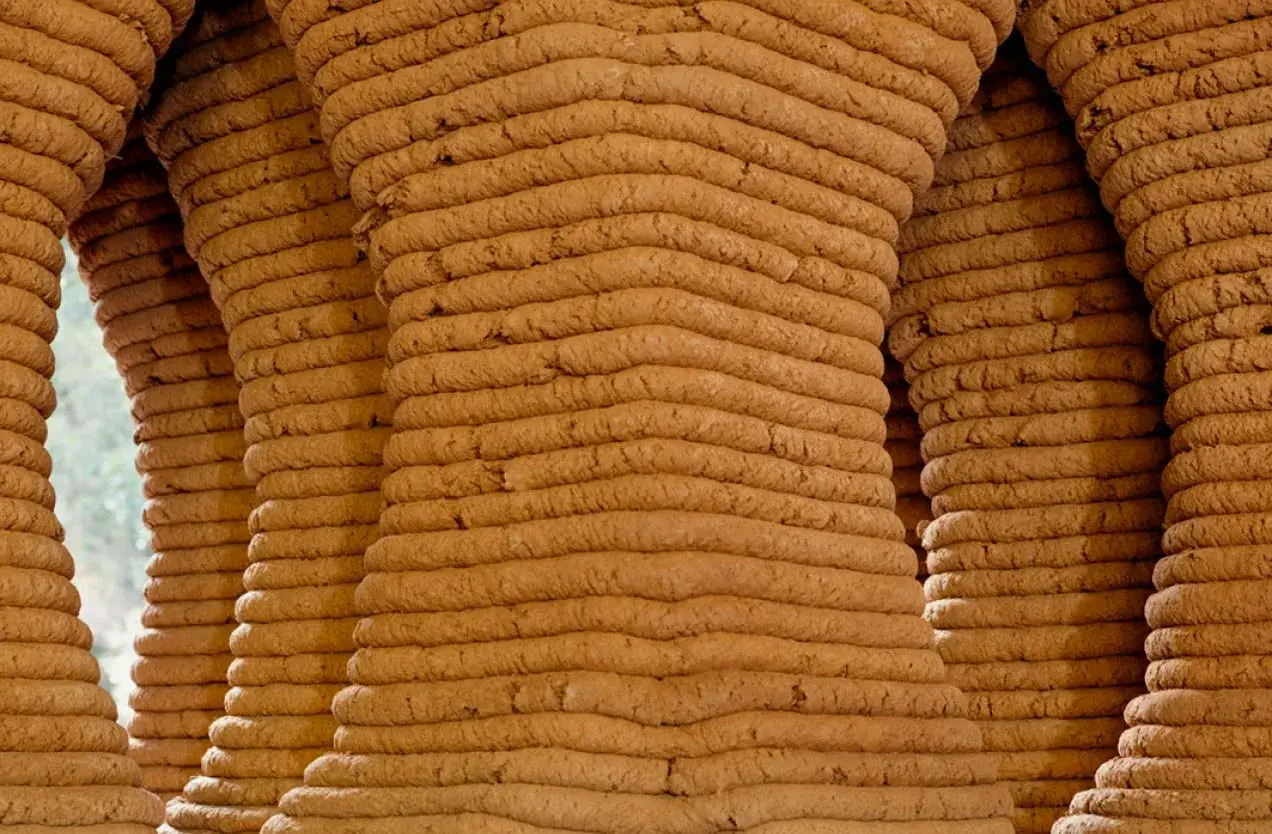
A construction-scale 3D printer can follow its programmed path at exactly the speed the machine allows. The earth leaving its nozzle has made no such promise.
That distinction gets lost when printed buildings are described like oversized desktop prints: file in, extrusion out, object finished. In August 2026 ArchDaily asked whether earth printing was producing a new kind of artisan, connecting TECLA with newer projects in Japan, Mexico and research campuses where toolpaths are becoming texture, structure and ornament at once.1 It is an appealing idea. The craft that once sat in a hand now seems to sit in the nozzle path.
There is some truth in it, just not enough.
The robot automates deposition. Around that automated step, somebody still has to decide whether soil dug a few metres away contains the right particles, how much water lets a mix travel through a pump without collapsing after extrusion, how many fresh layers today's wall can carry, where moist air should leave a cavity, how a window meets a material that is still shrinking, and when a roof can be attached without asking wet earth to perform a small miracle.
3D printing does not remove the craft from earth construction. It moves the workbench.
The shortcut
TECLA remains the perfect image of the shortcut. Mario Cucinella Architects and WASP developed the raw-earth prototype around two dome-like volumes, with geometry, infill and environmental performance treated as parts of the same printed envelope.2 MCA says the printing technology developed for the system can produce a dwelling unit in 72 hours.2
It is a memorable number, which is precisely why it needs a label.
Seventy-two hours of robotic fabrication is not necessarily seventy-two hours from a pile of local soil to an occupied house. Soil analysis, mixing, testing, interruptions, curing, complete drying, windows, services and approvals belong to a different clock. The machine has a fabrication time; the material has a process time.
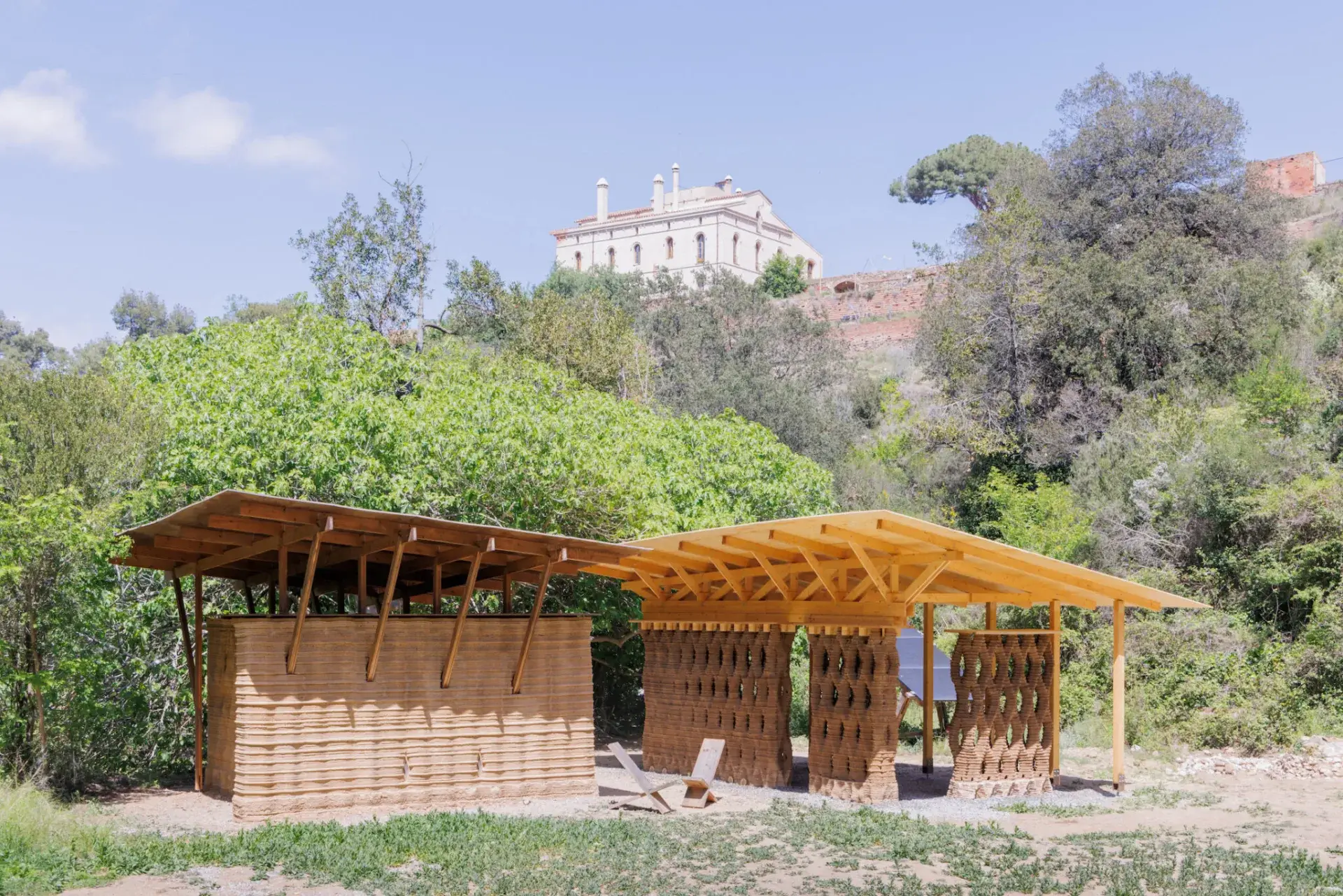
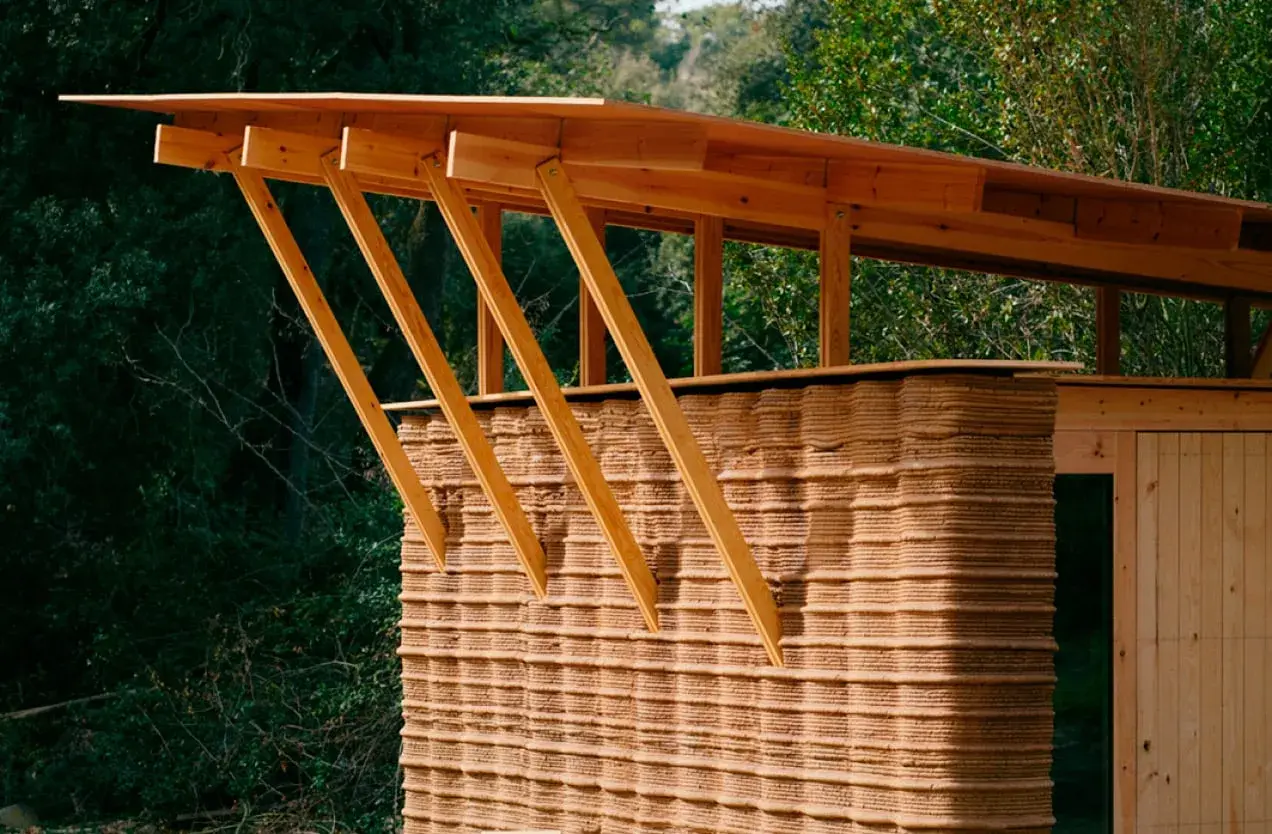
IAAC's Forest Campus outside Barcelona makes that second clock hard to ignore. TOVA, the programme's first printed-earth prototype, took seven weeks to construct according to IAAC.3 A later description of the campus gives a wall-building rate of roughly 25 centimetres in height per day, deliberately limiting the fresh stack so lower layers do not collapse under their own weight.4
The nozzle could move faster. The wall could not safely become taller at the same rate.
Making mud
Calling the feedstock “earth” makes it sound wonderfully simple. Nobody delivers this material as a standardized cartridge whose behaviour has already been guaranteed by a supplier.
For the Forest Campus, soil is sourced only a few metres from the building, excavated below roughly half a metre to avoid organic content, dried in the sun, sieved to remove larger stones, mixed with water, organic fibre and a natural enzyme, then pushed into the printer.4 Fabrication therefore starts well before the robot draws its first line.
The ecological attraction of the system creates one of its industrial headaches. If the point is to use local soil, the raw material changes with the site. A group of researchers can move the same digital workflow elsewhere and still face a new material problem when they arrive.
A 2026 review of soil-based printing puts the problem in material terms: rheology depends on moisture, particle distribution and stabilizing additives, while the useful balance among clay, sand, water and additives is highly dependent on the soil itself.9 A digital file may cross the world without changing; the mix cannot be assumed to do the same.
This is where calibration becomes craft. Material must flow well enough to pump and extrude, then regain enough stability to support the next layer. Make it too dry and it tears or jams. Make it too wet and the printer can produce a beautiful bead seconds before gravity submits its own, less flattering design proposal.
Stand in front of the printer and the machine gets all the attention; the repeated material tests beside it are where much of the transferable knowledge accumulates.
Twenty centimetres
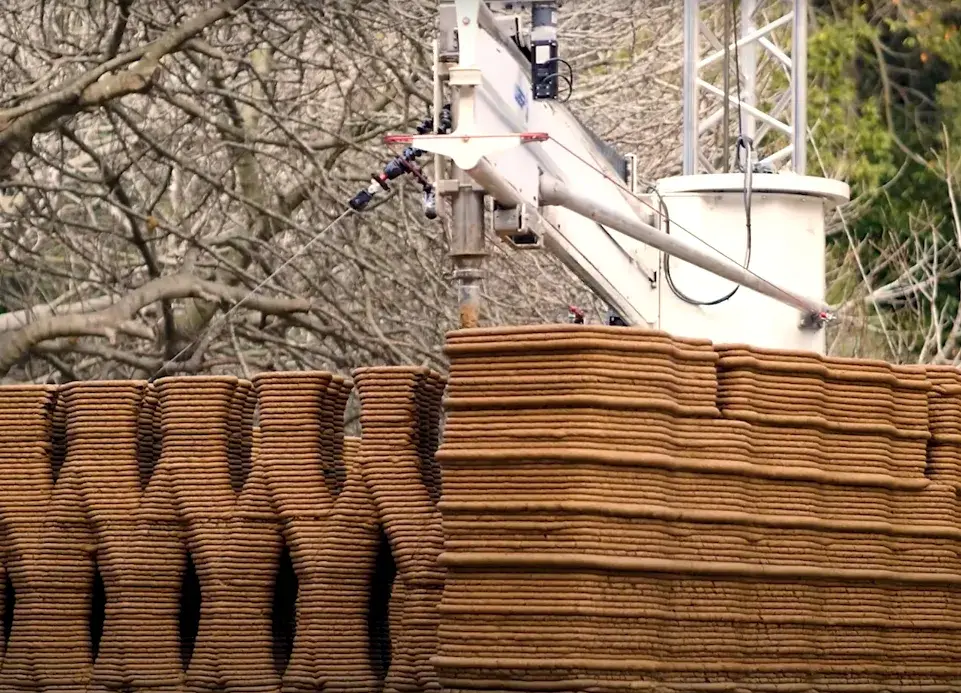
For current printed-earth research, the revealing speed figure is 20 centimetres per day, not the nozzle velocity.
In its 2025-26 research programme, after nine editions and several full-scale prototypes, IAAC says its team has been printing with a maximum daily wall height around 20 cm and calls this an important limitation for construction standards.6 The first research topic for the year is wet-state wall stability: how can a wall be supported during printing so that more material can be stacked before waiting?
The 2024 Forest Campus description used a 25 cm daily rate, enough to reach 2.5 metres in roughly ten deposition days.4 Treating 20 and 25 cm as a measured regression would be silly because geometry, mixtures and conditions differ. Taken together, however, they reveal the useful order of magnitude. Raw earth still needs time to develop enough strength to carry itself.
The waiting does not end at the last layer. IAAC's current syllabus notes that drying in some TOVA cavities took as long as four months, while later work showed a large difference between cavities with and without natural ventilation paths.6
This is not only a campus anecdote. A 2024 paper in Additive Manufacturing studied the structural build-up of printed earth specifically through drying and found that water-content evolution is affected by wall thickness.8 Geometry changes the drying problem, which in turn changes when geometry can safely receive more load.
Drying is therefore not the boring phase after fabrication. It is part of fabrication itself.
Teaching code
If earth remains this stubborn, what has the digital part actually added? More than speed.
TECLA provides one answer. Its infill was not conceived simply as one repeated internal pattern. MCA describes a system in which geometry can respond to ventilation, insulation, thermal mass, humidity and shading.2 Different performance requirements can therefore produce different material distribution in the wall.
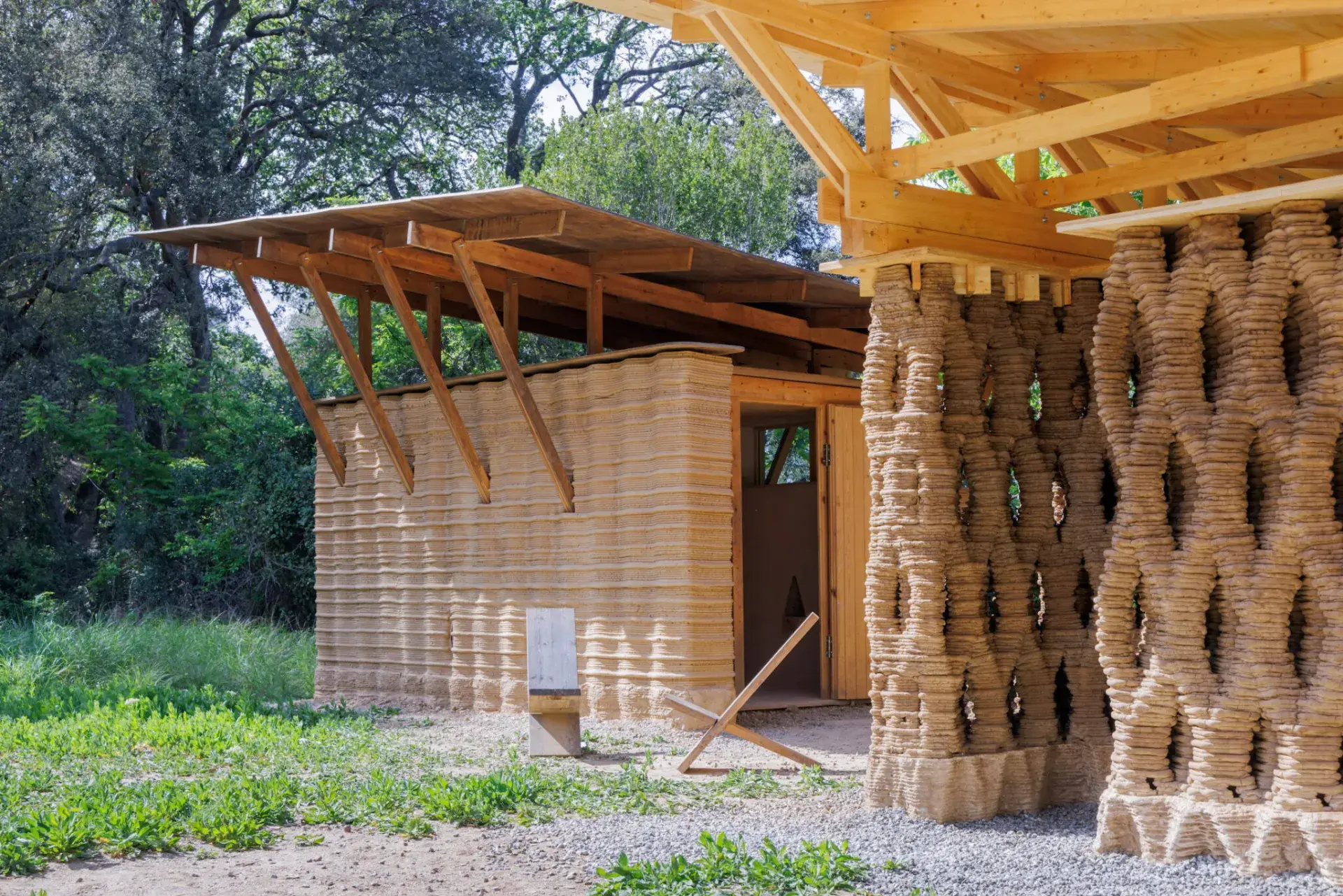
At the Forest Campus that logic becomes even more physical. Wall thickness varies from about 40 to 70 cm according to load and orientation; some walls use cavities that leave them roughly 50% hollow, making room for insulation, services or natural ventilation.4
Changing material distribution to match a wall’s job matters more than printing arbitrary curves simply because curves photograph well. The toolpath distributes material according to the work the wall has to do.
The code still cannot discover its own physical limits. Someone must print tests, watch deformation, see where a layer cracks, measure how much fresh earth can cantilever and convert those observations into geometric rules. A digital detail becomes reliable only after material behaviour has been translated into parameters.
Craft reappears in an unfamiliar form. Part of it remains in the eye and hand of the person preparing the mix; another part becomes speed limits, minimum widths, extrusion rates, layer heights and allowed trajectories inside a computational model.
A digital craftsperson is not somebody who replaces material knowledge with code. It is somebody who teaches the code what not to ask of the material.
Porous walls
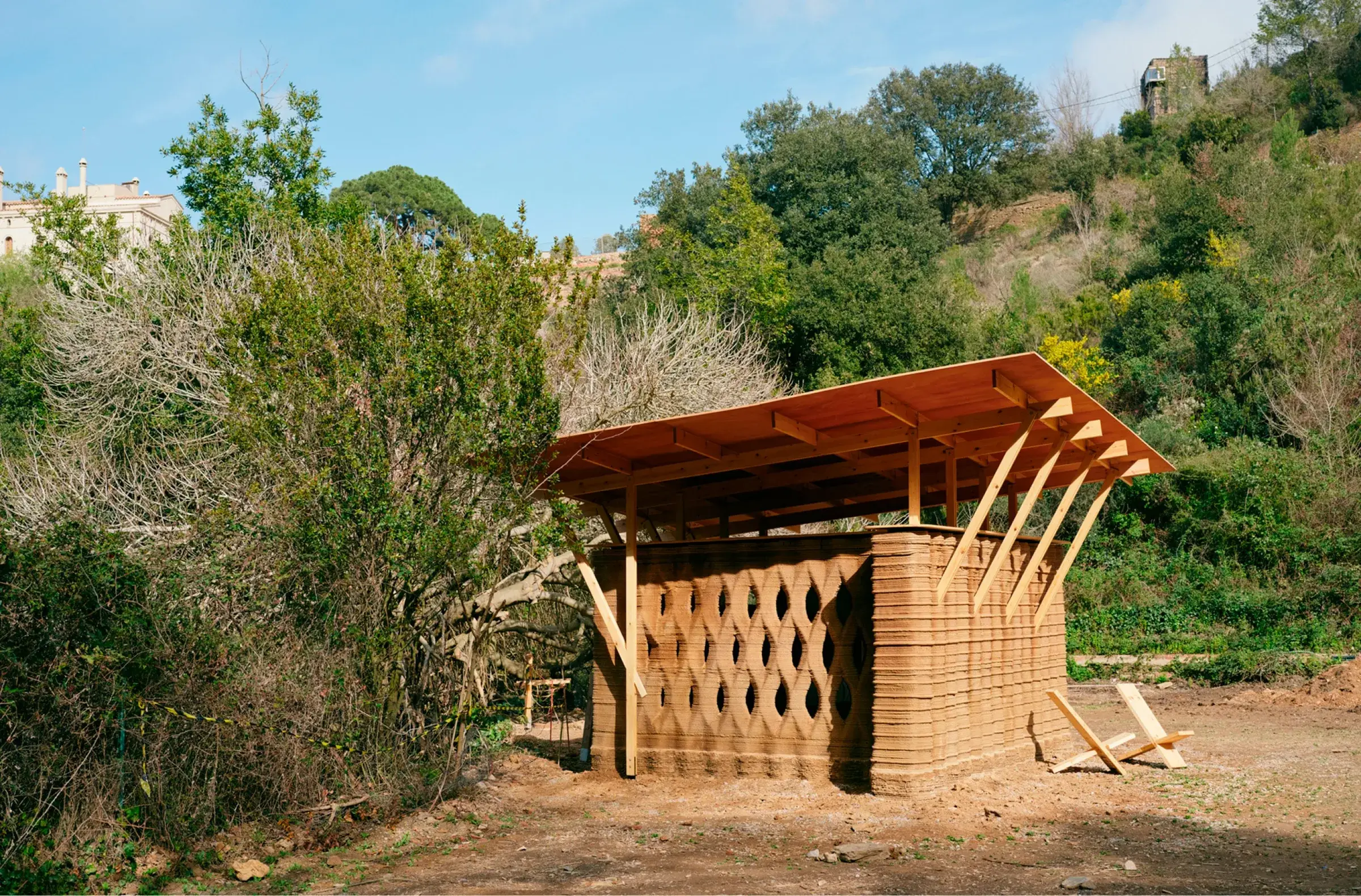
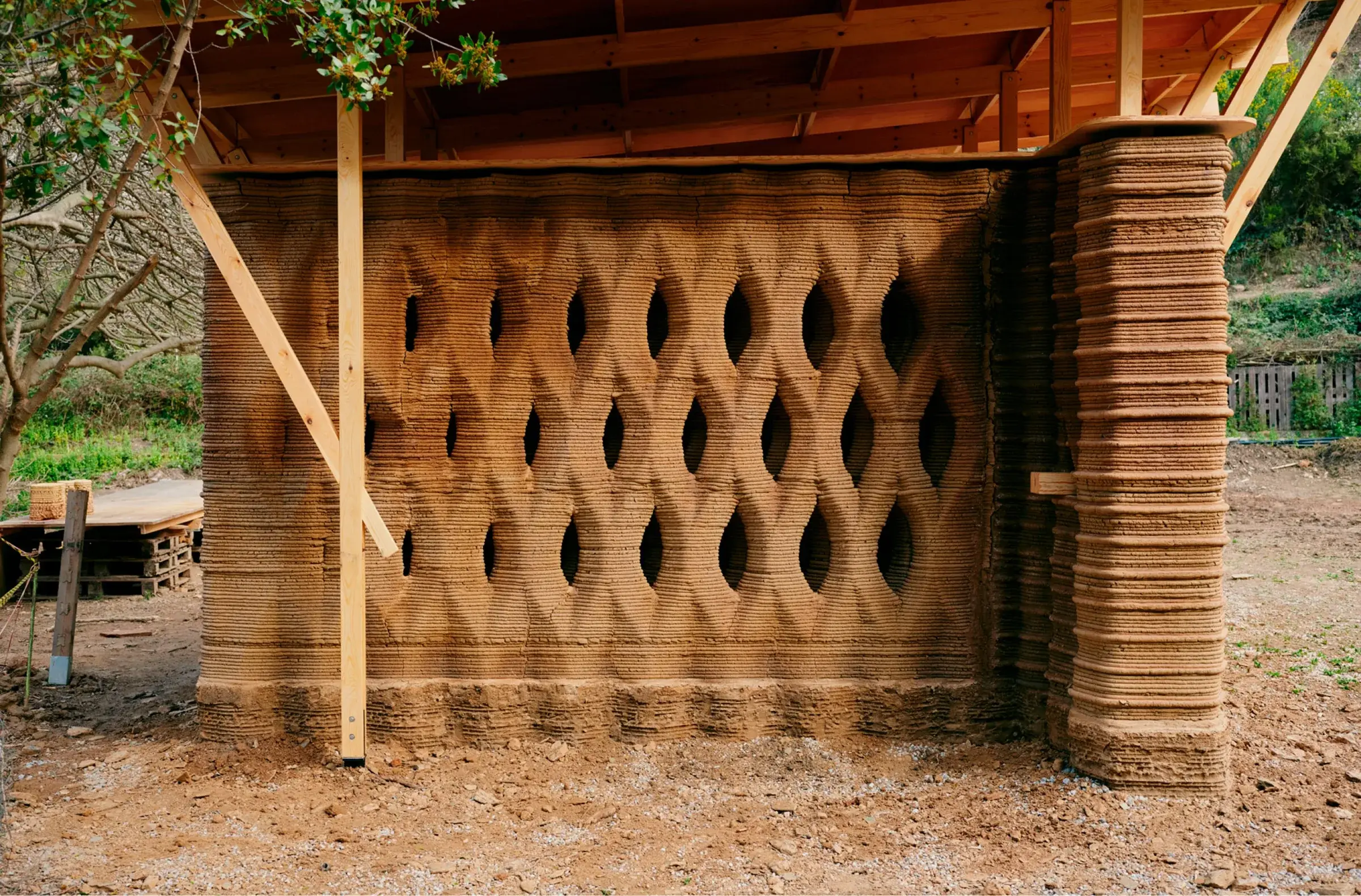
TEIXIT, one of the Forest Campus extensions, makes the idea almost literal. The team asked how much daylight could pass through a structural earth wall without simply inserting a conventional large window.5
The starting problem is ordinary material behaviour. Earth's comparatively low mechanical strength traditionally encourages thick, opaque walls, while large openings usually introduce a lintel, frame or another construction system. Robotic deposition offers a different possibility: varying the wall geometry itself to create controlled porosity.5
IAAC is careful about what makes that possible. The perforation is not merely a generative pattern poured into a slicer. IAAC says the geometry has to be developed alongside knowledge of the robot, the earth and the structural behaviour.5
TEIXIT consists of three printed walls supporting and anchoring a large timber roof. IAAC reports roughly 12 linear metres and six tonnes of earth printed over a four-week period. After the walls had dried sufficiently, post-tensioning cables were inserted through internal cavities to tie the roof back to the foundations and resist wind uplift.5
That construction sequence contains the whole argument. Robotic fabrication makes a porous structural wall feasible without repeating standardized blocks, yet the next operation still begins when somebody judges that the earth is dry enough to receive it.
Digital sophistication has not removed sequencing from construction. It has made the sequence more tightly coupled to the material.
Useful texture
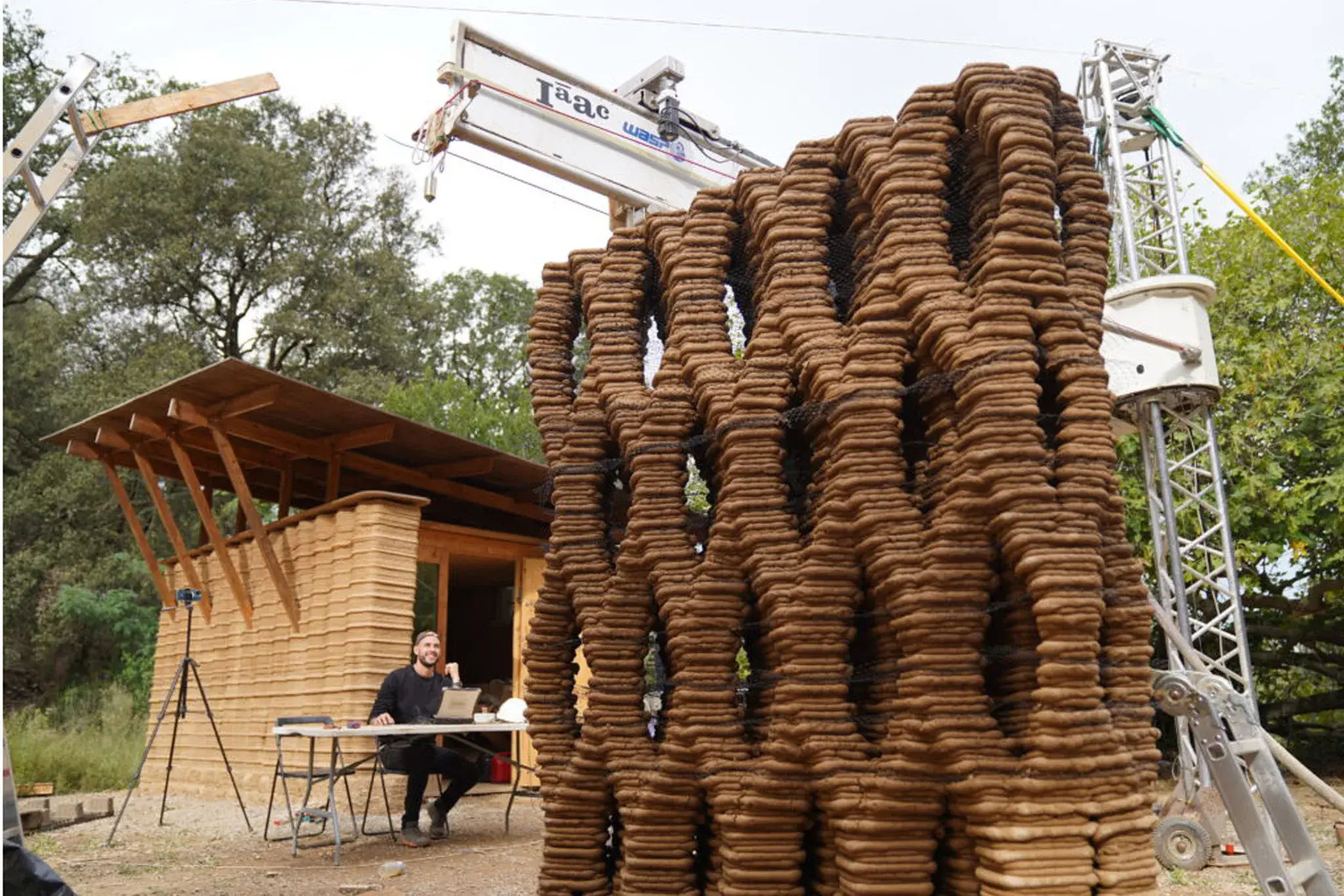
Most photographs of earth printing proudly keep the horizontal layers visible. The ridges have become such a recognizable visual signature that one could reasonably suspect raw earth was invented to give architecture magazines better close-ups.
IAAC's current programme is trying to make those textures earn their keep. One 2025-26 research stream examines “performative wall textures”, asking whether printed surface geometry can contribute to structural behaviour, finishes or resistance to water erosion.6 The proposed work includes printing patterns, compression testing and coating tests.
This is where the claim of a new craft becomes convincing. In conventional work, a relief may be the mark of a tool, an applied ornament or a detail shaped by a mason. With robotic extrusion, a change in toolpath can alter shadow, material quantity, local stiffness, coating behaviour and water runoff in the same operation.
Surface design stops being automatically downstream from construction. It can become construction data.
A pattern still has to survive reality. The mix must leave the nozzle cleanly, a fresh course must not tear the one below, overhangs must remain inside wet-earth limits and shrinkage must not destroy the geometry while water leaves the wall. “Printable” is not synonymous with “the software generated it without an error message”.
The decorative detail has acquired a materials-science department. We built giant robots and, with magnificent efficiency, rediscovered that mud has opinions.
The hard hole
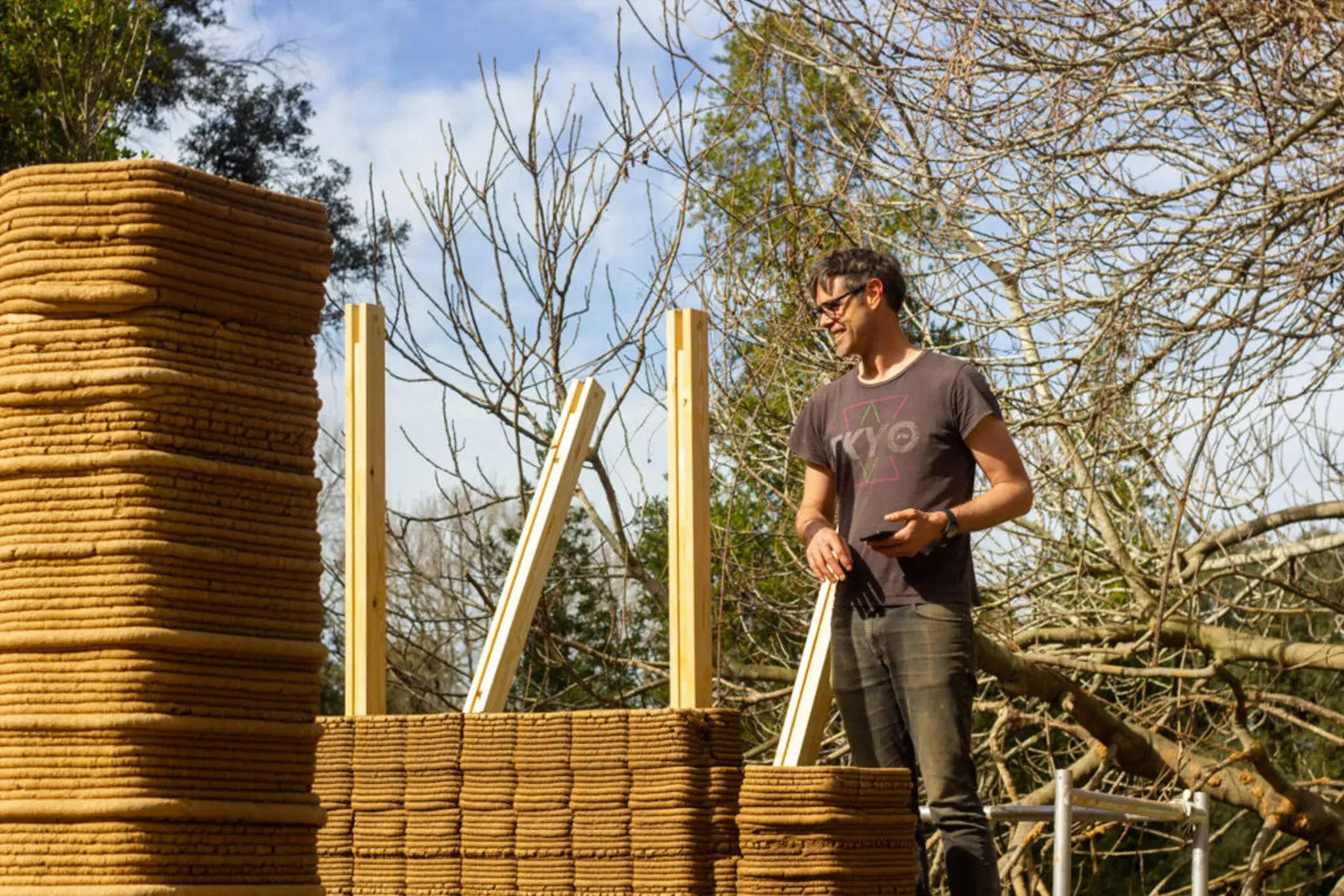
Printing an elegant curved wall is one challenge. Putting a standardized window, door and partition into it, then repeating that detail reliably on real projects, is another.
IAAC still lists earth-to-glass and earth-to-timber interfaces as active research topics for 2025-26.6 Its fragmented wall strategy leaves gaps between printed sections that have to become openings or connections. The research questions are magnificently unglamorous: assembly sequence, thermal bridges, tolerances, drying and printed patterns that can physically lock a window detail.6
Renders in which a printer appears to produce a complete house after somebody presses Play leave most of the difficult work outside the frame.
Buildings are mostly interfaces between systems that move and age differently. Earth shrinks and responds to moisture. Timber moves by another set of rules. Glass has less patience for misalignment. Joints need tolerances, services need paths, and somebody repairing the building years later should be able to understand what has been assembled.
Craft therefore concentrates at the interface rather than disappearing under repeatability. A mature digital file is not merely one that produces a dramatic form in a research yard; it anticipates boring things buildings need to do, such as keeping a window operational, holding a roof against uplift and leaving a repairable route when water eventually goes somewhere nobody invited it.
Technologies usually become construction systems at exactly this point. Conveniently, it is also the point where most promotional renders lose interest.
Carbon tradeoffs
Printed earth is commonly presented as low-carbon construction, and the basic reasoning is strong: use nearby, unfired, potentially reusable material, reduce transport, and avoid some of the energy attached to cement or fired masonry.
“Printed with earth” is not, however, an automatic environmental certification.
A 2024 study of local earthen additive manufacturing found that low-carbon outcomes are possible so long as cement binders are not added, and its life-cycle assessment showed important differences between raw and stabilized earth systems.10 The stabilizer that makes a material easier to standardize can also be the thing that weakens the original climate case.
The 2026 soil-printing review adds another tradeoff. Mix design can improve extrusion, shrinkage and early strength, but successful formulations remain soil-dependent, while durability under long-term environmental exposure is still identified as a major barrier.9
This tension is familiar whenever natural materials are industrialized. Greater consistency, faster stacking and easier certification encourage additives; those additives may reduce recyclability, raise embodied emissions or change hygrothermal behaviour. IAAC's 2025-26 Matter Research class is built around precisely those measurable compromises: green strength, shrinkage, compressive strength and water resistance, alongside attempts to establish repeatable testing methods.7
The engineering task is therefore not to discover the best mix in the abstract. It is to decide which compromise is justified for a particular climate, building, lifespan and end-of-life strategy.
The new artisan
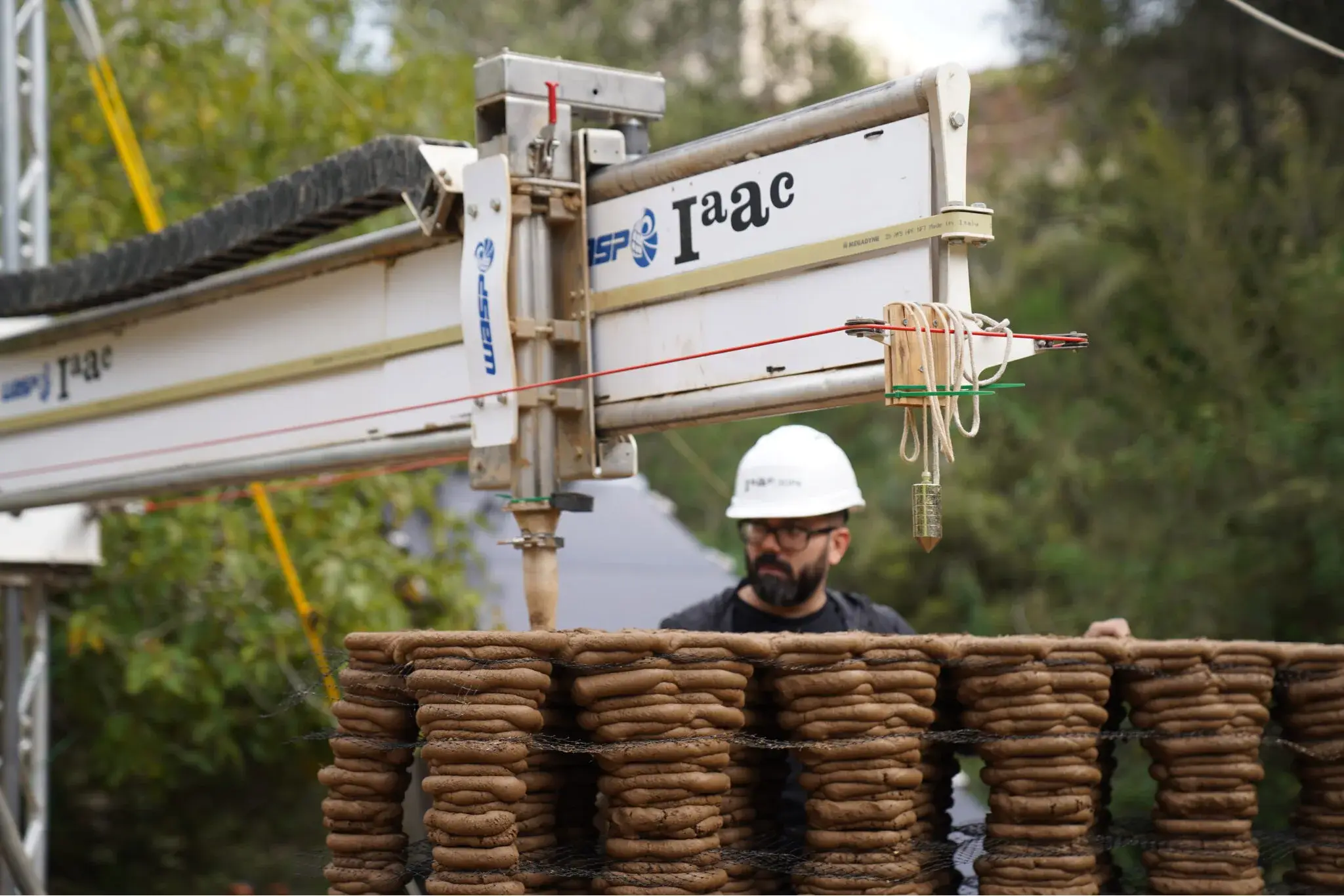
So who is the artisan on this site? Not the robot. A robot has no material judgement, no memory of a bad batch and no preference for a durable solution over one that merely completes the requested path. It executes parameters with the sort of obedience humans have been trying unsuccessfully to obtain from projects for several thousand years.
The interesting role is distributed across people who characterize soil, develop mixtures, program paths, watch deposition, revise geometry after tests, design connections and recognize when a wall is becoming too ambitious for its present water content.
IAAC's 3DPA programme is revealing precisely because material research, robotic fabrication and performance design are taught as one field rather than placing “the file” on one side and construction on the other.11 TEIXIT's porosity works because its digital geometry grows alongside knowledge of earth behaviour.5
That is remarkably close to craft in older trades: a sequence of decisions that are not all explicit at first, some of which eventually become tools, templates, recipes, tolerances and habits.
The unusual part is that a portion of those habits can now become code.
A wall pattern, nozzle speed or minimum thickness may quietly contain the memory of dozens of failed tests. The program becomes less an opposite of gesture than a partial archive of gesture. It records what a group has learned and then reproduces those decisions with precision no unaided hand could match.
What remains
It would be tempting to end with a polished line about an ancient material meeting the future. The projects themselves sometimes use that vocabulary, because raw earth, like everything else, eventually has to survive a communications department.
The actual situation is better.
To be sure, large-scale earth printing in 2026 is already making architectural objects rather than table samples. TOVA exists; the Forest Campus has developed through successive cohorts; TEIXIT uses printed walls to carry a roof while investigating daylight through structural porosity.35 The feasibility question has already moved.
Yet IAAC's active research list contains four profoundly ordinary problems: stack higher before wet walls become unstable, dry internal cavities properly, connect windows and doors, and turn wall textures into measurable performance.6 Its material course also notes that the lack of unified codes for printed earth makes commercialization difficult and often leaves teams demonstrating compliance case by case.7
That is exactly what a technology becoming a trade should look like.
The first demonstration proves that a machine can do something. Over the last several years, the harder work has been learning how to do it again on another site, with different soil, another climate and a standardized window, without erasing the environmental advantage every time a material problem appears by adding more cement.
The question is no longer whether digital tools can create a new artisan. They are already changing what the artisan needs to know.
Read soil, and read a file. Understand drying, and understand a toolpath. Notice why one course is sagging, then know which parameter should change because of that observation. Finally, accept the delightful insult at the centre of the technology: an extremely fast machine may be used most intelligently by letting it go slowly.
The nozzle draws the shape. The earth sets the pace.