An industrial robot arm is the ideal tool for repeating one precise gesture a thousand times. Feeding a badminton shuttlecock is the opposite job: grab an object that weighs a few grams, whose centre of gravity drifts as it wears, and slip it between two wheels spinning fast. Travis Mitchell spent about six months turning a used Denso VS-050 into a shuttlecock feeder for his family. The part of the story that stays useful isn't the robot. It's the little wheels.21
The arm behaves
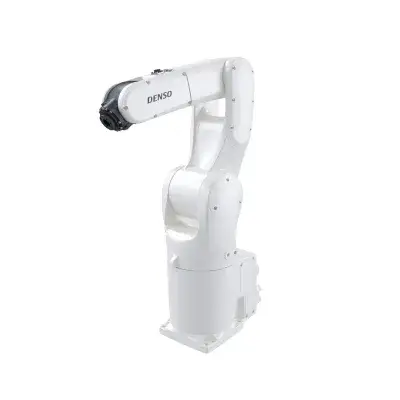
The Denso VS-050 is a six-axis arm with a 505 mm reach, a 4 kg payload and ±0.02 mm repeatability.3 Put differently, it repeats a path far better than any human, and has no idea what a shuttlecock is.
Mitchell took advantage of a 3D model Denso publishes for its arm, importing that real geometry into Fusion and designing the wrist hardware around it.1[2](#ref-2] On paper the plan looks modest: two 400 W AC motors spin the launch wheels, while two pneumatic cylinders grab the shuttlecock and push it between the discs.[2](#ref-2] The whole rig hangs on an aluminium frame bolted to the wrist, with stainless steel gripper fingers made on his own SLM metal printer.[2](#ref-2]
The robot kept its end of the deal. Everything else fought back.
The magazine does the math
For the arm to serve anything, you first have to feed it. Mitchell built a motorised carousel of six tubes, each holding around twenty shuttlecocks, for roughly 120 attempts before reloading.[2](#ref-2] A time-of-flight sensor checks whether a shuttle actually sits in the current tube: empty, spin; full, wait for the arm.[2](#ref-2]
Talking to the Denso controller becomes a small war of attrition. USB, RS-232 and Ethernet all turn into dead ends, so the fallback is Bluetooth plus a bank of I/O pins.[2](#ref-2] That is where the controller choice gets decided. A Raspberry Pi Pico does not offer enough inputs and outputs, and Mitchell switches to an AVR board, an Arduino Mega, that can drive what he needs.1[2](#ref-2]
The wheels fail
The robot can move. Sending the shuttle off cleanly is the hard part. Two discs spinning very fast must grip the nylon skirt, hold it firmly enough to clear the net, and not balloon out under centrifugal force.2
Finding the right material turns into a list of failures straight out of a workshop diary. EVA foam cut on a CO₂ laser only marks the shuttles. Gum rubber stretches until it is useless. Printed hubs coated with Flex Seal refuse to hold. Full silicone sheets deform too much at speed.2
The answer is almost a compromise born of exhaustion: a printed plastic hub with a single silicone strip as the contact surface.[2](#ref-2] Nobody found a magic material. What worked was cutting the amount of soft material down until the stretch stayed controllable.
Shop seasoning
One detail throws the whole project into relief. The pneumatic pusher sometimes stopped a beat too early, without fully cocking the shuttle, and the shot drifted. Mitchell revised the part and reprinted it.[2](#ref-2] Everything else, he reports, settled once that short stroke was corrected.
The whole thing sits on a motorised, height-adjustable desk: lowered to load the tubes, raised to clear the net by a wide margin.1[2](#ref-2] It rolls on a cart, and the tests start in the workshop before moving to the court.2
The lesson is not that you need patience. It is that a ±0.02 mm arm hits a wall on a few-gram object whose only reliable behaviour is to deform. That collision explains the project better than the assembly itself.