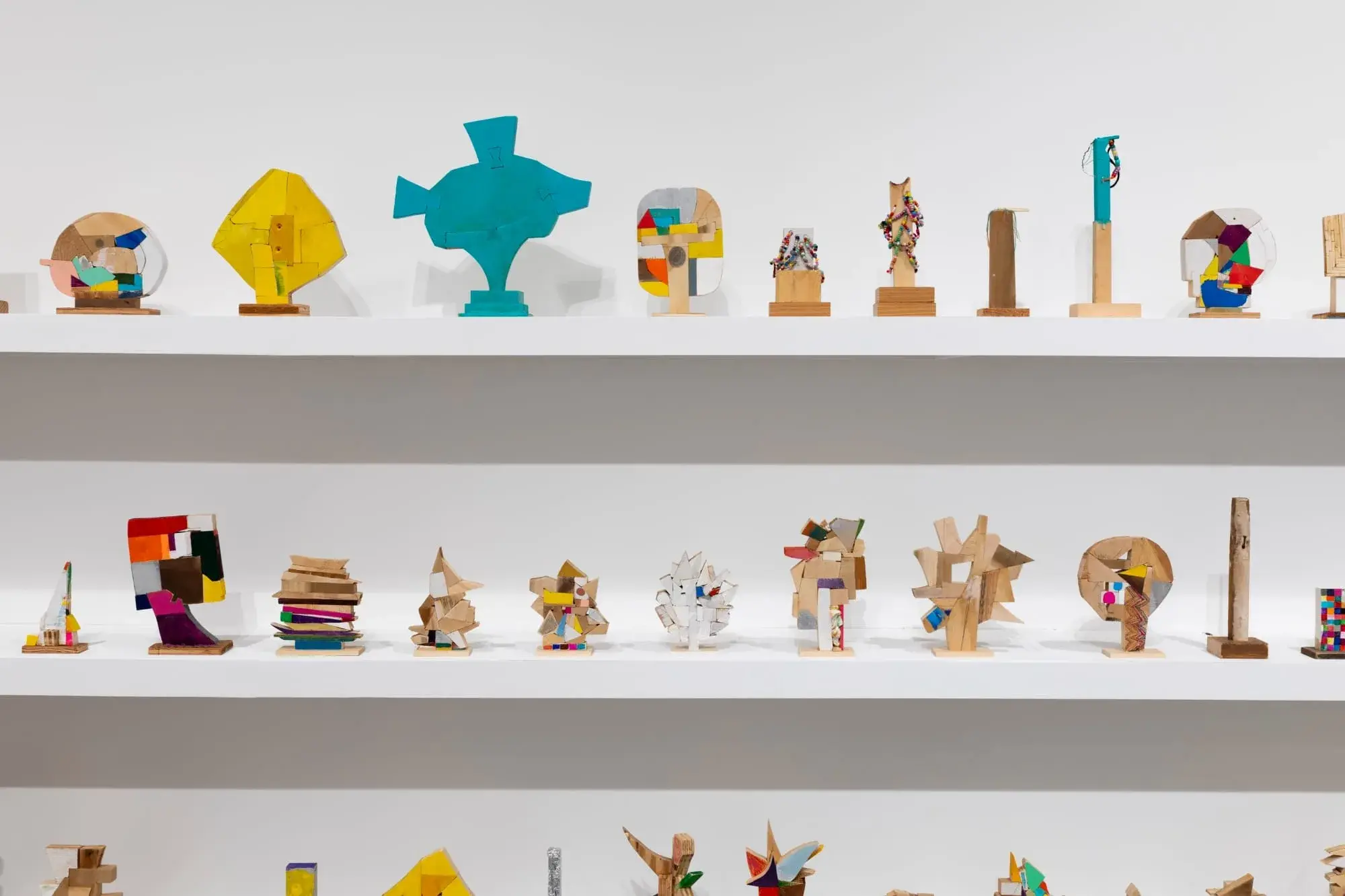
The rule was easy to remember: make one small sculpture every day throughout 2024. It is the kind of project that practically begs to be turned into a perfect streak, with one box checked every night and a clean number waiting at the end.
Except 2024 was a leap year, so literal completion required 366 sculptures. Colossal's August account, which quotes Damien Hoar de Galvan directly, says he finished 362 after a trip to Barcelona interrupted the routine for several days.1
I ran the simple arithmetic: 362 works across 366 days equals 98.9% of the calendar. Four days are missing, and that small failure makes the project more useful to me than another story about flawless discipline.
366 days
Other sources compress the number. ICA Boston describes a sculpture-a-day series completed over the 2024 calendar year,2 while GBH said in January 2026 that 365 works were on view after a year of daily making.3 Colossal later gives 362 and explains the Barcelona break.1
I could not find a public day-by-day digital catalogue that would let us recount the whole series independently. For the calculation here, I therefore use 362 because it is the newest specific total accompanied by an explanation and tied to the artist's own account. GBH's 365 remains visible as a source discrepancy rather than being quietly edited away.
The missing four do not make the project collapse. They change the meaning of the rule: the calendar acted less like a pass/fail test and more like sustained pressure on the way Hoar de Galvan made decisions.
Before the rule
Reclaimed wood was not invented for the 2024 challenge. In a 2016 interview, Hoar de Galvan already described working mainly with found or recycled wood and trying not to buy material beyond things such as paint, glue and screws.4
At that point, a renovation of his house had supplied both demolition material and scraps from the rebuilding. ICA Boston traces the inventory further back: some wood comes from his work as a preparator at deCordova Sculpture Park and Museum, while other pieces came from carpentry projects his father began in the 1970s after immigrating from Argentina.2
So “scrap” is not a neutral bucket. A small piece can arrive with dimensions already decided, an old painted face, holes, a cut edge, or a family and work history that predates the sculpture.
The daily project mainly changed how quickly he had to answer whatever was already on hand.
Little sketching
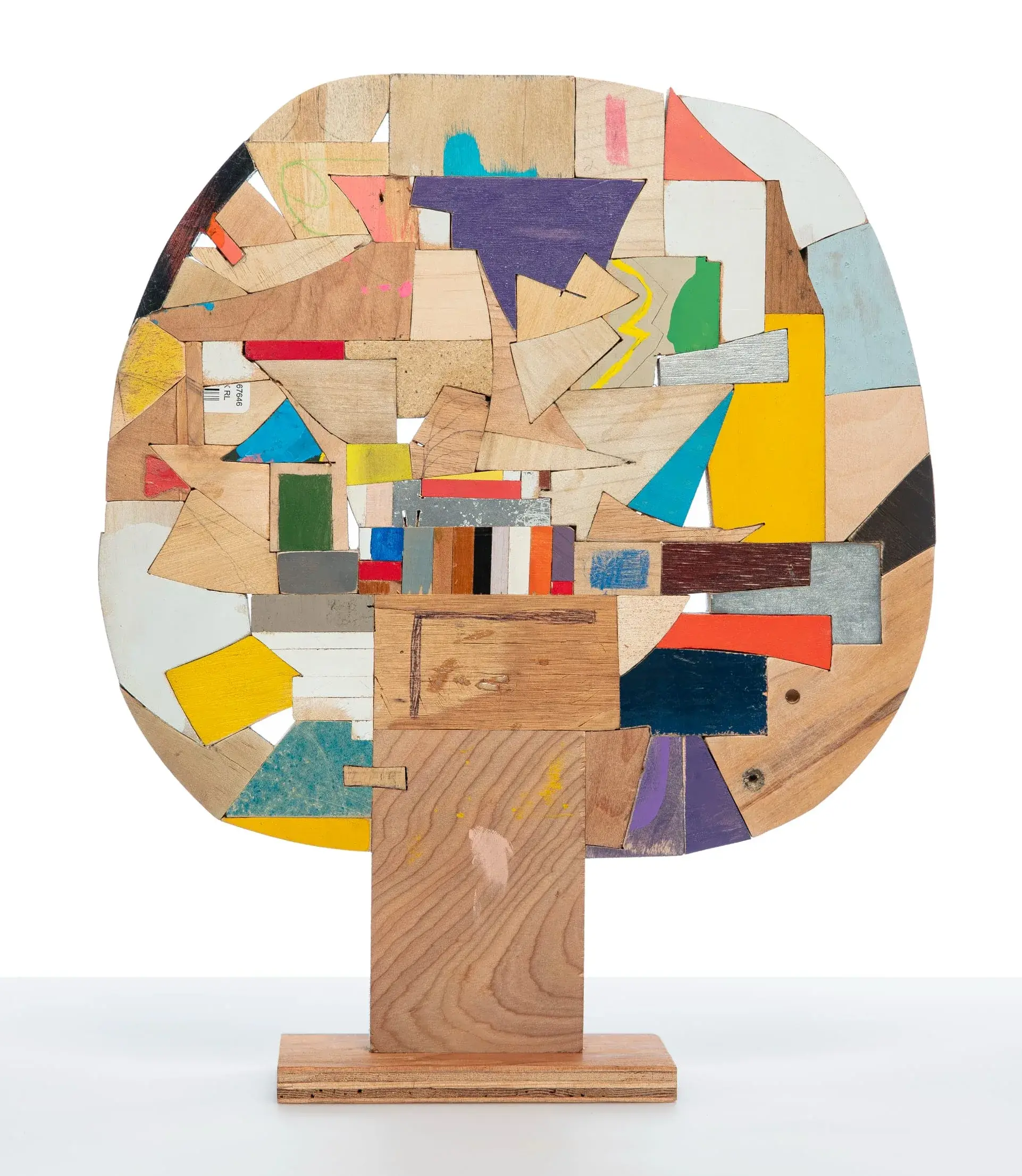
Colossal describes Hoar de Galvan as rarely sketching a composition before gluing and painting the reclaimed pieces. He may begin with a shape or colour that catches his attention and let the assembly push the next decision.1
That intuitive process predates the daily series. In 2016 he described moving small pieces of wood around until they began to work together, with formal choices often arriving before a fixed message.4
A daily finish changes what happens when a new idea appears, though. In a long project, a late thought can trigger a substantial rebuild; under a one-day rule, there may simply be no time left to make the current object absorb it.
That is where the series starts producing something more interesting than speed.
Ideas wait
Hoar de Galvan told Colossal that ideas sometimes appeared while he was making that day's sculpture but could not be used immediately because there was no time to change the piece. He would try them later, eventually noticing invisible connections running through the series.1
The constraint therefore does not necessarily kill side paths. It can postpone them.
Today's object can be finished without swallowing every good idea. An unused form becomes material for another day, and an unresolved problem can become tomorrow's opening move. Seen that way, the series creates an external memory for the practice rather than forcing every sculpture to be self-contained and definitive.
That is a useful antidote to perfectionism masquerading as standards: the next attempt is already built into the schedule.
Five shelves
Hoar de Galvan did not begin the project with an exhibition plan and was unsure what he would eventually do with all the sculptures.1 A studio visit from curator Tessa Bachi Haas changed that trajectory before he received the ICA's 2025 James and Audrey Foster Prize.12
At the exhibition, hundreds of separate daily decisions became one long object. Misstropolis describes five shelves covering two walls, with the sculptures arranged chronologically.5
Chronology matters here. A daily practice could easily be shown as a wall of productivity, an impressive quantity detached from time; keeping the order lets a viewer look for persistence, disappearance and return from one work to the next.
I did not find a sufficiently complete public photographic sequence to measure those changes month by month. Counting colour families, size or recurring shapes would be tempting, but the dataset needed for a defensible analysis is not public, so this article stops before pretending otherwise.
More than wood
The original IRZ issue described the project as sculptures made “only from available wood scraps”. Research makes that formulation too neat.
Reclaimed wood is clearly the main material and has structured Hoar de Galvan's practice for years.24 GBH also mentions jars and discarded household objects,3 while a review of the Foster exhibition notices Goya spice containers and even dirty toothbrushes entering his sculptural vocabulary.5
The rule is therefore less about material purity than about supply: begin with things that already have a shape, history and previous use.
That distinction also keeps the work from becoming a too-clean sustainability lesson. Reuse matters, but the daily pressure and the pleasure of assembling available fragments are equally visible engines of the practice.
After the year
ICA describes Hoar de Galvan as having worked primarily with recycled wood for nearly two decades, from tabletop sculptures to larger wall installations.2 The 2024 series did not replace that practice; it condensed it.
Twenty Summers is hosting him in residence in 2026,6 and Colossal shows recent pieces mixing wood with paint, mirror, ink, pencil and glue.1 The vocabulary keeps moving after the calendar stops demanding one finished object each day.
A better test of a creative constraint may be what habits, forms and unfinished questions remain after the rule disappears, long after the streak itself has stopped mattering.
The real rule
Reduce the project to “365 sculptures in 365 days” and you get a familiar story about willpower. It is also slightly wrong: 2024 had 366 days, the newer artist-attributed count is 362, and four missed days did not persuade Hoar de Galvan to abandon the year.
The useful rule was sturdier than the slogan. Use what is present, decide faster, allow today's work to leave something unresolved, and return tomorrow with whatever remains.
At 98.9%, the challenge is not interesting because it nearly reached perfection. It is interesting because the practice survived without needing perfection to remain valid.