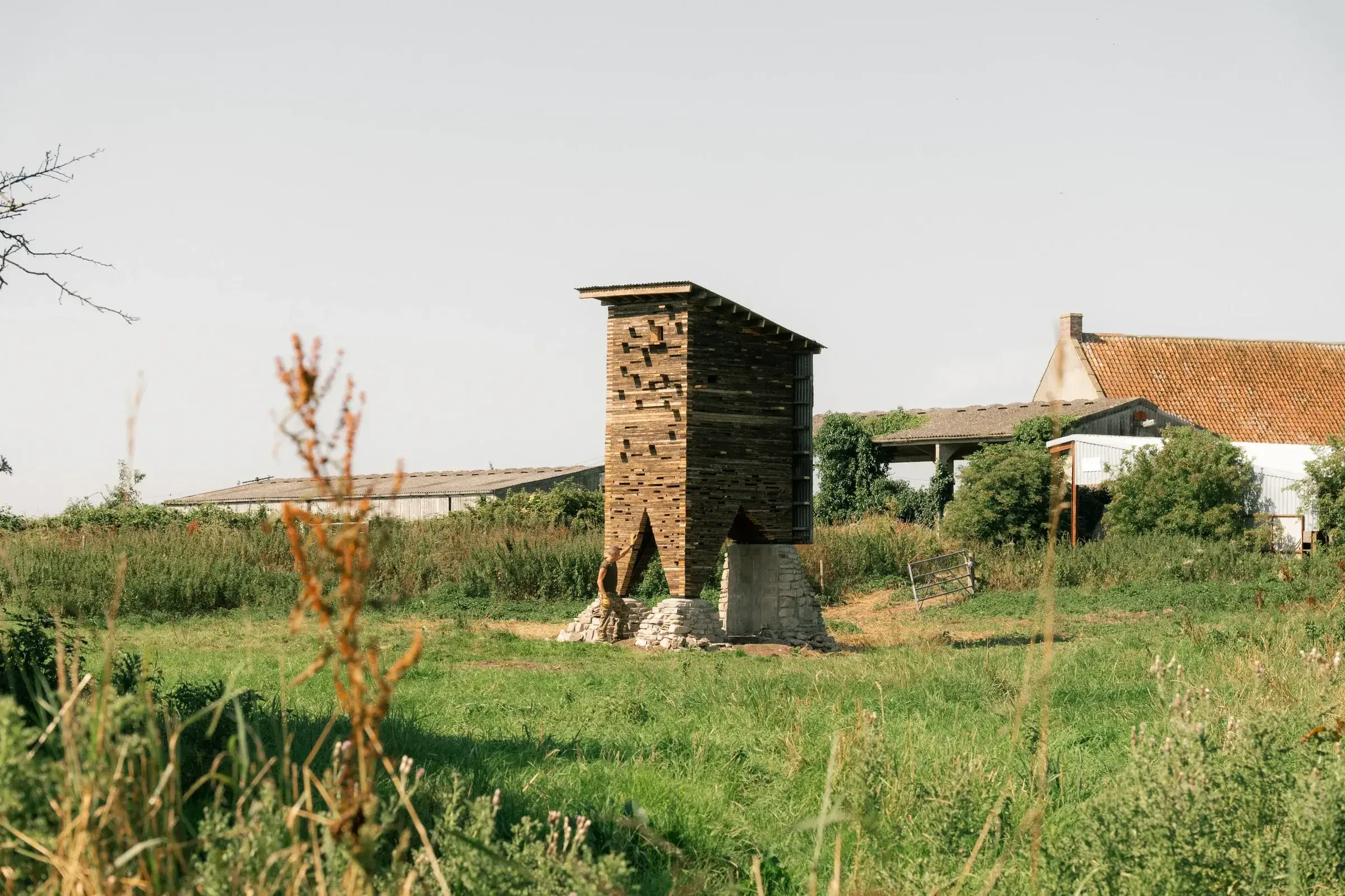
A building designed to rot. Not as a metaphor: it's in the spec.
At Honeygar in the Somerset Levels, UK, studio Pearce+ has put up a tower about five metres high for Somerset Wildlife Trust, meant to shelter several species at once: bats, barn and little owls, kestrels, swifts, invertebrates, amphibians and small mammals.14
The bulk of the thing is reclaimed larch boards, stacked in layers. They are not treated to last decades. The aim is the opposite: they will break down slowly, and the insects that colonise that decay will find a home in it.
Over five metres
The height follows the residents. Pearce+ explains that each species nests or roosts at a height it has chosen, so the overall mass of the tower depends partly on the animals it targets.2 Barn owls, for instance, want elevated, sheltered spots; the size of the upper part comes from the size of the nest boxes built into it.
Honeygar is not neutral ground. It is a former 81-hectare dairy farm the trust bought in 2021, with the plan to put water back on land long drained for livestock and to restore lowland peat, a resource that has become rare.5 The place embodies the "wilding" the organisation keeps referring to: few habitat goals fixed in advance, natural processes allowed to take over again.3
The tower itself has to stand on ground that is flooding again. So it sits on piers of reclaimed masonry, topped with reclaimed timber and a corrugated metal roof.12
Timber meant to rot
Buildings spend their lives pushing back rot: treatments, membranes, sealants. Here decay is part of the brief.
Untreated timber hosts moths, spiders, woodlice and other invertebrates.2 The gaps between the boards make cavities, ledges and perches.1
What a photograph does not reveal is what actually holds the tower up. Pearce+ has slipped a light steel frame in behind all that wood.4 Adam Preece, the Honeygar project manager at the trust, sums up its job: keeping the structure in shape "as it rots and becomes colonised by invertebrates over the coming decades."4
That sentence deserves a second look. The steel is not hidden structural theatre; it exists precisely so the timber can fall apart safely. Stability and scheduled decay live in two deliberately separate systems.
The materials tell the same story. According to Preece, the boards came from an old boardwalk dismantled on a neighbouring reserve, the stone legs are rubble found around the farm, and the roof is sheets stripped from derelict barns.4
Deliberate variety
This reuse is not just about ticking a "sustainable materials" box. The flaws in the reclaimed pieces are exactly what produces habitat.
The bushed timber feeds invertebrates. The masonry keeps cracks, textures and cavities where insects and small animals shelter.2 Openings between the piers let amphibians or small mammals get in. At the base, piled rubble and earth form a hibernaculum, the damp place that might suit newts, slow worms and wetland species.2 Set in a shallow dip, the tower is even expected to form a transient dew pond after heavy rain, good for reptiles and possibly amphibians.4
Each storey raises a separate construction problem. You leave wood to rot, leave stone unpointed, leave rubble unsorted. Several ways of not "finishing" the object, so that something other than us finishes it.
A documented promise
All of this is described with care by the studio and its client. What the sources do not yet show is who actually lives in the tower.
The structure dates from 2026.1 Pearce+ owns up to it: "We've provided the infrastructure, but ultimately wildlife will decide how to occupy it. In a way, the exciting part is that the building isn't finished when we leave – its inhabitants will complete it."2
No occupancy survey confirms any of it yet. The tower is a documented bet, not a colonisation record.
The idea to borrow
The thing worth copying here is neither the shape nor the bat-tower principle, which is an old idea.4 It is a design decision: accept that a material will one day lose its job, and arrange for something else to take the load.
Usually you design to resist, then discover the object degrades anyway. Here the team chose up front what is meant to wear, rot or give way, and handed the overall stability to a layer that is not supposed to be consumed.
The move transfers to plenty of fabrication: instead of pretending an object will last, name the part that will age and let the rest of the system protect what matters. At Honeygar, the larch will give itself to the insects. The steel does not have that job.