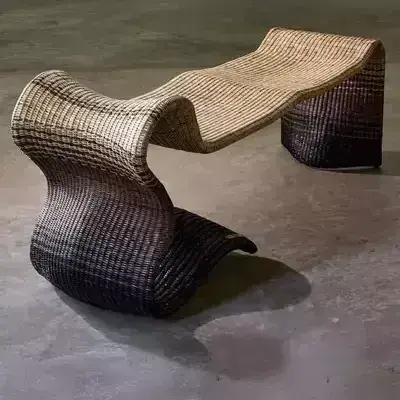
Parametric design loves forms that can be explained by an equation and manufactured by a machine. The Wicker Story attempts something harder: send those forms through a weaver’s hands.
Architect Priyanka Narula founded the Hyderabad studio in 2019. Its own description frames the method as a translation of complex digital design processes into Indian craft and material systems.1 “Translation” is the useful word. The artisan is not being asked to become a human CNC machine.
IIT Hyderabad, which invited Narula to present the practice in 2024, describes the studio as an attempt to connect art, architecture and products through parametric craft methodology. The talk focused specifically on its design processes for working with contemporary woven craft and digital exploration.2
That addresses a practical weakness in computational design. Complex forms are cheap to generate on a screen. Manufacturing them can then require moulds, multi-axis machines, composite materials or industrial infrastructure that simply does not exist where the object is meant to be made.
Wicker changes that equation. The material is already continuous and flexible. It can follow curves without requiring a freshly machined rigid part for every variation. Design therefore becomes less about replacing the hand and more about producing geometry that the hand process can absorb.13
The Wicker Story also claims a zero-waste production methodology and describes its products as sustainable.1 Those are the studio’s own claims, not an independent environmental assessment. The more concrete point is how continuous weaving, fewer joints and materials such as cane and rattan influence the form from the beginning.
That slightly reverses the usual hierarchy. The digital tool is not telling the craftsperson how to become more precise. It searches a space of forms, then has to bend itself around material intelligence that already exists.
The transferable question is broader than wicker: when new technology meets an old craft, the useful prompt may not be “what can we automate?” It may be “what language does the computation need to speak so a hand can still answer?”