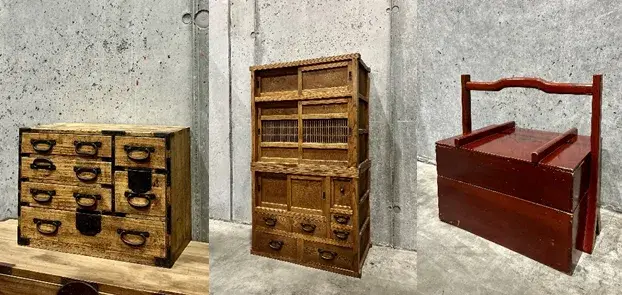
Old furniture creates a peculiar problem for a brand like MUJI.
A new product is normally judged against a standard, with the same dimensions, finish, tolerances and condition when it leaves production, whereas a piece that has lived for fifty years arrives with the opposite qualities: one door rubs slightly, the wood has darkened, a corner was repaired, a handle changed, and the top carries dents whose dates nobody knows.
Since June 2026, MUJI has been selling a Japanese range built around that variation.1
Japanese Old Furniture brings together furniture and household objects recovered partly from kominka, traditional old houses. Ryohin Keikaku inspects, maintains and repairs them before sale through eight stores.1
The revealing detail is the stated protocol. MUJI aims for continued use rather than the appearance of new furniture: pieces are checked against criteria specific to old furniture, their functions are restored, excessive intervention is avoided, and age-related colour change, scratches and previous repairs are retained as far as possible.1
That choice changes the meaning of restoration because the furniture becomes more than material diverted from disposal: it also becomes a physical record of how objects were made, used and repaired.
Useful scratches
On a production line, a scratch is normally a non-conformity.
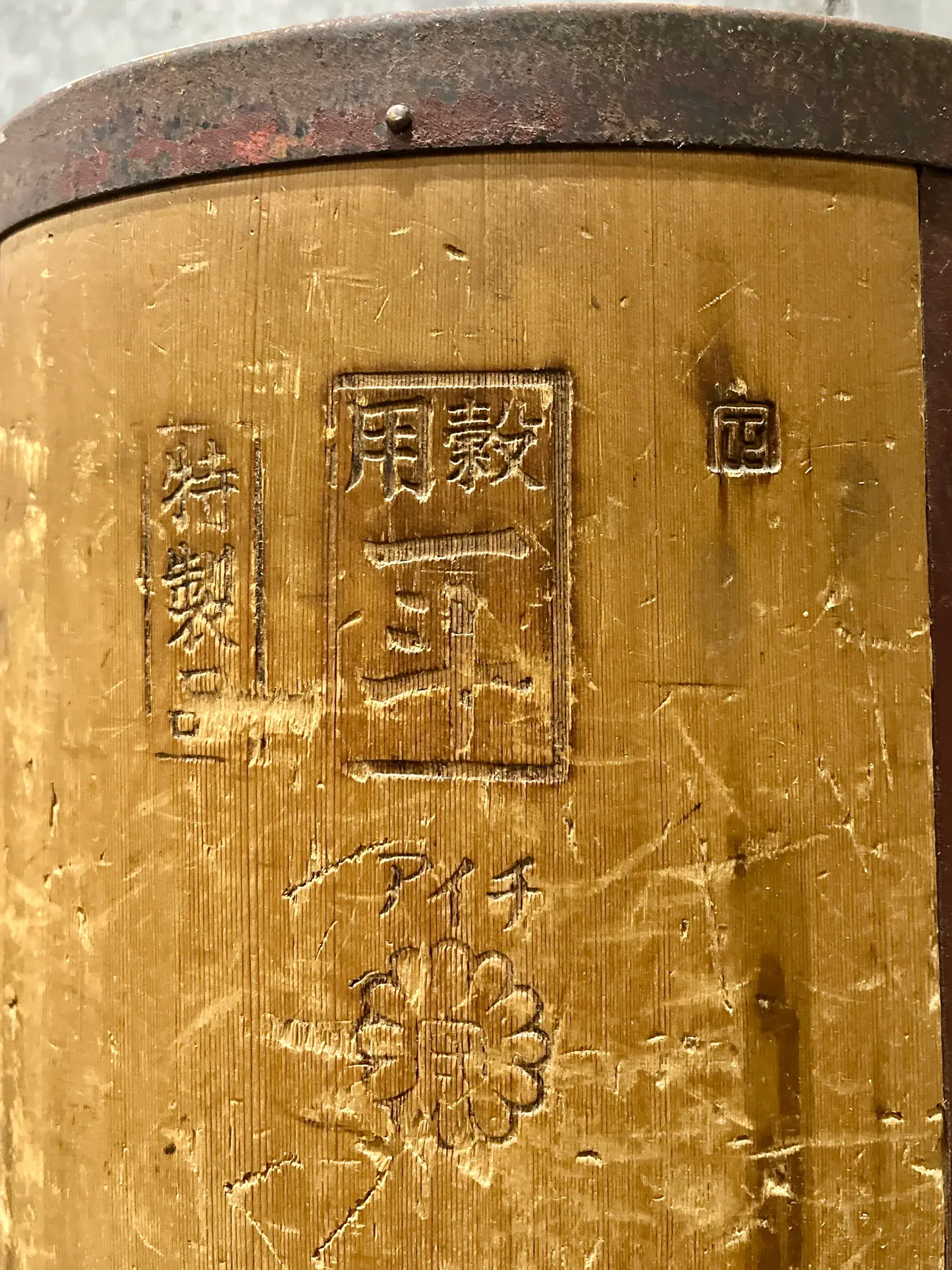
On old furniture, it may show where a hand repeatedly passed, which area received objects, how a door moved or where two wooden parts rubbed for decades.
MUJI explicitly reverses the usual reading by treating colour variation, damage and repair marks as evidence of long use and part of the individual value of each piece rather than simply as defects.1
Conservators are familiar with this idea.
Donald C. Williams of the Smithsonian Museum Conservation Institute writes that furniture surfaces can carry a tremendous amount of information about how an artefact came to be and what happened to it afterwards.3
A plane mark, saw trace, peg hole or repair is therefore more than visual irregularity, each becomes physical evidence that can help reconstruct how the object was made or altered.
A MUJI shop is obviously not a conservation laboratory and every chest is not treated like a museum object, although the logics meet at one point: removing a trace can also remove information, so sanding until the wood becomes perfectly uniform may make furniture cleaner while making its history quieter.
Furniture as document
Old furniture can be opened like a technical manual because the way panels are connected indicates what the maker knew, the loads they anticipated and the tools available to them. Mortise-and-tenon joints, dovetails, grooves, pegs, nails, screws and veneers belong to different manufacturing systems.
Smithsonian conservation literature treats joinery, materials and construction methods as essential evidence for understanding furniture.4
None of this documentation needs to have been printed, since it sits in the thickness of a rail, wood-grain orientation, the shape of a mortise or the decision to use solid timber rather than veneer.
This is where MUJI's range becomes more interesting than a vintage aesthetic.
Furniture made today may be documented by CAD drawings, bills of materials and production files, while an anonymous cabinet recovered from an old house usually arrives without any technical dossier and has to serve as its own record.
Leave it alone
The word restoration easily suggests a methodical return to new condition, although in practice the first decision may be the opposite: what should be left alone?
MUJI says it checks function while avoiding excessive restoration.1 That requires separating damage that compromises use from evidence that merely shows age.
An unstable leg needs attention and a split structural rail probably does too, while a loose handle does not carry the same documentary value as a patina created by decades of handling.
The distinction matters because a bad repair can create damage of its own.
Smithsonian furniture-conservation literature lists irreversible adhesives, inappropriate finishes, excessive sanding and poorly used screws or nails among interventions capable of permanently damaging furniture.5
Repair, in other words, is not always the opposite of deterioration, because an aggressive intervention can solve today's visible problem and make the next repair much harder twenty years later.
Second archive
Old furniture documents more than its original maker, it also records the people who tried to keep it in service.
A shim under a leg, reinforced panel, replacement hinge or added board indicates that somebody considered the object useful enough to spend time on it.
MUJI specifically includes repair traces among the characteristics it tries to preserve.1
That gives material heritage another dimension because the “original” state is not necessarily the only legitimate one.
A cabinet made sixty years ago, altered after twenty and repaired after forty contains several periods at once. Removing every intermediate intervention to reconstruct the hypothetical day it left the workshop would arbitrarily privilege one chapter of its history.
For furniture intended to return to a home rather than enter a display case, the compromise is even more concrete: information has to survive alongside continued use.
Moving the skill
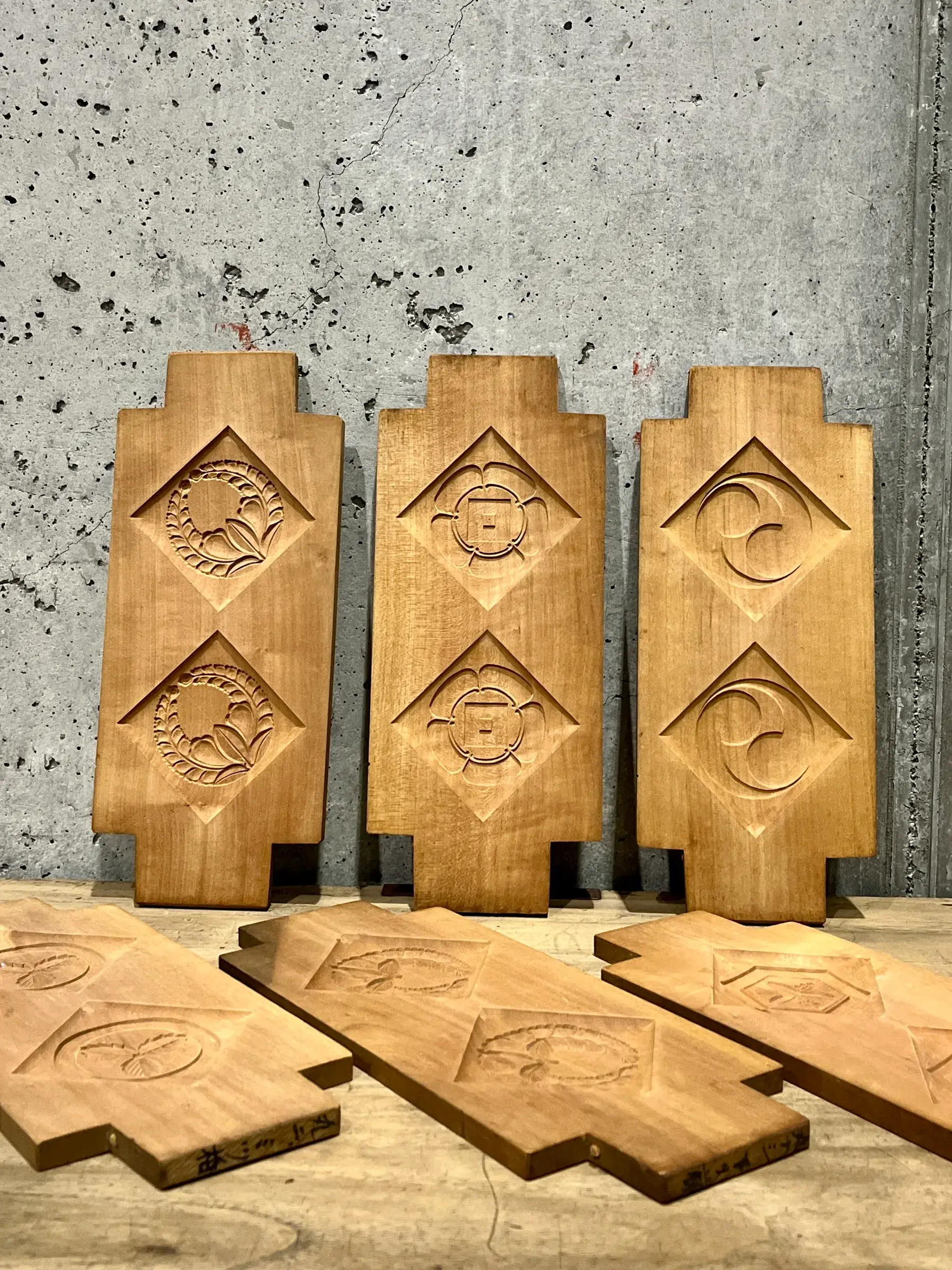
Recovering an old piece creates an obvious logistics chain, find, transport, store, clean, repair and sell, while the less visible chain concerns knowledge: which joint can be tightened, which adhesive is compatible with an older one, what timber should replace a missing part, how far a surface should be cleaned or sanded, whether a stain indicates active damage or an incident from thirty years ago, and how much movement in a drawer remains acceptable.
A flow of unique furniture cannot be treated exactly like a series of identical products.
This is why Ryohin Keikaku's announcement mentions its own criteria for old furniture, separate from the uniform quality standard of new goods.1 That sentence may matter more than the range itself, because industrialising reuse requires more than organising a supply of material, it also requires making the repairer's judgement explicit enough for other people to apply.
A company may have a hundred cabinets worth saving and still have a bottleneck if only one person knows which should be reglued, which should be reinforced and which should simply be left alone, making skill itself part of the supply chain.
More than vintage
There is an obvious risk here: every trace can be converted into the aesthetics of age.
A scratch becomes “authentic”, a clumsy repair becomes “character”, faded colour becomes a pricing argument. Markets have a remarkable ability to absorb any history and attach a kraft-paper label to it.
The difference lies in functional continuity: MUJI does not merely sell the objects as found, since Ryohin Keikaku says they are inspected, maintained and returned to a state suitable for everyday use,1 while the 2026 Japanese range extends furniture-repair sales already present in some MUJI stores during 2025.2 The furniture still has to work, which keeps the programme from being only a market for aged surfaces.
An old object continues to transmit knowledge precisely because it continues to perform a function: the drawer is still opened, the shelf is still loaded, and every use keeps testing whether a joint designed decades ago was genuinely durable.
To be sure, a manufacturing archive does not have to sit immobilised behind museum glass. Furniture can be repaired enough to keep living while retaining enough evidence to remember how it got there.