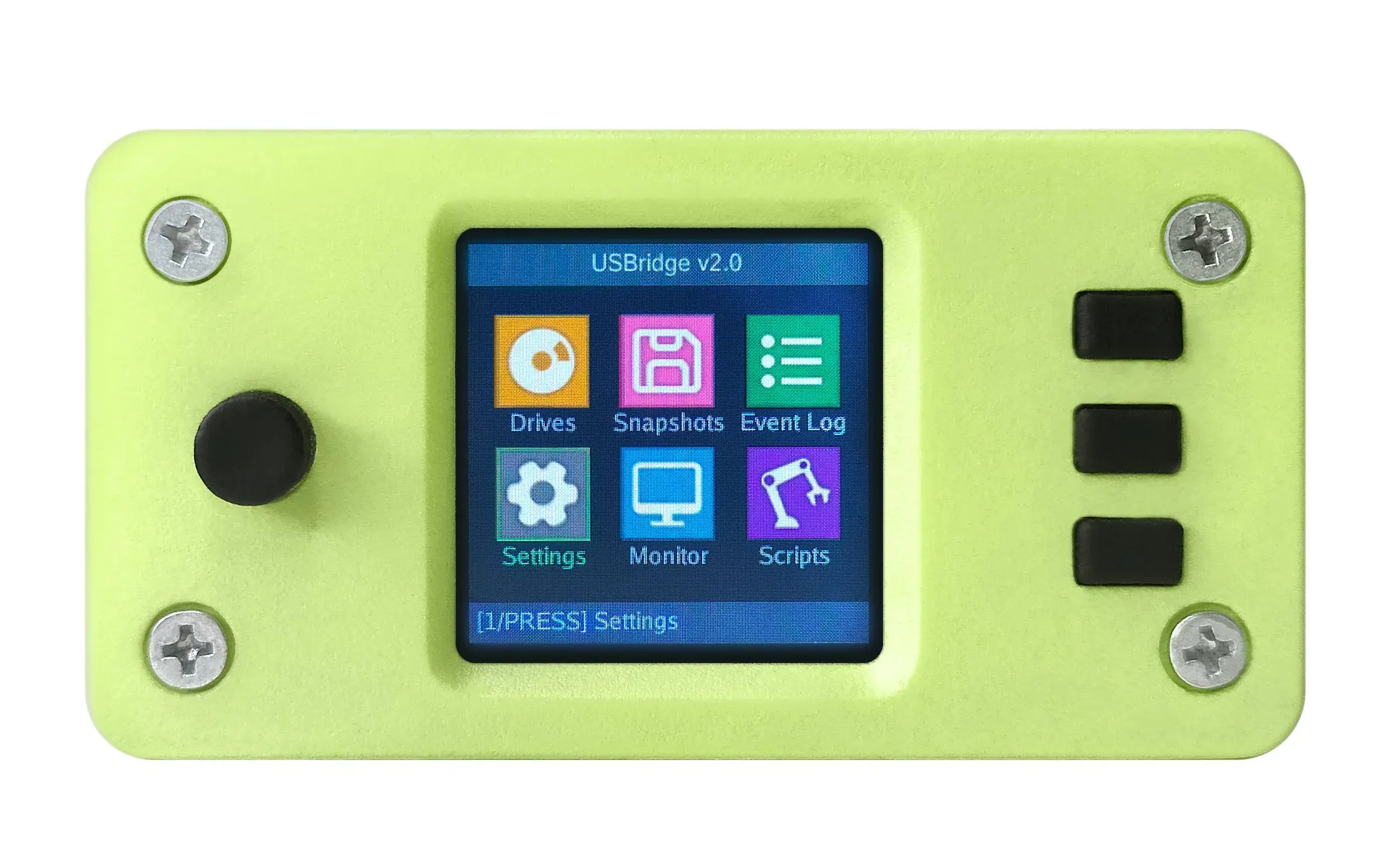
Normal remote access has a basic timing problem: it arrives after the fight, once an operating system, a network stack, a listening service and a machine still healthy enough to answer are already in place.
USBridge-KVM 2.0 points at the minute before all of that: BIOS on screen, keyboard emulation, a reset line, an ISO mounted as a disk, and a computer that has not loaded its OS yet.1
The IP-KVM part is old territory, while the unusual move is what USBridge wants to do with the video feed: turn part of the picture into text over SSH, using local OCR, then make that stream available to Starlark scripts or agents through MCP.12
Two facts pull in different directions: USBridge-Remote is public, active and GPL v3 software, while the KVM appliance is still a Crowd Supply campaign that, when we checked it, showed $1,533 raised toward a $33,000 goal, six backers and an October 1, 2026 funding deadline.134
The order page also listed March 21, 2027 as the shipping date for the $219 kit, with CE, UKCA and RCM certification work still in progress before final dispatch.1 The date places the object where it belongs: a publicly documented manufacturing project with an unusual ambition for such a small KVM, rather than a device already sitting in racks.
Nobody should read that as a new server-room standard, although as a question the project is sharp: how far down can remote maintenance move before the repaired computer has anything to say for itself, and when does that power become more dangerous than helpful?
Before the OS
The setup starts from a sound repair rule: the machine you are trying to save should not become the condition for its own rescue, so USBridge attaches an outside object, almost a parasite, that sees the screen and presses the keys for it.
It captures the server video output over HDMI, appears as a USB keyboard and mouse, can control power through a module wired to the motherboard front-panel pins, and mounts ISO, VDI or VMDK disk images as virtual media, with deliberately physical plumbing: HDMI cable, USB-C, capture dongle, Dupont wires for power and reset.12
That hardware layer is why the story belongs on IRZ, because RustDesk, VNC or an in-house agent behave like doors, comfortable as long as the house still exists behind them and useless once boot breaks. A KVM is closer to a window from outside, an emergency entrance rather than the daily one.
Then USBridge adds a rarer ambition: make pre-boot output readable as text. In the KVM repository documentation, BIOS-in-Terminal converts BIOS and Pre-OS screens into an interactive text stream using offline OCR, although the same page draws an important limit: at this stage, the feature targets text-based BIOS screens; graphical UEFI interfaces sit outside the frame.2
A very ordinary cable detail keeps the project grounded, as CNX Software notes that the USB-C capture dongle can run at 5 Gbps or fall back to 480 Mbps depending on cable orientation; when the stream lags, the suggested fix is literally to unplug it, flip the connector and try again.6 Before the autonomous agent, there is sometimes a reversible plug behaving less elegantly than the brochure promised.
The limit makes the promise more credible, since it avoids selling a magical version where any firmware suddenly becomes a clean API.
Text First
The point of a BIOS in a terminal goes beyond a neat SSH demo.
Automating a video screen cleanly quickly turns into blind clicking, pixel hunting and hoping a firmware update did not move the menu. Once the screen becomes text, the job changes: a script can wait for a string such as Aptio Setup Utility, copy a serial number or react to an error message without caring where a rectangle sits on screen.2
At this point, the AI references stop looking entirely decorative, since the campaign describes MCP integration so a model can read the KVM state and act on diagnostic tasks.1 Alone, that sentence would smell like a 2026 sticker; paired with an OCR-derived text stream, the mechanism becomes at least understandable, because the agent receives a layer it can manipulate rather than a screenshot it has to squint at like a human.
A large asterisk remains, because IRZ cannot verify today how robust the OCR is, what the real latency is, or how safe this automation would be across a fleet. USBridge advertises 25 to 50 ms at 720p and 50 to 75 ms at 1080p through Moonlight on Crowd Supply, and CNX Software repeats those figures in its write-up; treat them as campaign numbers, not as an independent benchmark.16
What Is Open
Open source, here, needs to be split carefully between the software that can already be inspected and the hardware that is still moving through a campaign.
USBridge-Remote, the client that combines software and hardware access, is published on GitHub, and its README describes a beta for Windows, macOS, Linux, Android, iOS and the browser, with downloadable client and agent builds.3 The license file is GNU GPL v3.4
The software side is not just a landing page: the latest release we checked, 2.1.20, was published on August 12, 2026 and provides client and agent binaries for Linux, Windows, macOS, Android and iOS, alongside signed manifests.7 Those files say nothing by themselves about implementation quality or protocol security, but they still create an inspectable and installable object, separate from the hardware promises of the campaign.
The KVM repository contains setup documentation, connection diagrams, usage notes and the BIOS-in-Terminal explanation, while another repository gives access to enclosure STL/STEP files, Gerbers and schematics for some hardware modules.25
The level of openness changes from one brick to the next, since Crowd Supply says schematics, PCB design files, the BOM and source code will be released after the campaign; the Hardware repository already shows mechanical and electrical assets, while a complete production review would still need more than that.15
The safer version is smaller: USBridge combines open, inspectable client software with publicly documented hardware, while the final product still has to pass through funding, manufacturing, certification and delivery.
The Real Promise
“AI in the BIOS” is the sticky version of the pitch and probably the least useful one, because it hides the more durable shift under the loudest label.
Remote administration is moving from interactive screens toward readable, scriptable and copyable surfaces, and that quieter shift matters more than the AI sticker. A pre-boot error kept as a blurry browser image is hard to share, hard to automate, hard to verify; the same information as text can become a ticket line, a script trigger, or proof that someone did not merely “see a weird screen”.
For homelabs, small fleets and workshops where nobody has iDRAC or iLO on every machine, that kind of object makes sense, although the risks move rather than disappear: if a tool can act before the OS, its network exposure, authentication and maintenance become part of the machine's real attack surface.
The campaign mentions Tailscale, SSH, OTA updates, certifications in progress and hardware isolation, which are things to verify over time rather than automatic guarantees.1
To be sure, the first real test is likely to be boring: whether the campaign funds, whether the units ship close to the stated March 2027 date, and whether the public repositories continue to receive the unglamorous maintenance that remote-access hardware needs after launch.123 Still, the device is part of a broader shift in which recovery tools are no longer satisfied with showing a remote screen; they try to turn that screen into data.
For now, USBridge-KVM 2.0 is most useful as a precise signal: even the BIOS is starting to be treated as an automatable interface, and while the machine still sits before boot, someone is already trying to give it text output.