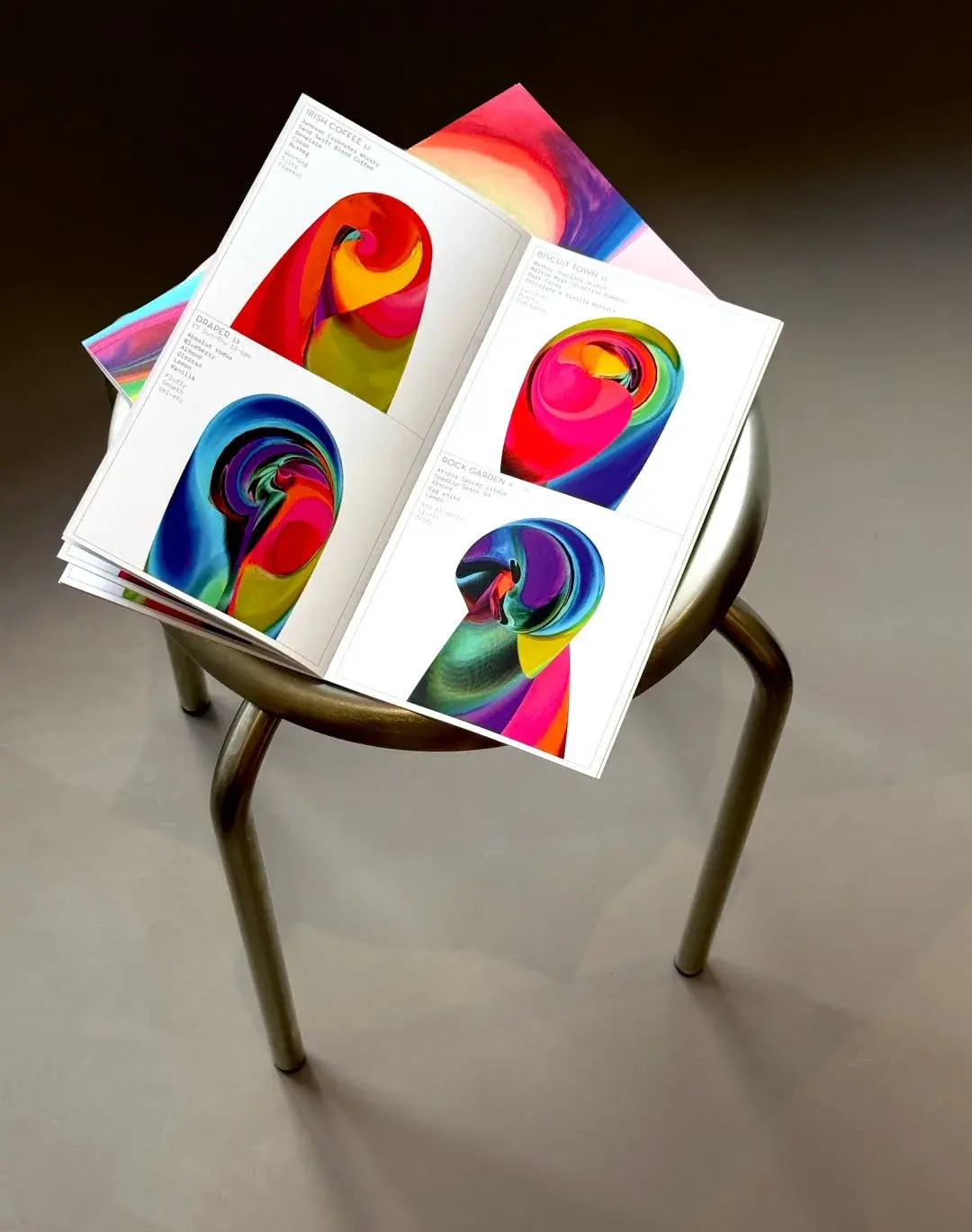
When Studio Dial starts an identity, one of the first things it builds can be a coded tool the public will never see directly.
Not a final export. Not an effect added after the logo. A tool that decides how the graphic system is allowed to behave.1
Natalia Witwicka, founder of the London studio, describes the method in very physical terms: Studio Dial treats code as a material to shape and test like paper and ink.2
That moves generative branding somewhere more interesting. The program is no longer a machine that produces a hundred versions after the design has been approved. It becomes part of the art direction.
Rules before images
Studio Dial says its tools are often among the first things it builds for a project, and that they then hold the brand system together.2
That changes the usual order.
You can draw a logo, choose a palette, define a few compositions and automate the adaptations afterwards. Here, part of the research is to discover what rule can produce interesting forms in the first place.
The studio’s site shows the principle across very different projects: an identity for Afghan restaurant Azra, a generative menu for Swift Bars, the Case for Cities campaign, and visual tools around Gemini and Lyria.1
Code does not necessarily make those projects look alike. It acts as a local constraint for each visual world.
Cocktail as function
For Swift Bars, the starting point is not an abstract pattern pulled from a library.
The studio looks at cocktail gestures: stirring a drink, twisting a citrus peel. Those movements become material for a generative system that gives each drink its own graphic variation.23
The method transfers well: find a behaviour inside the subject, then write a rule that preserves that behaviour instead of placing a style on top of it.
Azra follows the same principle. The identity starts with research into traditional Afghan textiles and the cloud-band motif. Studio Dial then builds a tool that can keep producing patterns from that logic.2
The program does not replace the cultural reference. It keeps it from being frozen into one composition.
Room for accidents
Witwicka also talks about unexpected outcomes in computational design.2
That is probably the hardest part to reproduce. “Generative” does not automatically mean surprising. A system can generate ten thousand perfectly boring variants with admirable efficiency.
You still have to design a space where outputs can vary without losing the subject.
For Case for Cities, Studio Dial describes experiments around visual growth that eventually resolve into skyline-like forms and gradients reminiscent of an evolving sky.24
The final form was not simply drawn first and parameterised afterwards. It emerged while the system was being explored.
Brand as software
This method has a practical consequence: a brand is no longer only a folder of assets and a PDF full of rules.
It can contain a tool.
That obviously adds maintenance. Code breaks. Browsers change. Parameters need documentation. A team needs to understand which variations are acceptable. The graphic object inherits some of software’s wonderfully mundane problems, because apparently even a poster can acquire technical debt if humans try hard enough.
But it gains something too: the ability to stay coherent without repeating exactly the same form.
For a small studio, the principle does not require a complicated engine. A script that generates grids, a parametric type rule, or a tool that transforms real data can be enough.
The important move is not asking code to “make more versions.”
Give it something to think about.