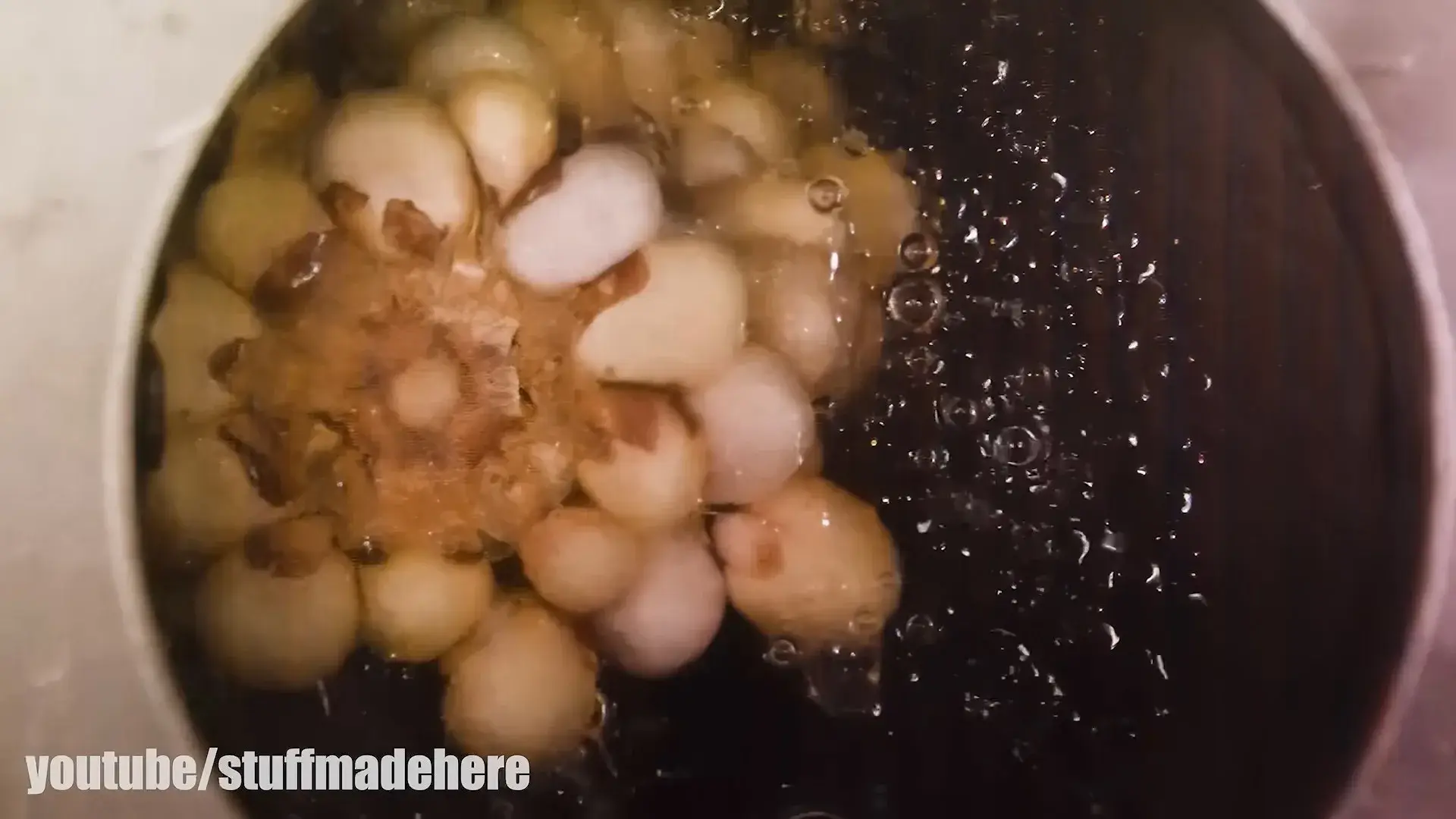
Stuff Made Here wanted to watch an industrial process that is surprisingly hard to find on video: peeling potatoes with pressurised steam. The principle fits in a few lines. Steam rapidly heats the water just beneath the skin. Pressure keeps that water from boiling. A fast pressure drop then makes it flash into vapour and pushes the skin outward.1
At 1:11 in his video, Shane Wighton explains the mechanism. At 17:49, after a sequence of progressively stronger tests, a potato leaves the chamber almost completely naked.1 Everything between those moments stops being culinary engineering.
The prototype has to contain heat and pressure while keeping a window for the camera. Wighton machines sealing surfaces, uses pneumatic actuators to operate valves remotely and adds Belleville washers to absorb the different thermal expansion of the stainless body and its tie rods.1 Before introducing steam, he also pressure-tests the vessels with water to find leaks while storing far less releasable energy.1
Hackaday describes the same device as a conceptually simple arrangement made difficult by reality: seals, welding distortion, chamber access and safety.2
That is the project’s useful lesson. A simple physical principle does not produce a simple machine. Most of the prototype exists to make the phenomenon observable, and much of its complexity comes from that extra requirement: being able to watch what happens without standing beside it when it happens.