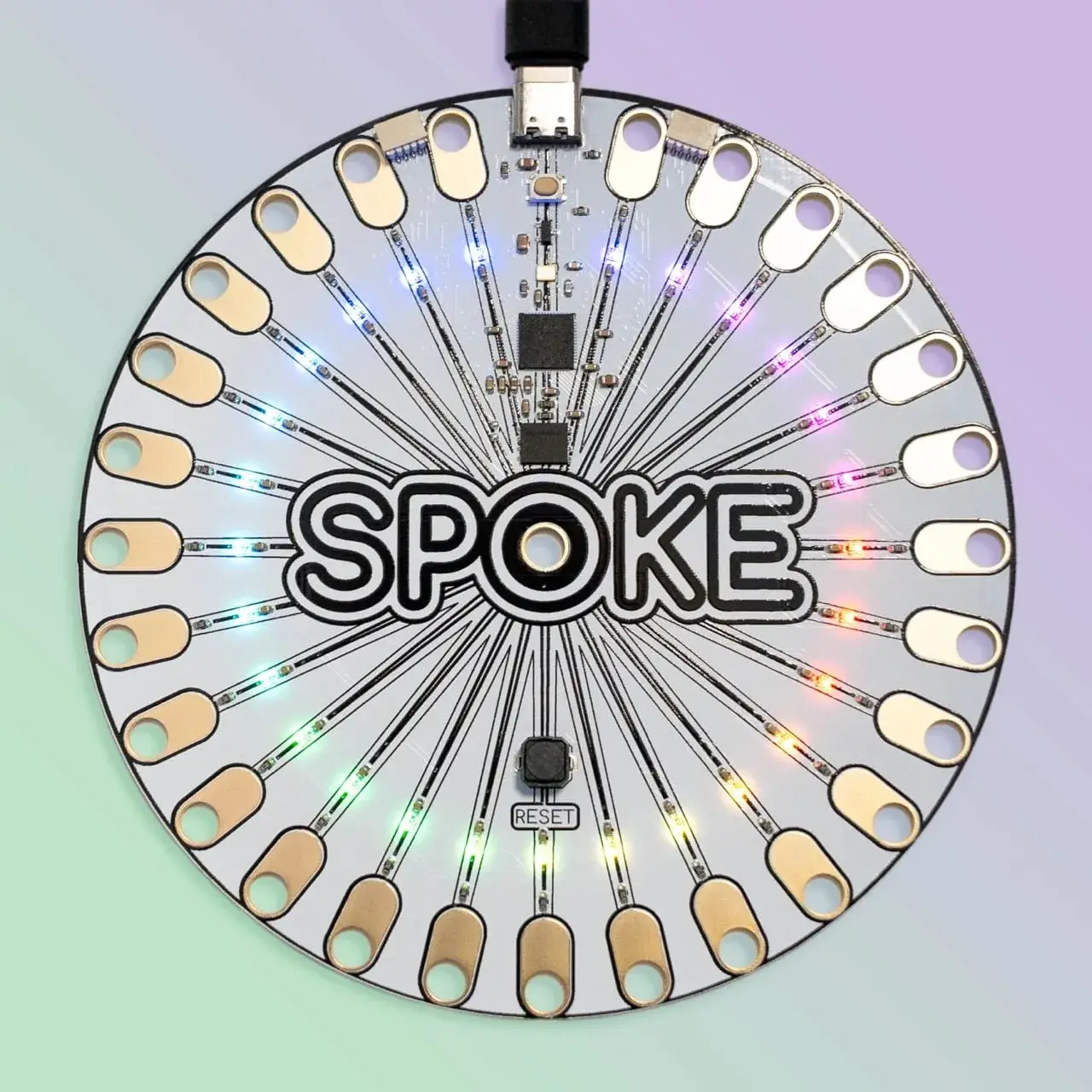
Face up, SPOKE could pass for a 1990s indie band's CD: shiny disc, cardboard sleeve, track listing on the back.1 It is not a CD. Twenty-seven holes are drilled around the disc, each ringed by a copper oval, and they are not decoration. They are the keys.
Plugged in over USB-C, the board shows up to the computer as a MIDI controller. Each pad plays a note, each note lights its NeoPixel, and the default mapping — a pentatonic scale — is editable in code.1 The site backs the board with visualisers, a harmonic table of a hundred polygons and a sampler that digs into Freesound.org's thousands of sounds. And because the board passes itself off as a standard MIDI controller, any synth or DAW recognizes it.1
All of that is pleasant. The interesting part sits elsewhere. The RP2040 running the board has no dedicated touch-sensing circuit. None. Detection happens entirely in software: charges, discharges, counting.
A chip without fingers
Plenty of microcontrollers ship with a touch peripheral. The RP2040 does not. On a Raspberry Pi Pico, with no hardware support, every GPIO pin can become a touch input under one condition: a resistor of about 1 MΩ between the pin and ground.2
You can read the whole method in the source of CircuitPython's touchio library. The pin is driven high for about ten microseconds to charge its capacitance, then switched to a high-impedance input. Then a busy-waiting loop counts how long the pin takes to drain through the resistor, about 50 µs at rest. Several measurements get averaged to reduce noise, and the threshold is set at startup from the raw reading: × 1.05, plus one hundred.3
Put a finger on the pad and your body's capacitance joins the circuit. The discharge slows down. The count crosses the threshold, the note fires. No dedicated sensor: a software stopwatch.
Twenty-seven pins
Tom Fox, the UK educator, maker and musician behind Vulpes Labs,11 tells the origin plainly. While building interactive music installations, he stumbled on the single-resistor trick. "It was so ridiculously easy that I instantly tried it with all 26 available GPIO assuming there'd be issues with thresholds and sensitivities etc. But I was wrong. It worked perfectly," he writes on the project page.4
The final board pushes the idea to the last useful GPIO: GP1 through GP25, GP28, even the pin normally reserved for voltage monitoring, board.VOLTAGE_MONITOR — twenty-seven touch inputs in all.5 The two Qwiic / STEMMA QT ports, meant for extra sensors, eat a few pads along the way. The pin budget does not forgive.1
Kit to instrument
SPOKE comes in two forms. The full board, £33.33 excl. VAT at Pimoroni, works out of the box: 27 pads, 27 NeoPixels, JST-SH connectors for extended wiring, open-source hardware and firmware.6 The SPOKE-mini kit, £20.83, asks for an afternoon with a soldering iron: a bare PCB, a Raspberry Pi Pico H to seat in the middle, and 26 1 MΩ resistors to solder into their R1-to-R26 spots.7
There is something satisfying about that parts list. It is exactly the touchio application circuit, the one from the documentation examples, replicated twenty-six times around a Pico.3 The hardware hides nothing because there is nothing to hide. The firmware is a plain code.py file you can edit in any text editor, or straight from the project's repository.8
To start playing, no DAW or IDE is needed. The site's web tools are enough to sample, record your voice through a mic or remap the notes.1 The board can also act as a keyboard, one letter per pad, a Minecraft game controller, an OSC device or a serial one.1
Drawing the touch
Capacitive touch extends to anything that conducts even a little. Copper tape, conductive thread and fabric, graphite ink, firm pencil lines, fruit speared with crocodile clips. The site even lists seashells lined with aluminium foil, with a warning that plants are less reliable than vegetables.9 After each graft, the Reset button recalibrates the thresholds.1
The project's path reads like a lot of good garage ideas: a Hackster page in June 2024, a crowdfunding campaign in early 2025,11 an Innovation Award page in its name on the MIDI Association site in July 2025, where Fox points out that a single chip now does work that used to require a separate sensing circuit,10 singing jellyfish installed at the Victoria and Albert Museum in the autumn,12 then the mini kit at Pimoroni in June 2026.
How the board behaves in the hand, its real latency, its stamina over a long evening, its reaction to a humid room: nobody has measured that publicly, and neither have we. What is already demonstrated, though, fits in one sentence: the interface is not placed on the circuit board, it is the board's geometry. The copper ovals decide where touch exists, and a 1 MΩ resistor is enough to invent more.