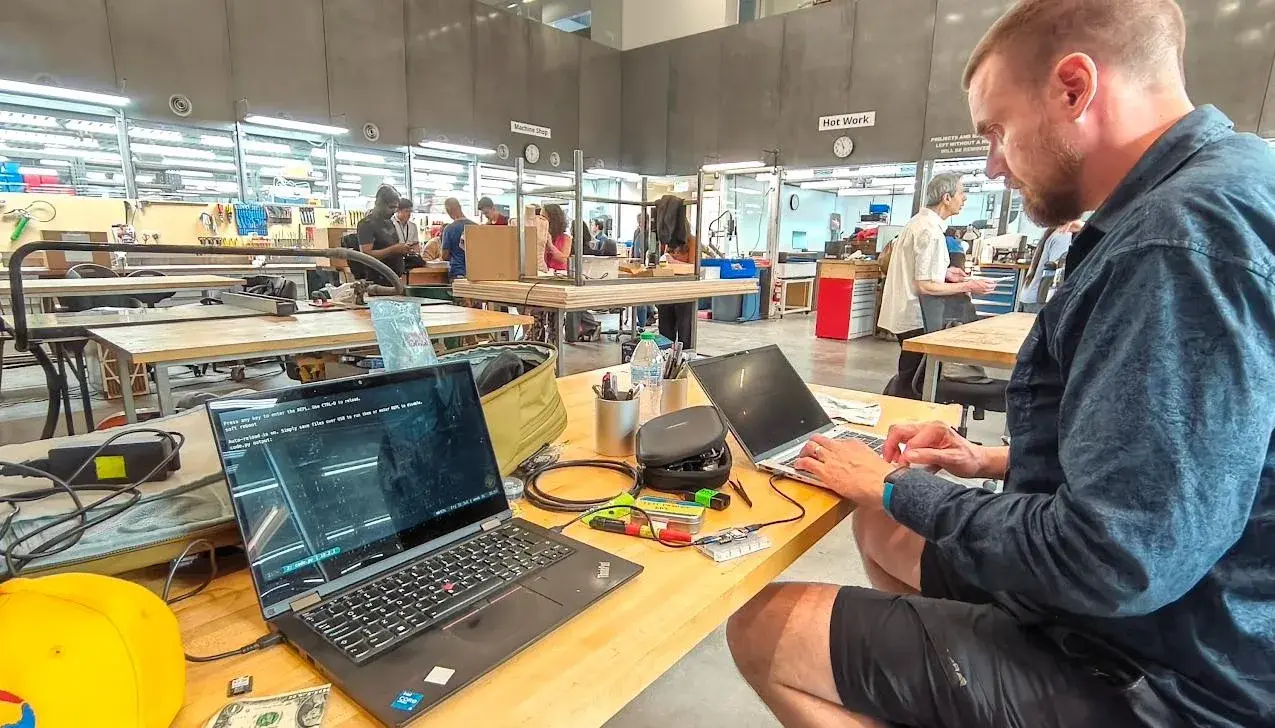
A laptop already has a perfectly good keyboard. The problem is that its USB port has no reason to present itself to a Raspberry Pi as a keyboard.
LapBoard puts two small RP2040 boards between the machines and changes that conversation.1
The project by Þórarinn BB Gunnarsson, developed with Árni, targets a very specific moment: setting up a headless machine before SSH or any other remote access is ready.1
Two USB roles
The first prototype uses two Seeed XIAO RP2040 boards running CircuitPython. The first receives serial data from the laptop over USB CDC and forwards it over UART. The second reads that connection and presents itself to the target as a USB HID device, which means a normal keyboard.1
The path becomes: laptop, USB serial, RP2040, UART, second RP2040, USB HID, target machine.
That is a surprising amount of plumbing for one key press. It is also what crosses the boundary between two different USB roles.
Hackaday describes it neatly as the K part of a KVM: keyboard, without the video or mouse.2
Capturing the keyboard
The first version only forwards text typed into a terminal. Gunnarsson then pushes the prototype further on Linux using evdev.
A script reads system keyboard events and sends them over serial. The second RP2040 converts them back into HID events. The project later grabs the keyboard exclusively and adds Ctrl+Alt+Esc as an escape sequence to return control to the laptop.1
The setup was tested with a Windows computer as the target.1
That is where LapBoard stops being a terminal trick and starts becoming a small troubleshooting tool.
Visible limits
The documentation is explicit about what is not implemented yet. Touchpad forwarding is still missing, and a Bluetooth or wireless bridge remains future work.1
So this is not a universal KVM hidden inside two cheap boards.
But the constraint is well chosen. To bootstrap a Raspberry Pi or another machine that only needs a few key presses before becoming headless, carrying a whole spare keyboard is an impressively bulky solution. LapBoard answers with two tiny USB translators that pretend, just long enough, to be the keyboard you forgot.