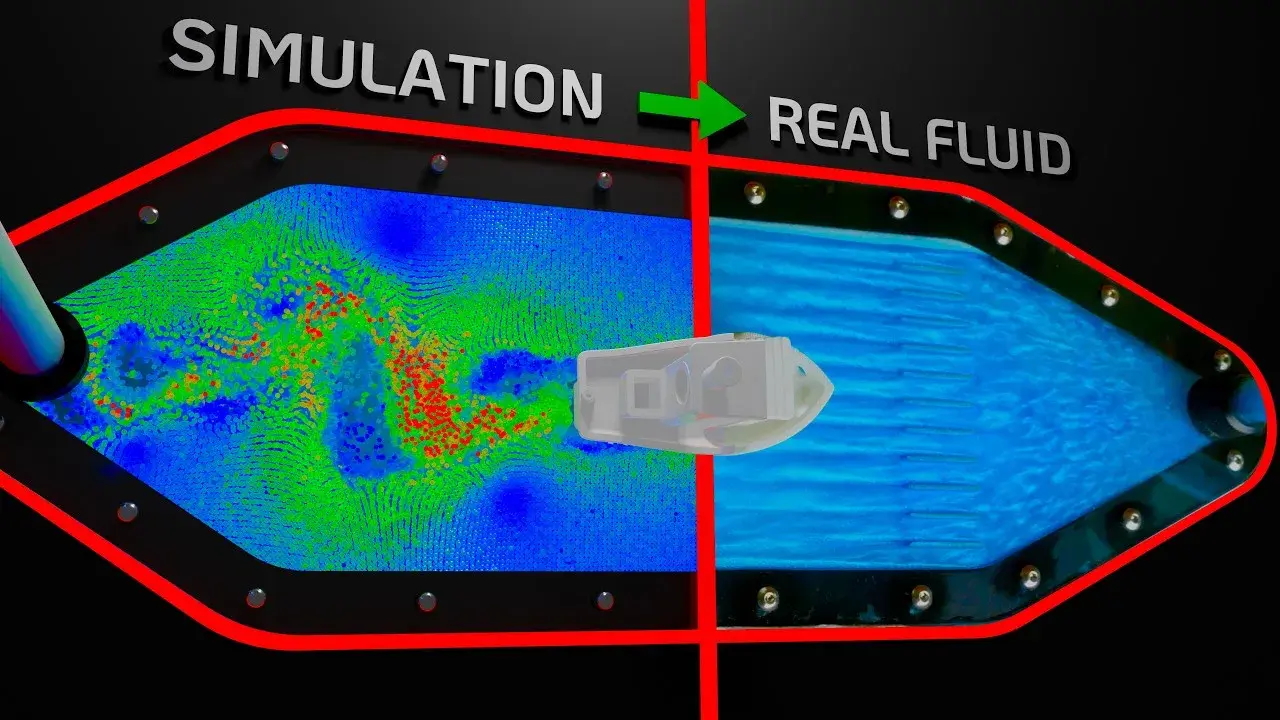
A polished fluid render hides everything that happened before its first frame: assumptions, geometry, meshing, solver setup and computation time.
Visual Thinker goes back to the test bench. The material list is short: water, mica flakes, sometimes a drop of soap, transparent plates and a physical shape moving through the liquid. Reflective particles align with shear, making the flow visible while the experiment runs.12
The result looks like a simulation that escaped the screen, although there is no analog solver hiding in the tank: it is a physical visualization tool, and much of its usefulness comes from that limitation.
Mica speaks
Rheoscopic fluid contains small reflective particles in suspension. UCLA describes microscopic crystals whose orientation changes with fluid motion; under suitable lighting they reveal currents, cells and structures that transparent water would make difficult to see.3
Mica works well because its particles are plate-like. Siemens describes flakes that are extremely thin compared with their width: they align according to shear direction and reflect different amounts of light as their orientation changes.5
Visual Thinker uses a maker-friendly recipe, mixing cosmetic mica with water and adding a small amount of soap when his particles tend to clump or fall out of suspension.2 No electronic sensor is added to the rig. The medium becomes the display.
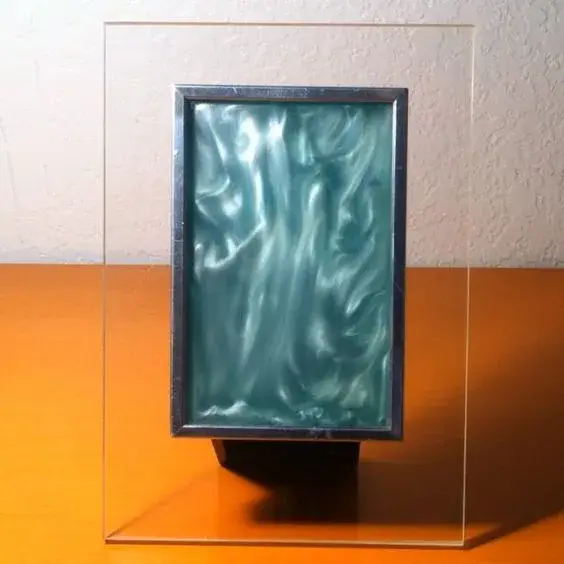
The technique is much older than the recent video. MIT's Towing Tank documents Kalliroscope, a commercial rheoscopic fluid, for small-scale flow visualization.4 The new project mostly brings an old laboratory trick into an accessible fabrication chain of laser-cut acrylic, 3D printing, magnets and video.
Flat hull
Visual Thinker's first device is almost a desk toy. A cross-section of a Benchy hull moves through a thin liquid layer trapped between laser-cut acrylic plates, with magnets pulling the shape without penetrating the chamber.2
The flat geometry gives with one hand and takes with the other. Change a shape, run it again, and separation, recirculation or wake patterns can appear immediately, making the design loop feel closer to “make, push, watch” than “edit CAD, remesh, solve again.” The shallow layer and nearby walls, however, affect the flow, so the device does not automatically reproduce three-dimensional water around a full boat; it creates a controlled experiment in which some changes in geometry become easy to compare.
For a maker, the model becomes tangible: a leak, a wall placed too close or particles settling out shows up on the bench, while a poor numerical assumption can still end in an immaculate render.
Fake wind tunnel
Visual Thinker then pushes the idea toward a wind-tunnel-like rig, still using rheoscopic liquid, laser-cut acrylic and printed parts.2 It is attractive because vortices become legible without smoke, Schlieren optics or a large computing budget.
This is also where the word “simulation” becomes dangerous, because Hackaday points to the Reynolds number: when a liquid model is supposed to represent airflow or a different physical scale, the ratios controlling the flow regime matter.2 Changing size, speed and viscosity can move the experiment into another regime, so a beautiful vortex street does not prove that a full-size vehicle will generate precisely the same structure.
The limitation helps choose the question: this bench is excellent at exposing a structure and much weaker at assigning that structure a precise value.
Surface view
UCLA notes another constraint: rheoscopic mixtures can be opaque enough that visible structures are mainly observed from the surface.3 A beautiful pattern is therefore not a volumetric reconstruction of the entire motion.
The contrast with numerical work matters because a well-built CFD model can provide velocity, pressure or temperature fields at thousands of points, including regions a camera cannot see, while also repeating a scenario exactly and producing numbers for later comparison. The rheoscopic bench offers something else, a very short perceptual loop: change the shape, run the flow, watch a structure appear, and within seconds a designer may know whether an idea deserves a second prototype or is obviously heading nowhere.
During early design work, saving that cognitive time can matter more than receiving a richer numerical result much later.
Two tools
The liquid and the solver eventually belong to different stages of the work.
The physical rig is excellent for rapidly exploring shape, teaching a phenomenon, revealing a strong difference or finding a question worth investigating, whereas simulation becomes stronger when values matter, a full 3D field is needed, conditions are hard to fabricate or parameters must be swept systematically.
The combination is better still: the bench can decide what deserves simulation. A simple experiment reveals the region where flow separates or the geometry change that appears to matter; numerical work can then spend precision on that question instead of calculating every imaginable case at the start.
Material instrument
The transferable gesture reaches beyond fluids.
We often add a sensor, model or interface whenever an invisible phenomenon needs to become measurable. Rheoscopic fluid is a reminder that a material can sometimes encode part of the information itself: platelets become a display oriented by flow.
That is no permission to replace metrology with attractive glitter; it is a prototyping strategy in which, before building a complicated measurement system, one asks whether material, light, chemistry, deformation or color can first make the phenomenon visible.
Visual Thinker chooses a smaller question and builds the apparatus that lets him watch it directly.1 For many prototypes, that order is enough: see early enough to know what deserves calculation next.