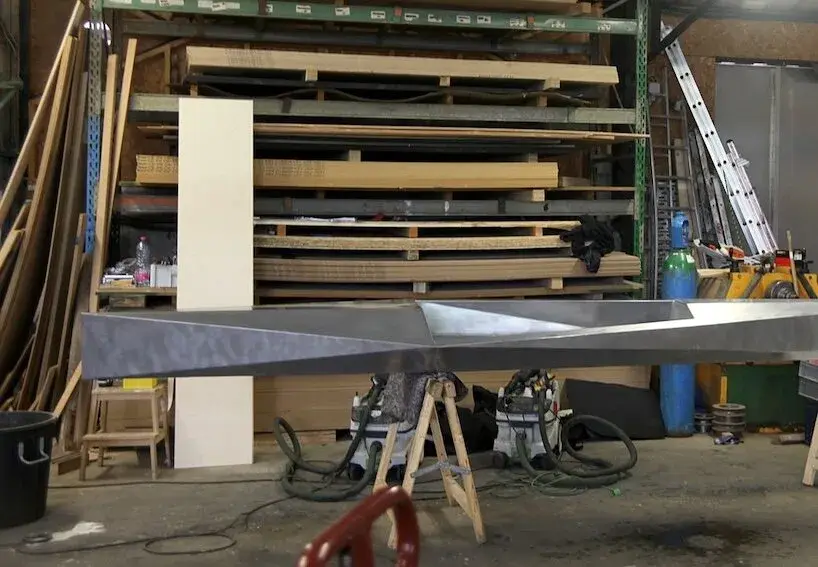
Sharp begins with a manufacturing circumstance almost too neat for a design exercise: during a residency with Association Rhizome in France's Morvan region, Guillaume Bloget met craftsman Antoine Rivière, a boat enthusiast whose workshop stood beside a lake and had just acquired a press brake for folding metal sheet.1
The Cité du design gives the causal chain plainly: that new machine prompted the idea of a folded-aluminum kayak.1 The product did not arrive as a finished shape waiting to be made manufacturable; tool, material and place first established the territory in which a shape could emerge.
Sharp measures 477 × 70 × 32 cm in its 2023 form, built from aluminum and cork with Rivière and Rhizome after the November 2022 residency.12 Its faceted surface is not graphics applied to a conventional kayak, because the folds belong to the structure itself.
Tool first
A press brake gives a designer a different vocabulary from a plastic or composite hull mold: it starts with sheet, concentrates deformation along bend lines and turns those bends into stiffness.
For Bloget, that constraint became the beginning rather than a manufacturing problem to solve later. The Cité du design describes his wider method as attention to tools and materials, part of what he calls observing the surrounding environment before adding another form to it.1
Sharp makes the method unusually legible, because the environment already contains a boat-minded craftsman, a lake on which models can be tried and a newly available machine; designing the folded-aluminum kayak means connecting those three resources.
That starting point could have produced a conceptual prop, an angular boat whose only argument was that the machine could make it. The real design work begins when the geometry favoured by folding has to negotiate with water.
Fold to glide
Bloget describes an empirical investigation of a hydrodynamic hull carried out with Antoine Rivière in search of a good gliding sensation.1 The Cité press pack also documents a folded-and-welded aluminum model made during the residency.1
Designboom added a more specific detail in 2026, reporting that successive half-scale models were tested directly in water before the full-size prototype.3 That exact scale is absent from the 2024 primary press pack, so IRZ treats it as a detail from the recent report, consistent with Bloget's documented empirical research rather than a contemporaneous measurement published by the Cité.
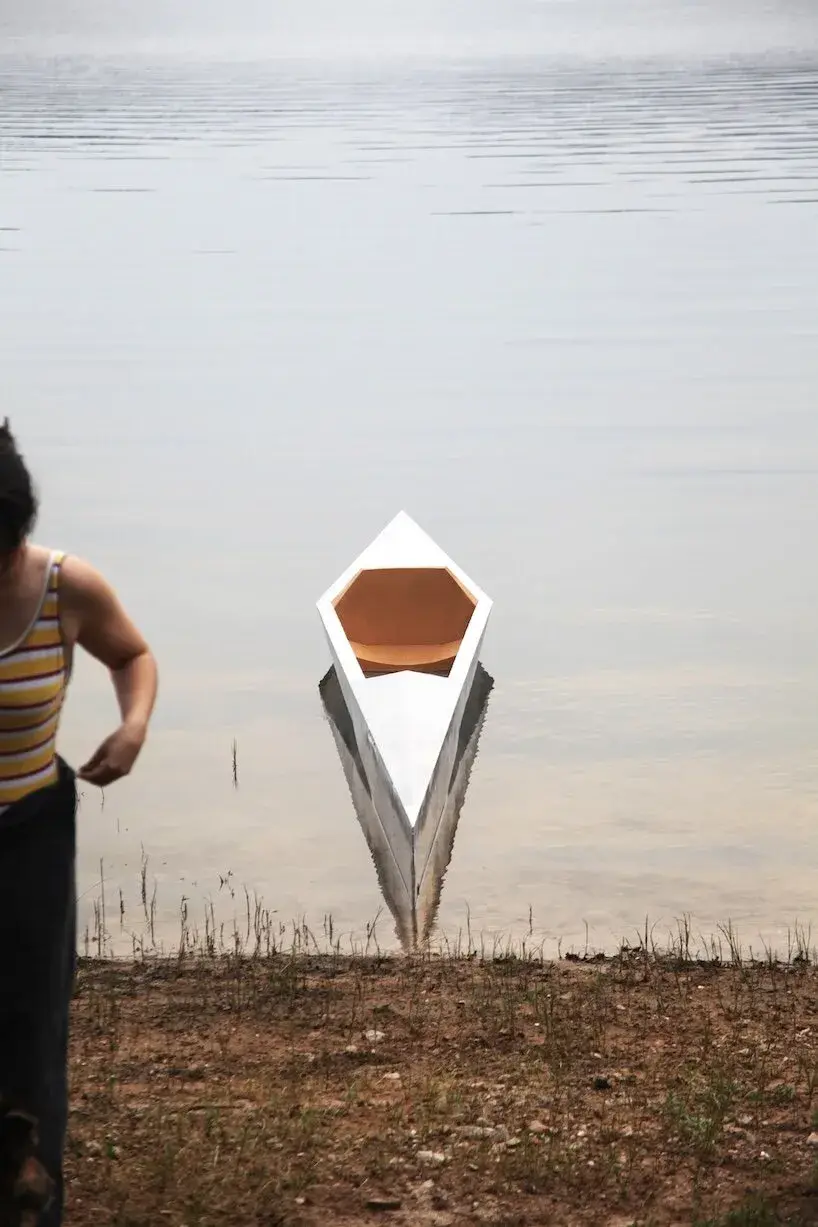
The process then becomes a conversation rather than a dictatorship: the brake favours developable surfaces and sharp bend lines, while water rewards a hull that does not waste every paddle stroke in turbulence, leaving the finished geometry somewhere between those two demands.
This is why the facets matter structurally: rather than imitating ribs on a hull, they provide part of the stiffness directly through the aluminum sheet itself.
Double wall
The primary source is direct about the principle: Sharp is “structured only by bending,” and its double-walled hull makes the kayak unsinkable.1 Core77 reproduces the same description from Bloget.4
“Unsinkable” still deserves careful handling. The project sources describe a property of the double wall, but IRZ found no published certification protocol, quantified flotation test or regulatory category for Sharp. The article can report the design claim without quietly upgrading it into independent marine approval.

The economy is visual and mechanical at once, because one operation creates the creases that define the kayak's silhouette and the relief that prevents a broad metal sheet from behaving like a floppy plate; manufacturing gesture, structure and appearance arrive together.
The cork seat does the opposite job. Bloget describes it as mediation between the curves of the body and the angles of the cockpit.1 Aluminum can therefore remain faithful to the press brake while a softer material appears only where a paddler actually touches the boat.
No hull mold
Comparison with a molded kayak is useful only if we avoid inventing an industrial balance sheet the sources never published.
Sharp avoids a conventional hull mold within its own fabrication process and stays close to folded sheet. That can make small batches or local production plausible because changing a bend does not require rebuilding a large shell tool. In August 2026, Designboom reported that Antoine Rivière now produces Sharp on demand.3
That remains a commercial status reported by Designboom, with no public price, order count, annual capacity or production cadence attached to it; “on demand” should therefore not be inflated into evidence of a mature mass-market watercraft.
Nor does Sharp demonstrate a lower full-life-cycle impact for folded aluminum relative to composites, because the sources reviewed by IRZ publish no comparative emissions accounting, detailed mass, manufacturing-energy figure or measured service period. The cost of less tooling cannot be converted into an environmental claim without that missing accounting.
Workshop draws
Sharp's reusable lesson lies elsewhere.
Industrial design is commonly narrated in the order idea → drawing → process selection → factory, whereas Sharp almost reverses it: a workshop gets a new tool, the surrounding landscape suggests a use, the limits of the machine establish a visual language, and physical trials correct that language until it works on water.
This does not reduce the designer to executing whatever the machine already knows how to make. The difficult part is recognising what the presence of that machine suddenly makes worth designing, then pushing the possibility far enough to become a coherent object.
Sharp could certainly have been rounder with another process, but in exchange for that freedom it would have lost the precise reason for looking the way it does.
For workshops equipped with CNC routers, lasers, brakes, lathes, 3D printers or embroidery machines, the project suggests a useful reversal: before asking how to manufacture the object already drawn, sometimes ask which object deserves to be drawn because this machine is now here.