If Dressmaker simulated sewing minute by minute, a play session might last longer than your desire to play it.
Cut, pin, stitch a long straight seam, repeat. Real craft contains a lot of repetition. Sabrina Becker and Jonathan Hau-Yoon’s problem was therefore less about reproducing sewing than deciding which parts of sewing actually make you feel that you are creating something.1
Their answer keeps the decisions: fabric, patterns, cutting, assembly, decoration. It compresses the rest.
Not a dress-up game
The Steam page presents Dressmaker as a crafting game inspired by real dressmaking: choose fabric, cut patterns and sew the pieces together for the people who live around you.2
Becker grew up sewing with her mother. In an interview with Creative Bloq, she explains that the project helped her reconnect with that practice after Ehlers-Danlos syndrome stopped her from pursuing costume work professionally.1
That experience matters to the design because it shifts where the reward sits.
The pleasure is not only seeing a character wearing a nice dress at the end. It starts in the fabric shop, when different materials, shapes and styles become possible decisions.1
Dressmaker is trying to simulate the creative decision more than the real duration of the task.
Compressing the tedium
Hau-Yoon says their conversations about making clothes kept returning to the same reality: cutting and sewing take a huge amount of time even when the final result is satisfying.1
Professional simulation software can preserve that complexity because precision is the point. A game needs a loop you want to repeat.
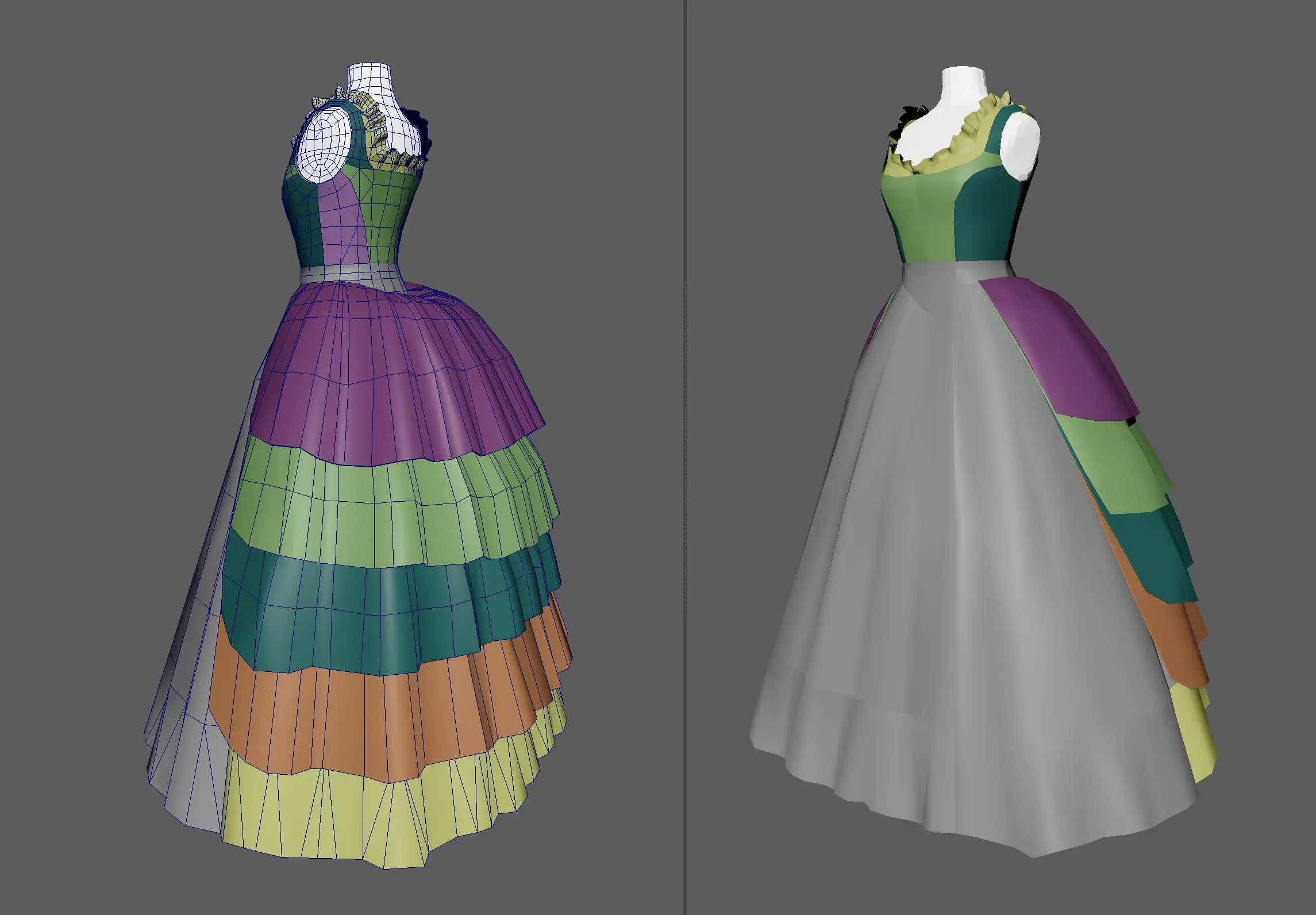
Dressmaker therefore keeps pattern-making, cutting and sewing as readable actions without pretending to become Marvelous Designer or a certified sewing course.1
The rendering follows the same philosophy. Fabrics do not all chase perfect photorealism. Hau-Yoon gives the example of sequins: if they need to read as shiny, the game exaggerates the sparkle so the property is immediately legible.1
It is translation, not duplication.
The desired prototype
Dressmaker also has a pleasantly sensible prototyping story.
The project began as a very small side project: a cutting table, then a mannequin used to assemble pieces.1 Hau-Yoon posted a short TikTok video which, according to him, reached roughly half a million views before the game even had a name.1
Free Lives then helped the team spend three weeks building a prototype simple enough to release on itch.io.1 3
Again according to Hau-Yoon, the prototype reached 40,000 downloads in its first month and 100,000 after two months.1 Those are creator-reported numbers from the interview, not independently available analytics, but they explain why the team kept going.
The method is more interesting than the number: put the central gesture in people’s hands quickly, then see whether they make things, share them and ask for more.
Choosing the essential
The same logic could apply to many crafts.
A faithful tattoo game probably would not need to simulate eight hours of awkward posture and twenty minutes spent looking for the right cable. A pottery game does not need several real days of waiting between firings.
The better question is: which decisions make the practice recognisable from the inside?
Dressmaker answers with material, cutting, construction and decoration.12
The rest can be shortened.
That is not betraying reality. It is editing it.