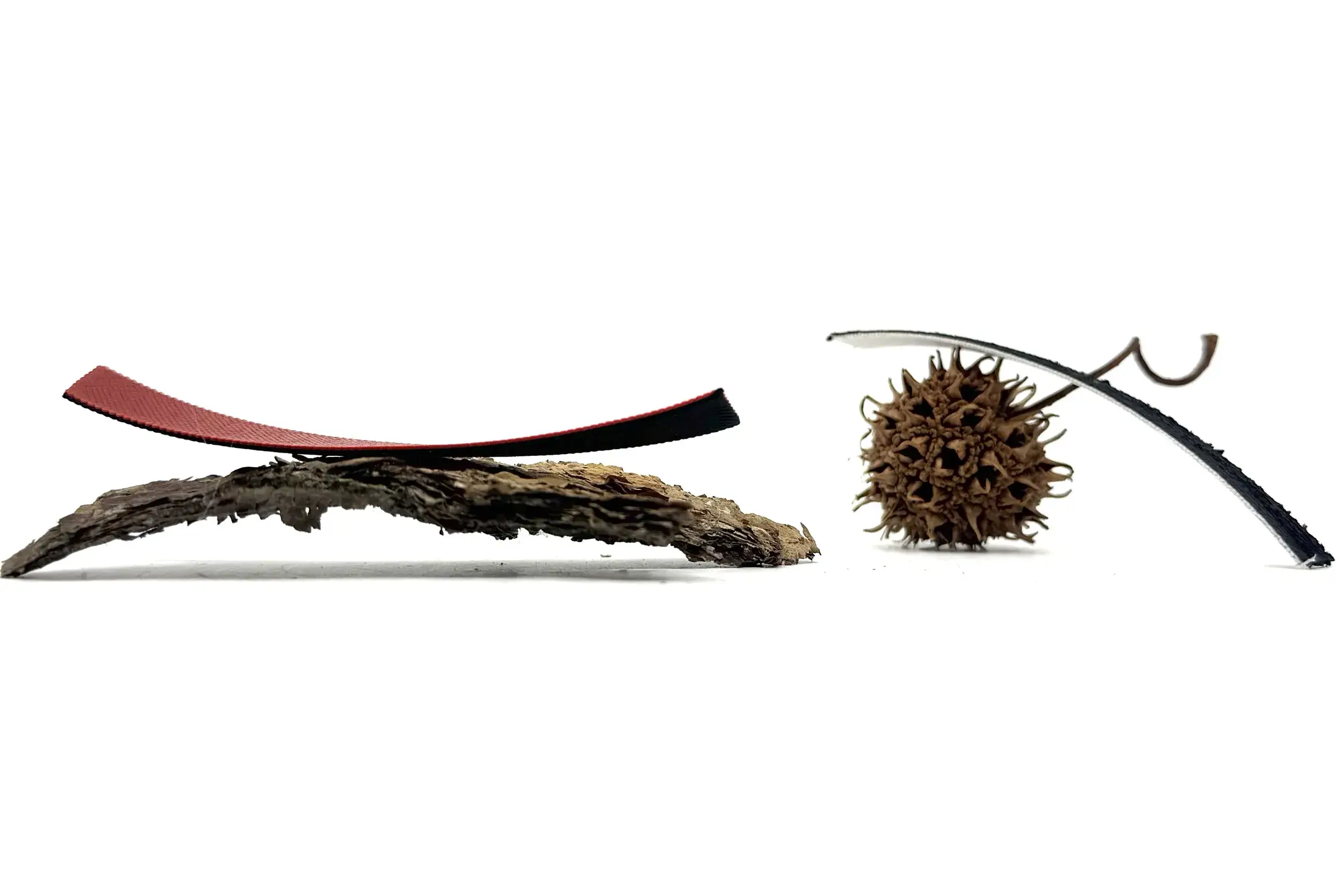
A pine cone has no motor, sensor, or battery, yet its scales still move when the air changes around it.
Dry air makes them open; rising humidity closes them again. The motion is passive, driven in part by the orientation of cellulose fibres and by neighbouring tissues that swell by different amounts.3
Engineers have borrowed that trick for years, but a group of four researchers, Lee Marom, Skylar Tibbits, Gioele Zardini, and Markus Buehler, takes a less familiar route in a 2026 paper. Rather than stopping at “nature does this, let’s imitate it,” the team tries to write down the whole chain from biological mechanism to manufactured object.1
Their sequence runs from the natural response through a formal model and an artificial equivalent, then into a fabrication specification that can finally reach a 3D printer.1
That extra paperwork, mathematical in this case, is the interesting bit.
Not the shape
A pine-cone-shaped object is easy to copy; the reason a real cone moves is not.
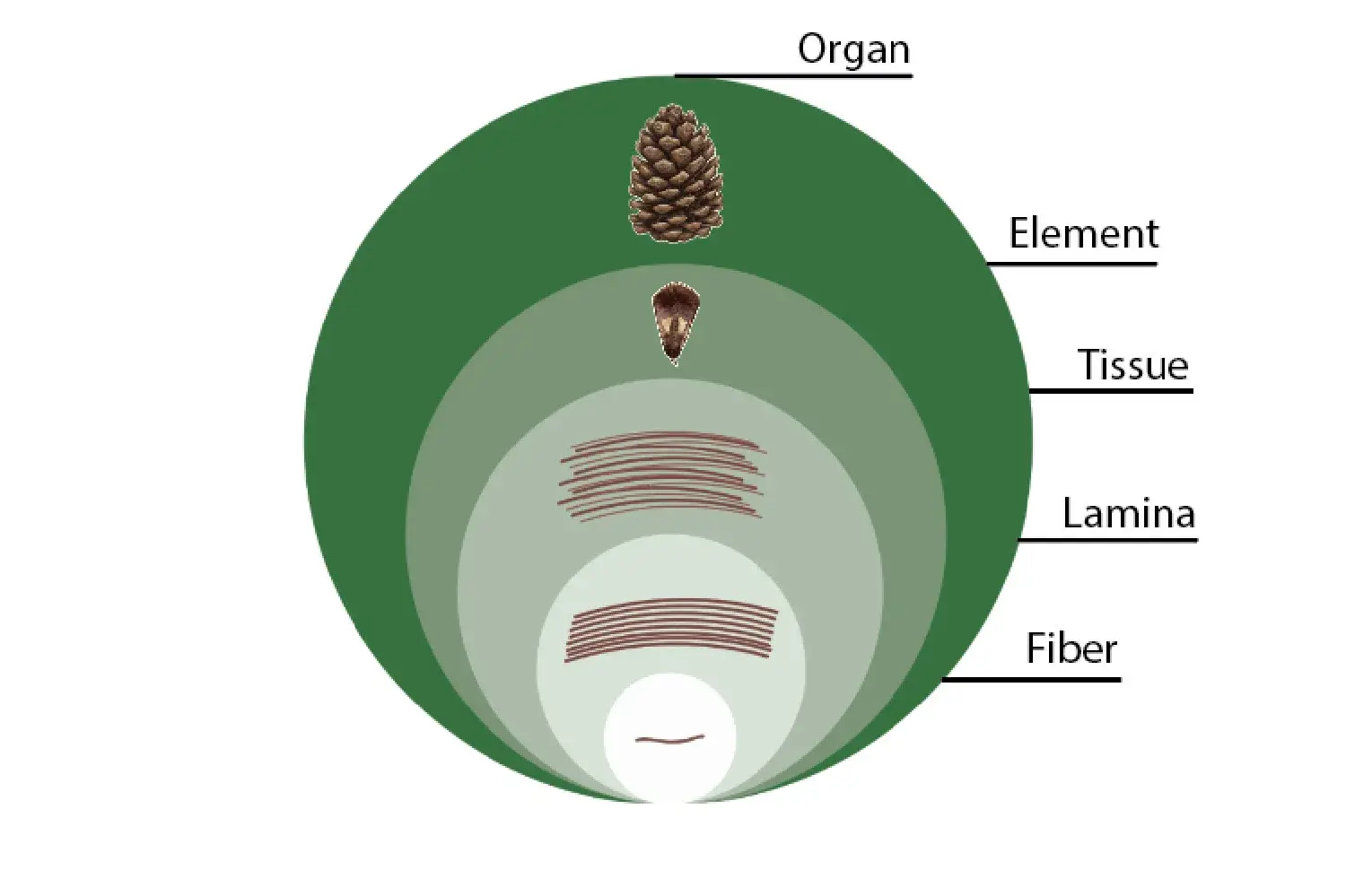
Its visible motion depends on several linked levels, from fibres and lamellae to tissues, scale geometry, and the whole organ. Simplify one level too aggressively, or swap a material without preserving the right relation, and the larger behaviour can drift away from the thing you meant to reproduce.
This is where category theory enters the paper. The name sounds as if somebody has hidden the useful idea behind a departmental door, but the practical question is straightforward: what relationships have to survive when one system is translated into another?
Each level is described as a stimulus-response system, while the transitions between levels carry explicit conditions that have to remain valid as the model moves from biology into an engineered counterpart.1
So the team is not merely preserving a silhouette or a vague design principle. It is trying to preserve the mechanism's logic closely enough that an engineered substitute can still be reasoned about rather than guessed at.
That shift matters more to me than the biomimicry label itself, because it forces a rude but useful question: after replacing the fibre, tissue, material, and geometry, what exactly must stay true for the object to behave as expected?
Grasshopper in between
The work does not end with a formal description that looks impressive in a PDF.
The researchers built the pipeline in Grasshopper, Rhino's visual programming environment, where the formal specification becomes modular parametric scripts and then fabrication instructions for fused-filament printing.1
Across the experiments they generated four actuator classes, combining two stimulus types, humidity and heat, with two motions, bending and twisting.1
A printed part, by itself, says very little about why it works, and an STL file says even less. The point of this pipeline is to keep the reasoning attached to the part, linking the intended response to the choices that eventually produce the geometry and toolpath.
That makes the result reusable in a different way: you can carry forward part of the design logic, instead of copying only the final shape.
The odd combination
The clearest test comes when the researchers stop reproducing one natural example and start mixing mechanisms.
They also model a wheat awn, whose structure twists in response to humidity, then take already validated pieces from the two systems and recombine them into an actuator that responds to heat and twists.1
At that point the pine cone starts to look like a bank of mechanical ideas: individual pieces connect with other pieces, provided the formal relationships still hold.
The team fabricated that new actuator and tested it physically; MIT reports that its behaviour matched the prediction produced by the pipeline.2
Calling it a push-button material inventor would be silly. The useful result is smaller and, for prototyping, probably more practical: a library of verified mechanical components could let designers reuse part of an earlier derivation instead of rebuilding every step from scratch.
Where it breaks
The word “verified” deserves an asterisk large enough to notice. To be sure, mathematical consistency cannot rescue a bad description of the biological material. If a local model is wrong, the composition may be perfectly tidy while the manufactured object behaves badly; the paper itself leaves material fidelity, fabrication tolerances, and local approximations to experimental validation.1
Pine cones provide a useful warning here. An independent 2025 study compared several mechanical descriptions of their scales using tomography, hygroscopic measurements, and simulation, and found that a simplified bilayer model underestimated the observed bending while geometries that represented fibres and tissues in more detail performed better.3
A separate 2024 project on pinecone-inspired paper actuators reached a similarly unglamorous conclusion: because the composite structure is complicated, predicting hygromorphic behaviour with one universal model remains difficult.4
That limitation actually makes the MIT framework easier to take seriously. The mathematics does not erase the messy material layer; it gives engineers a place to mark assumptions, preserve relationships that are known to work, and see where another physical measurement is still required.
A different biomimicry
Biomimicry is often presented as a neat album of correspondences: gecko means adhesion, lotus means a water-repellent surface, bird means efficient wing.
That shorthand works on a presentation slide. On a workbench, where somebody has to manufacture the object and watch it fail, the guidance gets thin very quickly.
The 2026 paper points toward a different unit of design. Instead of treating an animal or plant as the thing to copy, it treats the relationship between stimulus, structure, and response as the reusable piece.1
The design question then changes from “what can I copy?” to something stricter: which relationship has to be preserved, and which parts of the original system can be replaced without breaking it?
The photograph shows a small printed actuator. What I find more interesting is the chain behind it, because that chain is precise enough for a mechanism extracted from a pine cone to be recombined and, several translations later, arrive as fabrication instructions.