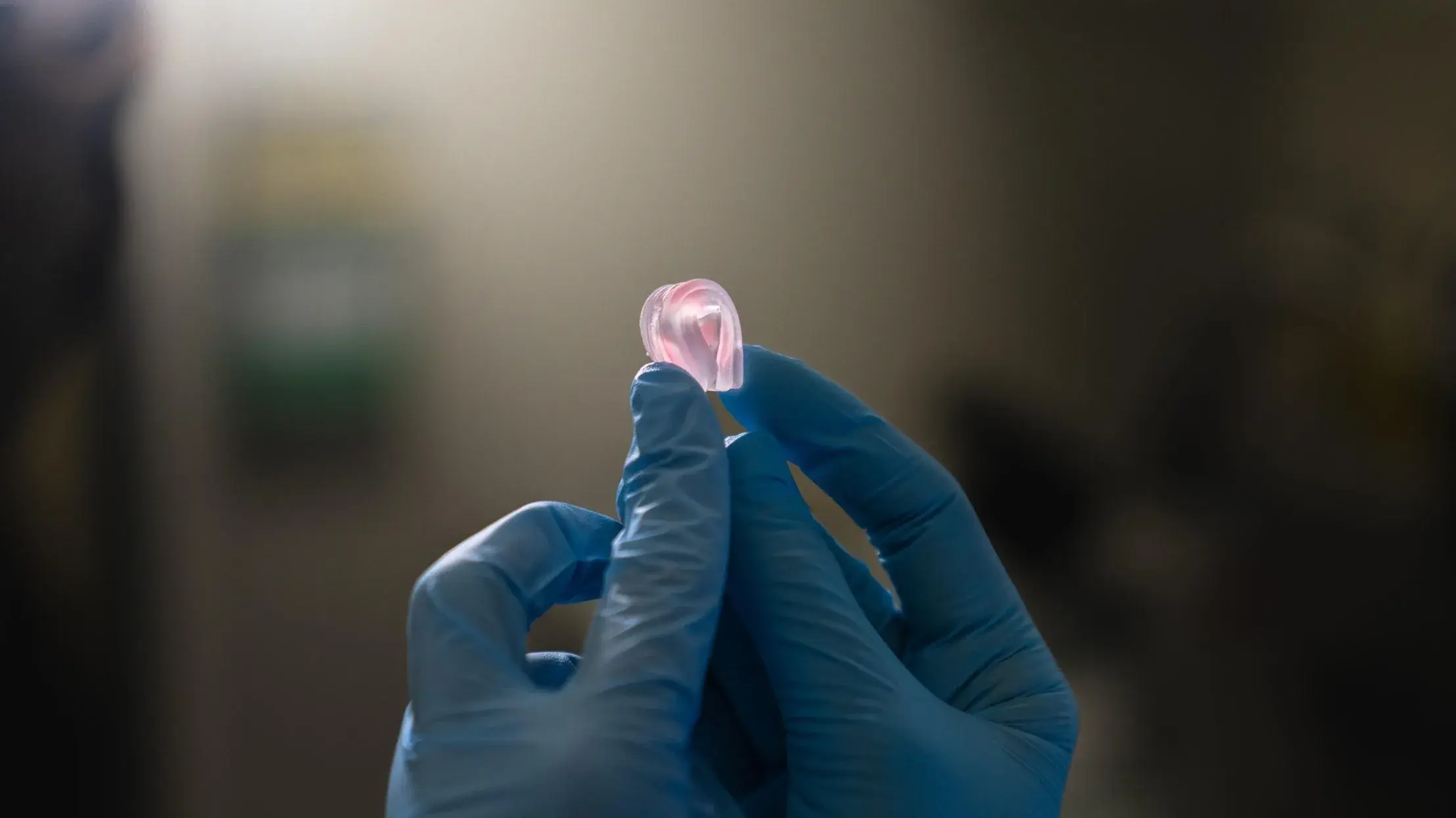
In most 3D-printing software, material still looks like a dropdown menu: the designer draws a part, then selects PLA, resin, TPU, nylon or whatever else the machine can process, while the geometry is allowed to become complicated and material behaviour is usually treated as uniform across the object.
Work from Eva Baur, John Kolinski and Esther Amstad at EPFL pushes in a different direction. Their double-network granular elastomers, or DNGEs, were first developed so that printable elastomers could change mechanical properties locally.3 Two years later, the team has shown that the same granular architecture also changes a more difficult combination: stiffness, resistance to fracture and resistance to fatigue.1
Calling this a “stronger rubber” would erase most of the result, because a material can be hard to deform and still easy to tear, survive one large stretch while accumulating damage under repeated smaller cycles, or cycle for a long time before failing abruptly once a small notch concentrates stress.
The Science Advances paper published in July 2026 matters because its target is broader than one isolated maximum: the team tries to move several mechanical trade-offs at once, then uses 3D printing to distribute those behaviours inside one part.1
First, make it printable
To understand the 2026 result, it helps to start with the manufacturing constraint.
Elastomers can be formulated over a broad range of stiffness and stretchability, but their liquid precursors are not automatically useful printing inks. Direct ink writing, or DIW, needs material that will move through a nozzle under pressure and then hold the deposited shape long enough for the final network to be formed.
In 2024, Baur, Benjamin Tiberghien and Amstad published a DNGE architecture built around that requirement.3 Rather than starting with one homogeneous bulk precursor, they make the first elastomer network as microparticles, swell those particles with precursor for a second network, jam them into an injectable paste, deposit the paste through a nozzle and finally connect the printed structure when the second network polymerises.13
Granularity does practical work before it does any sophisticated fracture mechanics: under nozzle pressure the packed particles move relative to one another and flow as an ink, while after the pressure is removed the jammed structure retains enough body to hold the printed geometry until curing locks it together.
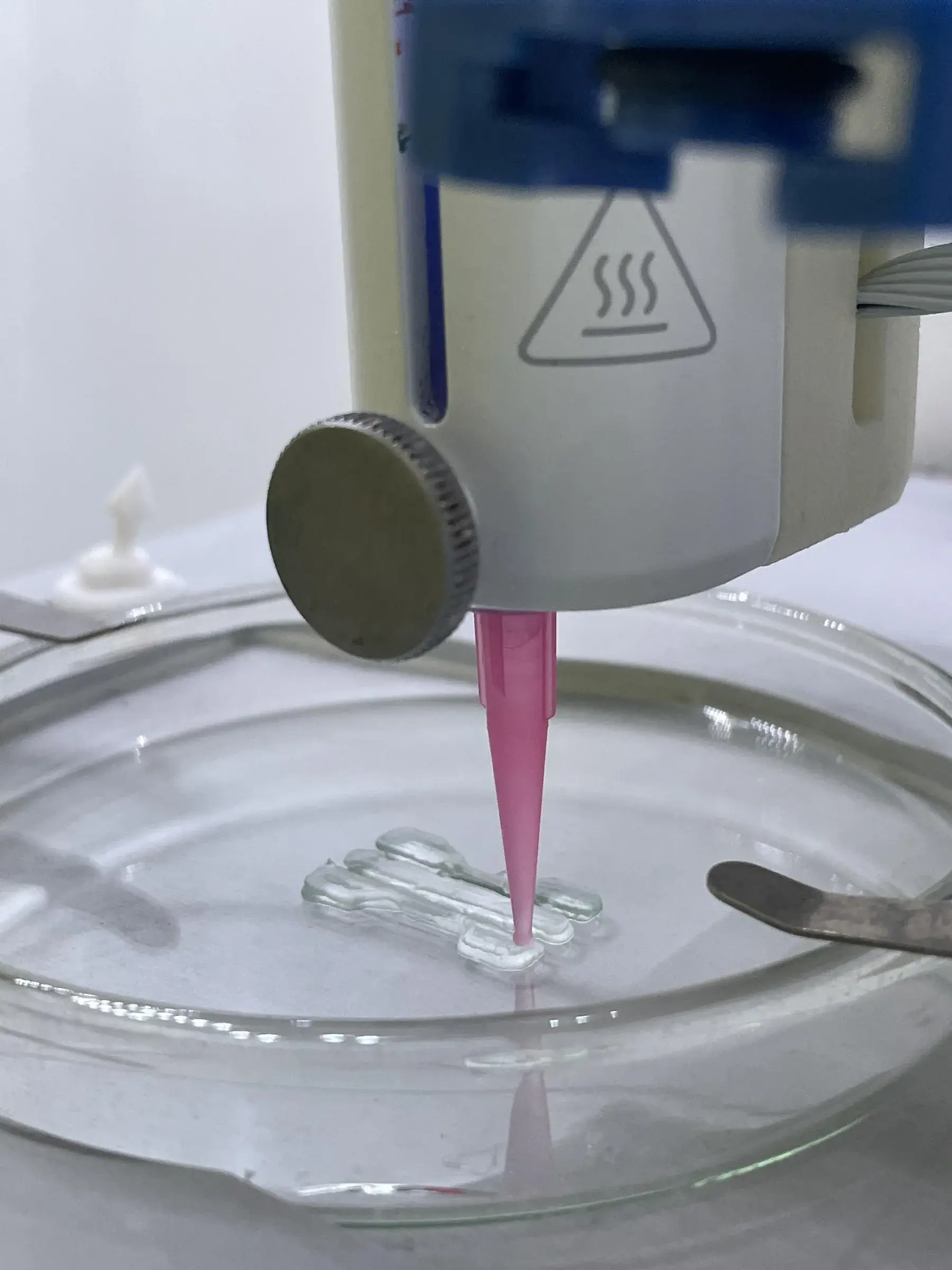
The 2024 paper already used that process for more than printability: by changing the composition of the microparticles and the network connecting them, the researchers produced a broad range of stiffness and ultimate tensile strain, including an elastomer finger with rigid “bones” surrounded by softer “skin”.3
The object therefore did not have to remain one geometry made from one rubber recipe, because composition itself could change during fabrication.
The 2024 work describes local mechanical control on length scales from hundreds of micrometres to roughly a millimetre, depending on process and structure.3 At that point, a printed component begins to have two overlapping geometries: the visible shape and the internal map of mechanical properties.
One question was still open, and the 2026 paper is built around it: was the granular microstructure merely a good way to print and tune stiffness, or did it also change how the elastomer aged and cracked?
Toughness through sacrifice
A simple elastomer consists of polymer chains connected into a network, and increasing cross-link density generally makes that network stiffer while shortening the chain length available for rearrangement and extension; the usual price is reduced extensibility and lower fracture toughness.1
Double-network elastomers divide the work.
The first network is more densely cross-linked, contributing stiffness and dissipating substantial energy when some of its bonds break during a large deformation, while a softer second network provides more stretchability and helps the whole material retain its shape.1
For a large one-off mechanical event, that can be extremely effective because damage spreads through a broader region rather than concentrating all available energy directly at the crack tip; the first network spends part of itself on that dissipation, making the crack harder to drive.
“Sacrificial” is literal enough to create a second problem. If the toughening mechanism depends on bonds breaking irreversibly, the material has paid for today's protection with part of its internal structure. It may resist a severe pull while becoming less impressive when the same loading pattern returns hundreds of thousands of times.1
That is the toughness-fatigue trade-off the granular architecture begins to move.
Uneven by design
A DNGE is not simply a homogeneous double-network elastomer chopped into grains after curing.
Its microparticles form relatively stiff regions containing the first network and, after final curing, part of the softer second network that interpenetrates them; between the particles sit interstitial regions dominated by that second, softer network.1
Composition therefore varies at microscopic scale.
For particular formulations in the paper, softer microparticles swell substantially in precursor for the second network before printing. Once jammed, they leave a large interstitial fraction that becomes the soft connective phase; confocal measurements put that fraction around half of the material volume for particular formulations.1
A conventional materials process might treat such heterogeneity as something to minimise, whereas in DNGEs the heterogeneity itself becomes part of the mechanism.
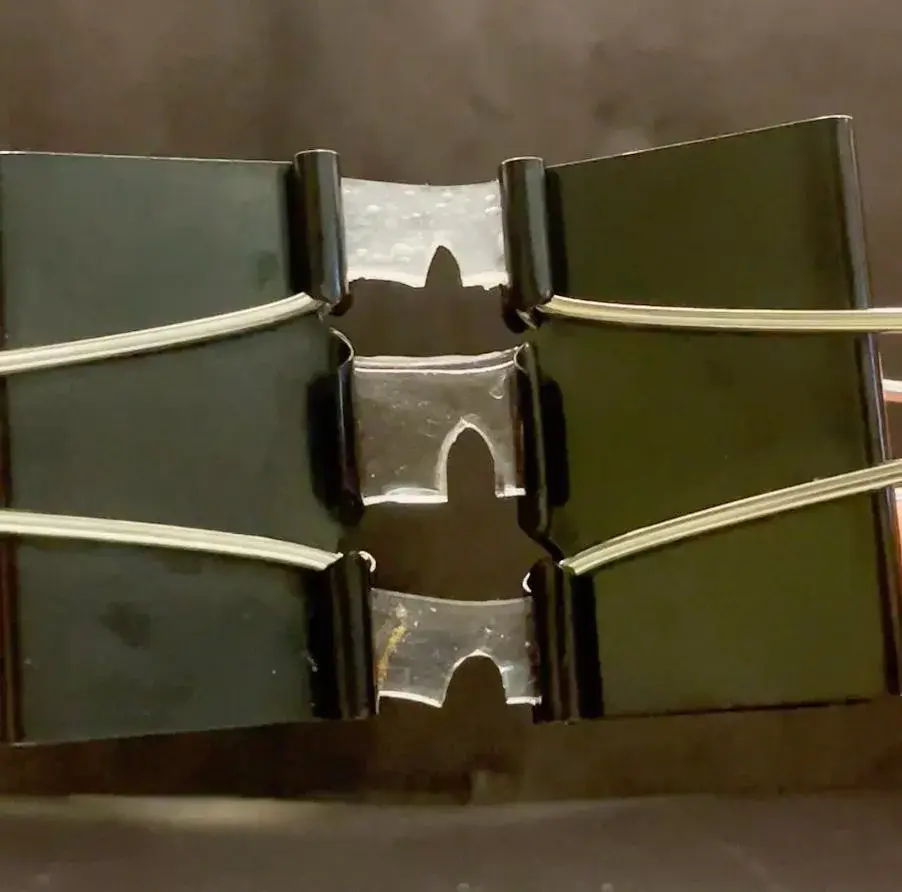
When stress concentrates near a crack, stiff microparticles help redistribute part of that load while softer interstitial regions accept more deformation; under the moderate repeated strains examined by the team, polymer chains in those regions can slide and rearrange, dissipating energy repeatedly instead of forcing new irreversible bond scission in the stiff network on every cycle.12
The material therefore has more than one route for handling motion: large loading can still create permanent damage, but within the cyclic regime studied here, part of the dissipation is available again on the next cycle.
That repeatability is what makes fatigue different from a one-time fracture test.
The crack detours
The microstructure changes a second part of failure: crack trajectory.
In a more uniform medium, a crack advances according to the stress field around its tip, but inside a DNGE it encounters regions with strongly different stiffness and preferentially follows the softer interstitial zones instead of cutting directly through the stiff microparticles.12
The observed crack path is therefore serpentine rather than straight.
The detour cannot stop fracture by magic, but it increases the route a crack has to travel before reaching a critical length while spreading deformation through a less uniform region instead of maintaining one direct path.1
A crude description would be: the crack still gets a road, but the material removes the motorway.
The winding path and the repeatable dissipation come from the same design decision. What made the ink heterogeneous enough to print also gives the solid material mechanically distinct places where stress can move.
The almost-stopped crack
The fatigue numbers deserve their own explanation because a threshold of 72 J/m² is not a strength value read directly from one tensile test.
The researchers use notched samples under cyclic tensile loading, with a camera tracking crack growth while different maximum strains are applied.1
For each loading level, the team calculates an energy release rate, G, representing the mechanical energy available to grow the crack per unit area. Crack growth per cycle is then plotted against that energy release rate.
The experimental difficulty appears when the material becomes good at resisting fatigue. The imaging setup cannot directly resolve arbitrarily slow crack motion; the paper gives a practical resolution limit around one micrometre of growth per cycle.1
The measured region is therefore fitted and extrapolated using a Paris-law relation towards a critical growth rate of one ångström per cycle, which the authors use to define the fatigue threshold for these comparisons.1
That matters in two ways.
First, the final threshold includes both a definition and an extrapolation, rather than a direct observation of the crack becoming motionless at atomic resolution.
Second, the authors note that behaviour may deviate from the Paris law near the threshold regime, while still using this approach because it gives a consistent basis for comparisons within the study.1
Buckling during several strain-controlled tests is another caveat: the paper notes that this effect tends to underestimate the fatigue threshold for certain reference samples, particularly the single-network systems.1
The correct reading is therefore a controlled comparison inside the paper's test method, rather than a universal leaderboard for every elastomer ever published.
The fifteenfold trap
For optimised formulations, the paper reports a fatigue threshold up to 72 J/m², fracture toughness up to 13,500 J/m², and Young's modulus up to 1.1 MPa.1
Those maxima are impressive, although they are also extremely easy to overstate once the specific comparison disappears.
The team compares DNGEs with bulk double-network elastomers of matched overall composition and associated single-network systems. Within those comparisons, DNGE fatigue thresholds reach roughly three times the bulk-DN counterparts and fifteen times the single-network reference. Some fracture-toughness comparisons also reach about fifteen times the corresponding DN or SN systems.1
None of those comparisons means that one sample is fifteen times better on every property, or that a DNGE beats every commercial elastomer by the same factor.
The paper itself includes literature comparisons but explicitly warns that published fatigue thresholds were measured using different methods, criteria and test conditions, so direct cross-study ranking requires caution.1
That caveat is useful well beyond this material. Once a headline turns a specific materials comparison into a universal superlative, most of the engineering information has probably been lost.
The stronger result is the combination, because the granular architecture lets the team obtain high fracture toughness without collapsing the fatigue threshold in the way tough conventional double-network elastomers often do.1
Forty percent stiff fibre
Up to this point, it would be reasonable to imagine searching for one ideal DNGE formulation and printing the entire object from that recipe.
The team takes a different route and uses printing to combine formulations.
Because composition can already change during printing, the researchers fabricate a composite with a soft, fatigue-resistant DNGE matrix containing 40 volume percent fibres made from a stiffer DNGE.1
At this point, manufacturing and formulation become difficult to separate, because the printer is also arranging the mechanical compromise.
The composite reaches a Young's modulus of about 0.53 MPa, roughly four times the soft DNGE matrix while still around half the stiffness of the stiff DNGE used in the comparison.1
Yet the intermediate stiffness comes with a major difference in damage behaviour. Compared with the stiff DNGE alone, the printed composite has almost six times its fracture toughness and about six times its fatigue threshold in the reported tests.1
The authors also observe ductile fracture in the composite, in contrast to the catastrophic failure of the stiff DNGE formulation.1
This changes what “printable material” means. Avoiding a difficult mould is one advantage; the more interesting one is the ability to place different mechanical behaviours deliberately inside the same shape. It can place different mechanical behaviours in space. Rather than asking one rubber formulation to do everything everywhere, stiff regions can be used where they are needed while softer, fatigue-resistant regions interrupt or redistribute damage.
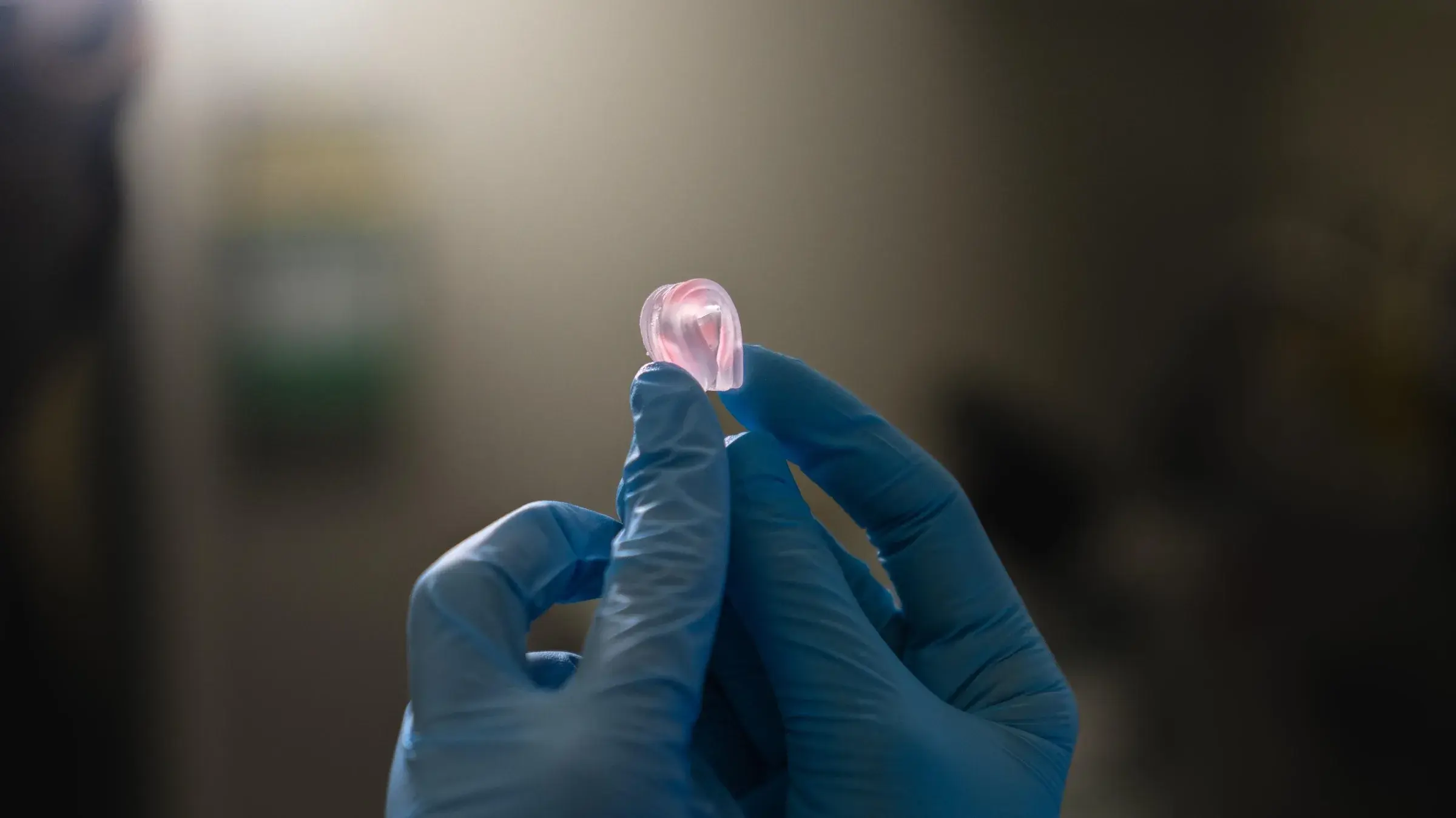
Material has topology
Conventional mechanical CAD defines geometry and then assigns a material, while topology optimisation already lets designers decide where matter is required to carry load; DNGEs add another level because composition and microstructure can also be placed deliberately inside regions where material exists.
The 2024 finger showed this with stiff “bones” inside softer material.3 The 2026 composite makes the mechanical reason clearer: spatially arranging formulations allows stiffness, fracture behaviour and fatigue resistance to be negotiated within the same printed object.1
There are now two overlapping maps: one describes the visible shape of the part, while the second describes how that part should behave depending on where it is loaded.
A soft robot could eventually use compliant hinge regions surrounded by stiffer structures. A wearable might prioritise fatigue resistance near a repeated fold and greater stiffness at an attachment point. These remain application directions rather than products validated by the present study.12
That distinction is important because the paper tests laboratory specimens and printed composites; multi-year clinical service, industrial qualification and durability inside a commercial device remain outside what these experiments establish.
What it does provide is a manufacturing vocabulary that becomes useful before those applications: mechanical property becomes a spatial field.
Printing in air
The free-radical polymerisation used for the second network is sensitive to oxygen, a familiar problem in many photopolymer chemistries that would make the process much less practical if every part required a perfectly controlled inert atmosphere.
The 2026 paper therefore examines DNGEs prepared in air.1
The researchers see reduced stiffness in some formulations, consistent with lower polymerisation efficiency. A soft DNGE prepared in air has a Young's modulus around 0.13 MPa in one comparison, versus roughly 0.23 MPa for its glove-box counterpart.1
Fracture toughness and fatigue resistance can nevertheless remain high. Soft DNGEs prepared in air reach about 13 kJ/m² fracture toughness and a fatigue threshold up to 72 J/m² in the reported conditions.1
That improves the manufacturing story, but the current process is still far removed from loading a spool into a desktop FDM machine.
The material still requires preparation of microparticles, washing, swelling in second-network precursor, jamming into an ink, extrusion and final curing, while the reported chemistry uses butyl acrylate and specific cross-linking reagents.1
The SMaL group is already exploring other curing routes. A 2026 project description, for example, examines moisture-triggered curing as a way around some UV limitations, particularly for opaque samples.2
“Printable on commercial equipment” therefore describes the deposition hardware better than it describes a commodity feedstock ready to order by the kilogram.
The 3.9 GB result
The paper links to an associated Zenodo record containing data behind the tensile, fracture and fatigue measurements, along with material needed to evaluate and reproduce the analysis.4
The deposit runs to several gigabytes, which matters here because the supplementary material is carrying much more than a decorative appendix.
For a result where the fatigue threshold depends on cyclic experiments, crack-growth measurement and extrapolation, access to the underlying data is particularly valuable. It separates the simple statement “better fatigue resistance” from the series of measurements that produced it.14
Reproduction is still not trivial because a lab needs the formulations, particle preparation, printing and curing process, mechanical test equipment and crack imaging, but the final values are at least not locked inside an unqueryable chart.
There is a broader open-fabrication lesson here. For an advanced material, the equivalent of source code is spread across formulation, protocol, geometry, processing parameters and characterisation data. A printable file is only one layer.
Another kind of durability
EPFL says the team is working on biodegradable elastomers and materials derived from recycled sources.2 That direction is relevant, but it should not be merged into the current mechanical result.
The 2026 paper demonstrates an architecture that changes fracture and fatigue trade-offs; whether the present formulations have a lower environmental footprint than elastomers they might eventually replace is a separate question that this study does not answer.
The two questions meet only in a larger lifecycle analysis. Longer-lasting parts can reduce replacement and waste, but production chemistry, recyclability and end-of-life still matter. Likewise, a recyclable or biodegradable formulation that loses necessary fatigue resistance would not automatically be preferable for a highly loaded component.
The lab is actively working in this wider space, including dynamic and recyclable granular networks in related projects.2
For the paper discussed here, the verified result remains mechanical and process-related.
Shape and material converge
“Smart material” is often used whenever a polymer changes colour, shape or conductivity. DNGEs point towards an idea that is less magical and perhaps more consequential for fabrication.
Material is no longer waiting passively for geometry to give it a function: granularity determines whether the precursor can behave as an ink, the division between microparticles and interstitial network affects stiffness, dissipation and crack propagation, composition can change while printing, and the resulting pattern can mix stiff and fatigue-resistant regions inside one object.13
In 2024, the central question was close to: how do we print an elastomer whose mechanics change locally?3
In 2026, the same system adds a second answer: that heterogeneity can also reduce the usual conflict between fracture toughness and fatigue resistance.1
The connection between processing and mechanics matters more than any isolated record value.
A homogeneous material usually forces a designer to select one recipe and compensate for its weaknesses through shape, whereas here macroscopic geometry and material architecture can be designed together: a rib can change composition instead of merely becoming thicker, and a hinge can use a formulation selected for repeated cycling instead of merely becoming thinner.
We are not yet at the point where a designer clicks “high fatigue resistance” in Blender and lets the printer invent a formulation. Between this paper and that ideal tool lies a substantial chain of modelling, calibration, mixing, process control and qualification.
The direction is nevertheless clear.
For decades, one promise of 3D printing has been to free geometry from constraints imposed by machining and moulding. DNGEs add another ambition: free local mechanical behaviour from the assumption that a part has to be made from one uniform material.
At that point, designing the object and designing its material start becoming the same job.