A miniature motor has an annoying problem: even if the motor itself can be made small, it still needs energy, a way to transmit motion, structural parts and surfaces that survive friction. At millimeter scale, every bearing, magnet, coil and wire becomes a substantial fraction of the machine.
A team at EPFL tried a different strategy. They print a hollow cavity, tune it to an acoustic frequency and let an external sound source provide the energy.1
When the frequency matches the cavity's resonance, air oscillates inside it. At the opening, outgoing flow forms a more concentrated jet than the diffuse incoming flow. That asymmetry creates thrust.12
The machine has not miniaturized a conventional electric motor. It has turned geometry into an actuator and moved part of the system into the environment.
The bottle-note engine
The underlying effect is Helmholtz resonance. Blowing across a bottle gives a familiar version: the volume of air in the cavity and the air moving through the neck have a natural resonant frequency.
The EPFL researchers use the resonance in another direction. External sound drives the air in the cavity, while the neck geometry turns that oscillation into directed flow.1
The Science Advances paper demonstrates structures from centimeter to micrometer scale, with reported thrust from millinewtons down to micronewtons.1
Small boats use up to three cavities for propulsion and steering, with excitation delivered either through the air or through the structure.12
At this scale, the device does not necessarily have to carry the transducer producing the sound. That is both the central advantage and an obvious constraint.
Power stays outside
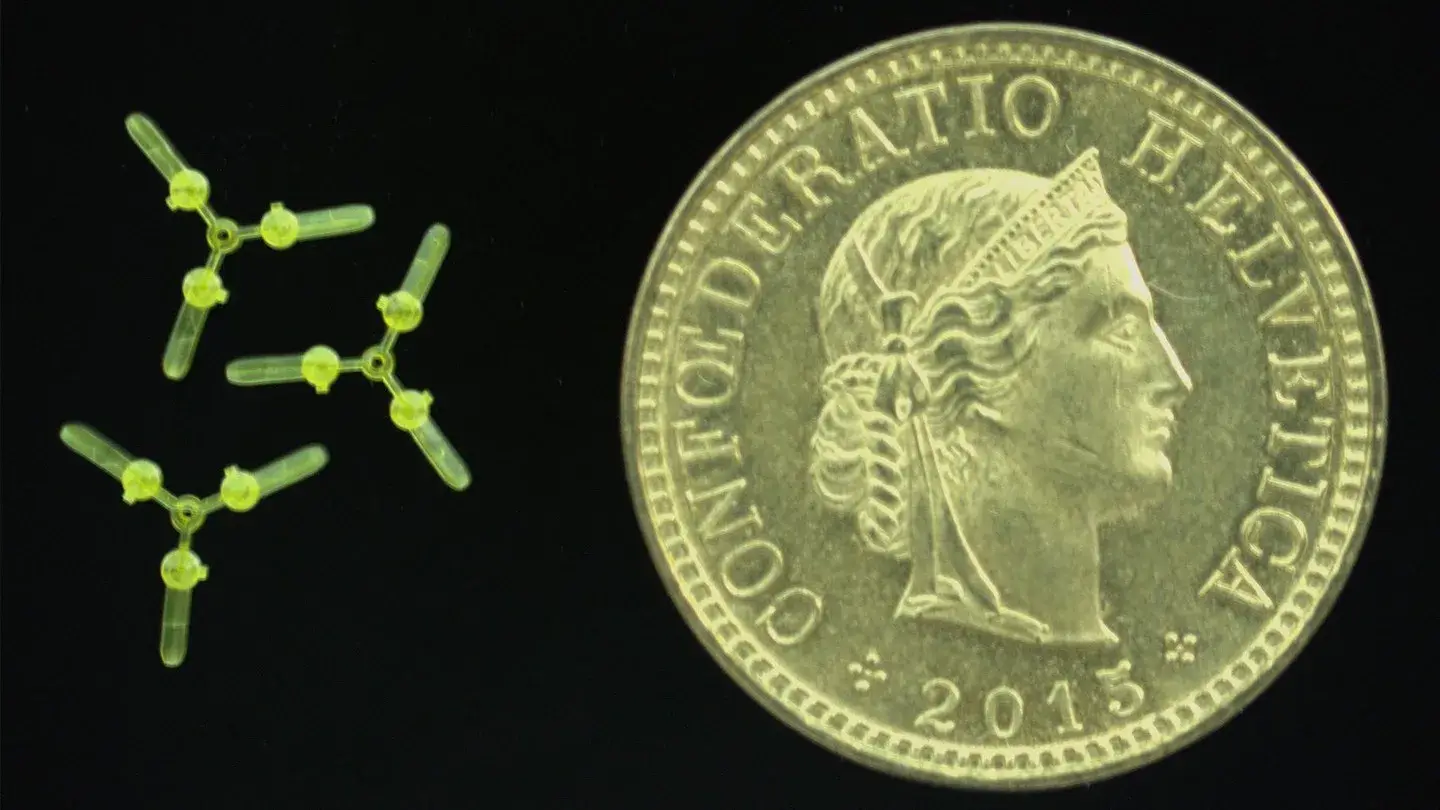
The most striking experiment uses 3D nanoprinting to integrate three cavities directly into a polymer microflier.2
One design weighs 150 micrograms and generates direct vertical thrust. The paper reports a thrust-to-weight ratio of 4.9.1 Another 184-microgram design uses the cavities to drive tiny blades, reaching up to 13,000 revolutions per minute.12
The microfliers are excited at ultrasonic frequencies above human hearing.2
Those numbers are impressive only if the thing outside the frame remains visible: the acoustic field powering the object. The microflier is not autonomous in the way a battery-powered quadcopter is. It is closer to a device operating inside wireless energy infrastructure.
Hackaday highlights the distinction: the boat can carry transducers on its structure, while the microflier's mass budget pushes the ultrasonic source outside the flying device.3
Move what will not shrink
That may be the project's most reusable lesson.
When a component refuses to become small enough, one option is to ask whether it has to remain inside the object at all.
Industrial robots can keep heavy computation elsewhere. Passive RFID tags omit a battery and harvest energy from the reader. Here the tiny robot mainly retains geometry capable of selecting and converting acoustic energy at a particular frequency.
Selman Sakar's team suggests that several structures tuned to different frequencies could eventually be integrated into one flexible device. Changing the applied sound could make different regions move, bend or vibrate.2
That begins to resemble less a conventional miniature robot than a material whose parts respond to different notes.
This remains a research direction, not a product. The current experiments rely on controlled acoustic excitation, the absolute thrust is tiny, and whole-system efficiency matters as much as the elegance of the actuator.
But the demonstration changes the design question.
Instead of asking “how do we fit a motor into 150 micrograms?”, it becomes possible to ask: “what is the smallest structure that can transform energy already supplied by its environment?”
At that scale, a carefully sized hole can become a machine.