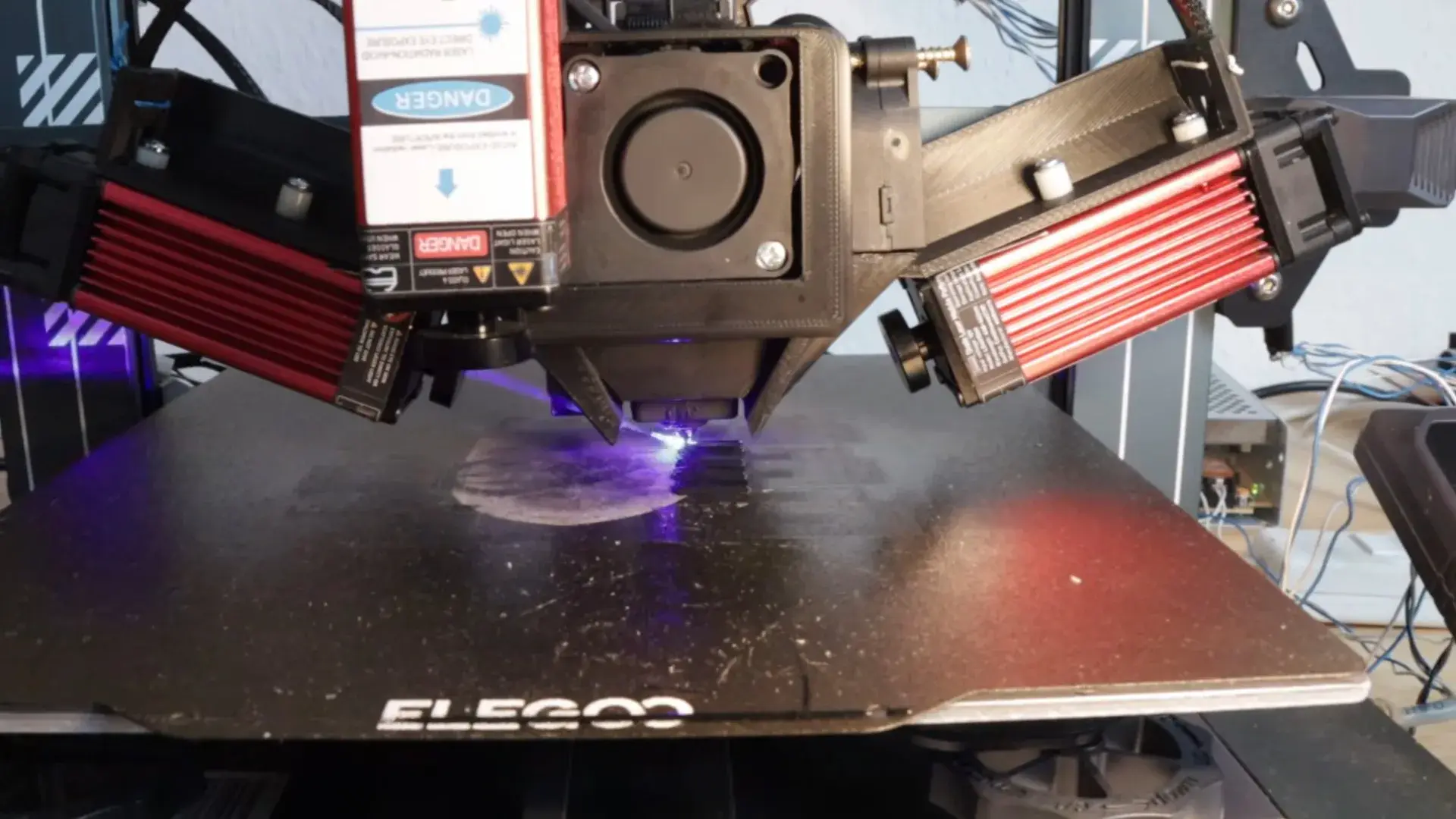
The familiar weak point in an FDM print sits between layers. A nozzle lays hot material onto a surface that has already cooled, so strength along Z can remain far below strength within the layer plane. A modification shown by I Changed a Thing attacks that problem with an almost aggressively literal idea: heat the previous layer again immediately before the next one arrives.1
Two laser modules sit around the toolhead. One locally reheats the previous layer just ahead of the nozzle. The second extends the hot zone. The aim is not to melt a broad area of the part, but to let newly extruded polymer meet material that is still hot enough to form a better bond.1 2

The numbers are striking as long as they stay attached to the experiment that produced them. Hackaday reports up to 94% for ABS and 77.9% for PLA, compared with roughly 60% and 41% without the lasers in the demonstrated tests.1 Those values should not be promoted into general numbers for ABS or PLA. Geometry, filament, temperature, speed, specimen orientation and test method all matter. This is evidence for a direction, not a new constant of additive manufacturing.
The modification also moves the engineering compromise elsewhere. Two laser modules, mounts and wiring add mass to the toolhead. On a fast CoreXY machine, that weight may become a motion problem before layer adhesion stops being one.1 Putting lasers next to a hot extrusion process also means the integration has to be treated as machine design, not as a decorative clip-on accessory.
The interesting part, then, is not the phrase “isotropic print”. Hackaday explicitly notes that the resulting parts are not fully isotropic.1 The useful idea is the timing. Instead of changing only infill, geometry or the printer’s overall temperature, the modification targets the interface a moment before it disappears under the next layer.
FDM has spent decades learning to live with visible layers. This experiment treats the boundary between two of them as a welding process in its own right. That is more interesting than any single percentage.