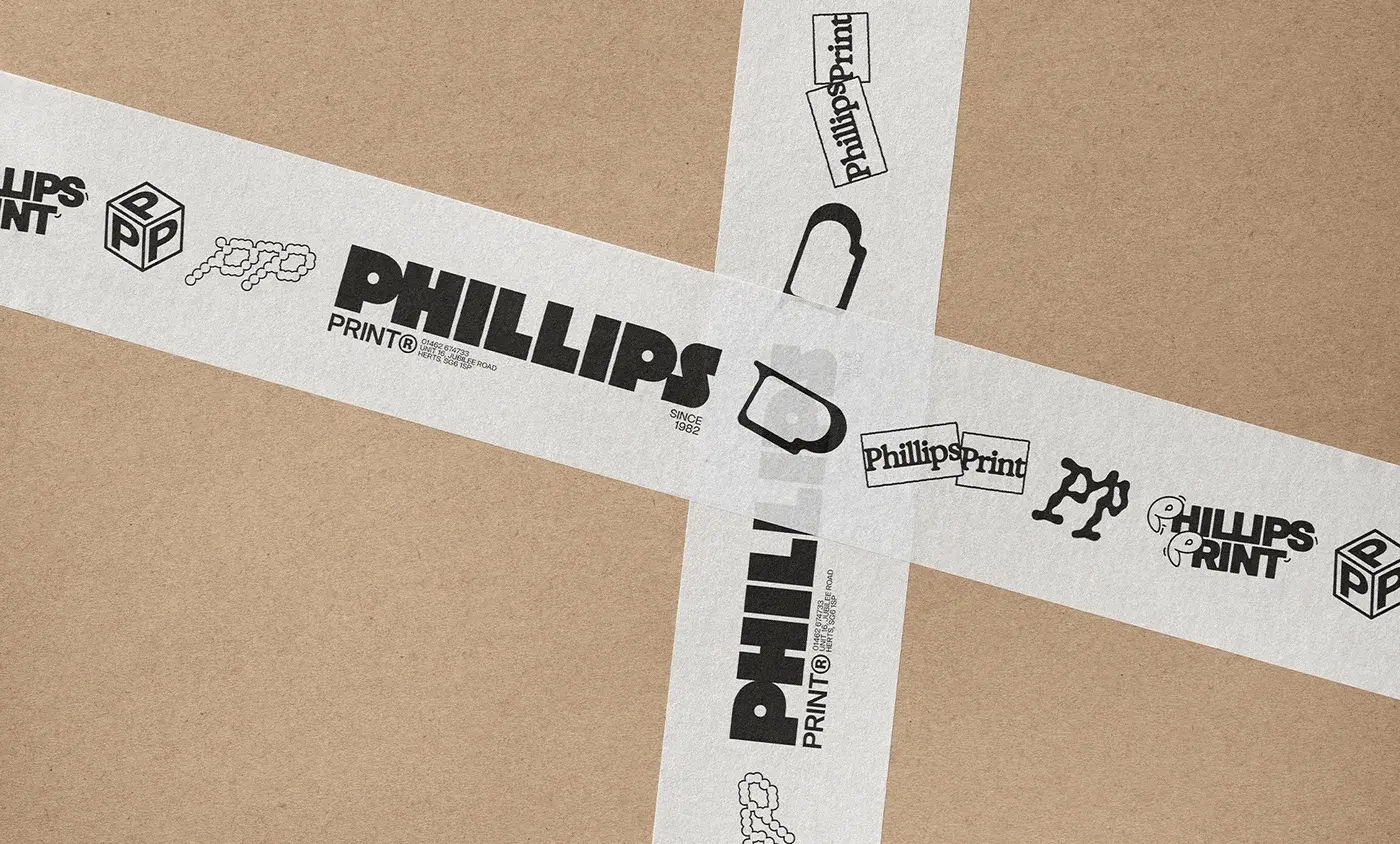
A print shop provides a rather unforgiving test bench for its own identity, because the mockup can move straight from the screen into the machines that will later reproduce it for real.
While Laura Clink was redesigning Phillips Print, Liam Phillips was not only reviewing mockups on a screen. He kept printing flyers, stickers, merch and vinyl, then sending the tests back to the designer.4 The surfaces that would eventually carry the brand therefore helped shape it.
The finished identity contains a custom-drawn wordmark and nine interchangeable logos.4 Calling the result “flexible” is easy; the operational question arrives after handoff, when the printer has to choose, combine and produce those variations without bringing the studio back for every application.
Nine doors
Phillips Print is a small family-run printer in Letchworth Garden City, north of London. The company presents itself as founded in 1984 and operates today with a small team.35 Laura Clink describes it as a third-generation business built around word of mouth, regulars and conversations rather than a fully automated buying journey.1
The new language starts from that way of working. Clink summarises the project as “People printing for people” and lists her scope as strategy, brand identity, messaging, illustration, and website design and build.12
The wordmark gives the system a centre, but it does not have to sign every application in exactly the same way. Nine marks rotate around it.4 Clink also brought a version of the original 1984 logo back into that family rather than treating the company's past as something a rebrand needed to erase.1
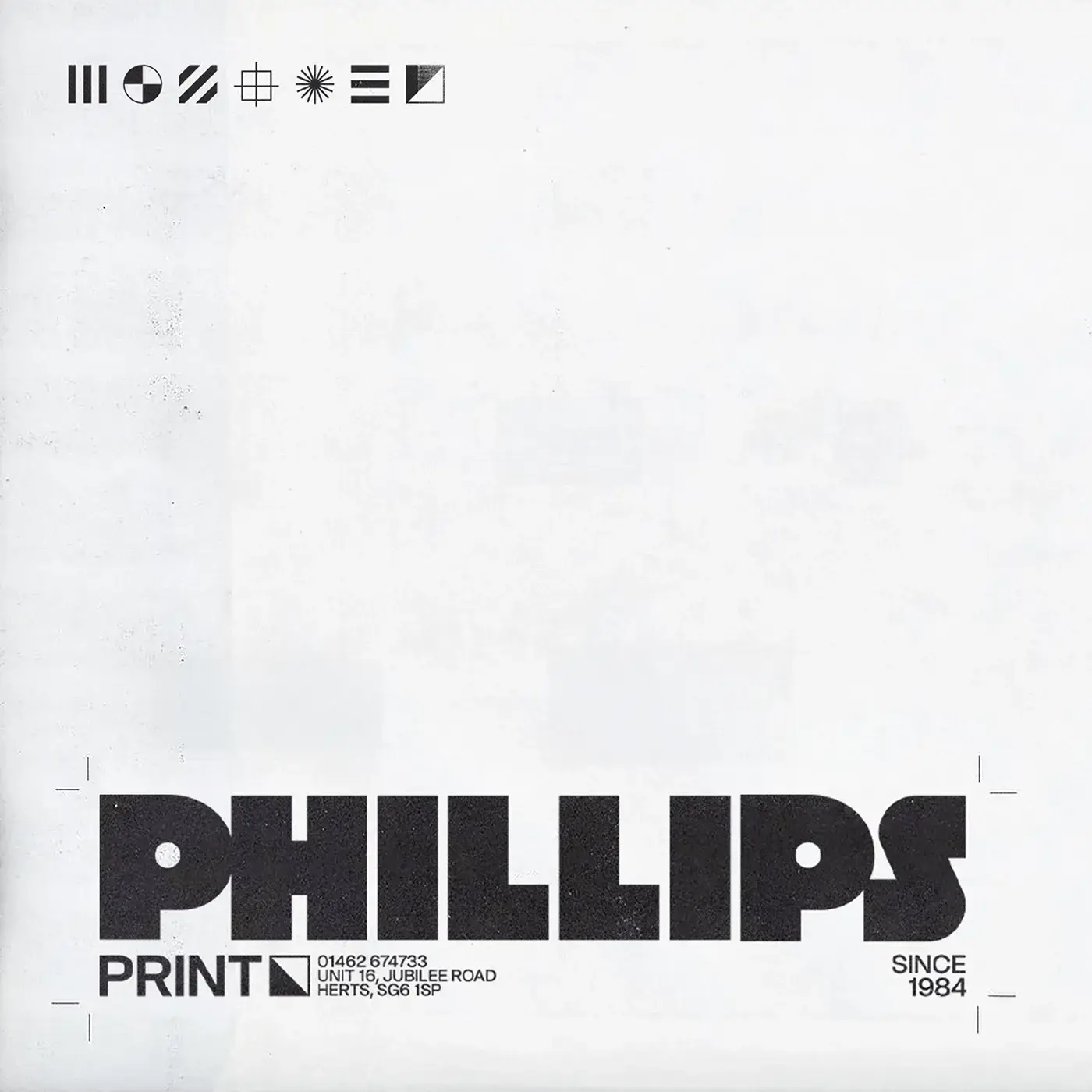
Keeping the old mark in circulation avoids the usual clean break of a rebrand, allowing the system to signal a generational change while retaining a visible piece of the company that started four decades earlier.
Test it early
This client has an unusual advantage: it owns the machinery that materialises its brand.
It's Nice That reports that Liam Phillips continuously printed tests during development.4 A team can therefore see immediately whether a mark survives on a sticker, whether an illustration works on merch, whether vinyl retains enough presence, or whether a composition that felt obvious on screen goes soft once it becomes a physical object.
The public material gives no measurements for colour accuracy, long-term durability or production economics, so the proofing loop cannot establish any of those claims. What it does establish is narrower and useful: graphic decisions met real outputs before the project was finished.
That distinction matters for a printer. The client's product is not an interface that will always appear on roughly the same display. Phillips Print offers flyers, brochures, large-format work, cards, exhibition materials and bespoke jobs; its site also emphasises short runs, same-day service and custom requests.3
An identity that demanded the same rigid lockup everywhere would almost work against that variety of output.
Bounded freedom
Flexibility has a very ordinary failure mode: it can move every unresolved decision onto the client.
If every logo, colour, crop and message can change without a rule, the client has not received a system. It has received a folder of options and the responsibility for guessing which ones belong together.
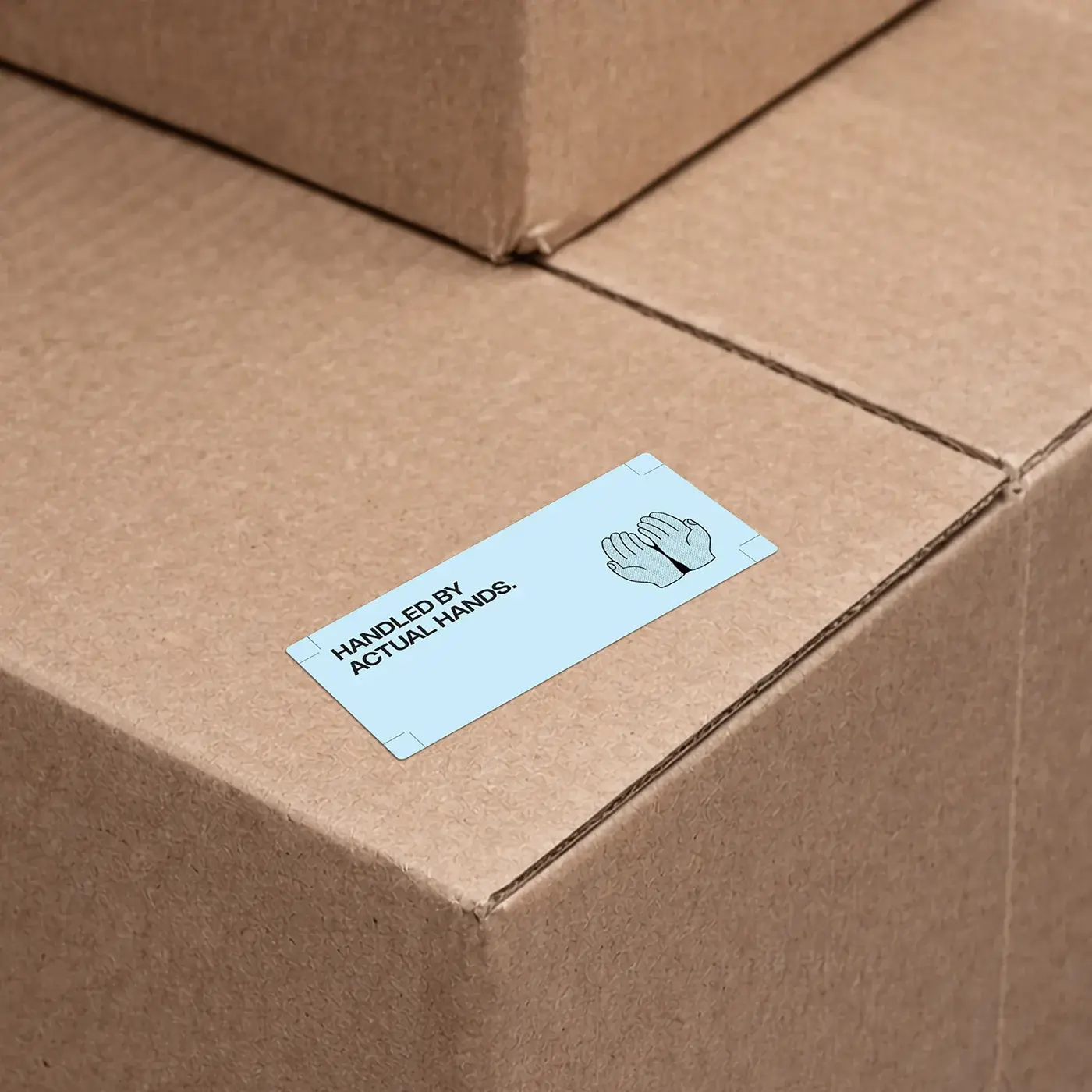
Phillips Print avoids at least part of that trap by keeping the ingredients simple: a heavy wordmark, a limited family of marks, recognisable illustrations and direct language.1 The current site carries that voice with lines such as “Printed by real people” and “Proper print without the faff.”3
Clink says the nine logos are meant to give the client enough room to experiment itself, including on company merch and shirts for the Letchworth Garden City Eagles, the local football club Liam played for as a child.4
The sources do not describe an algorithm that chooses a logo for each medium, so there is no reason to invent one. The rule appears more human: keep the same vocabulary and let the team select the expression that fits the situation.
No generator
IRZ recently looked at another flexible identity, De Bijloke by Pentagram. In that project, transfer happens through a generator: the internal team receives software that can produce new variations from defined rules.6
Phillips Print reaches the same problem from the other end. There is no public generator, no parameter panel and no promise of infinite forms. The client receives a small enough set of parts to manipulate directly.
The common point matters more than the aesthetic difference: flexibility has to be usable by whoever stays after the studio leaves. De Bijloke encodes that handoff in software, while Phillips Print reduces it to a finite group of marks, a voice and rules simple enough to manipulate directly.
The handoff
The new website was the core deliverable, but the project did not end there.4 Phillips Print's live site now shows the language in use: the same direct voice, the same emphasis on proximity, and the same proposition that the job is handled by actual people.3
Nothing here guarantees that all nine marks will still be used well in five years; only the shop's future output can answer that. It is nevertheless a stronger starting test than a launch case study whose entire set of applications was produced by the design studio itself.
The client was already printing the brand while it was being drawn. After delivery, that production does not change hands: it stays with the people who participated in the tests.
A flexible identity is therefore not measured only by how many versions appear in a portfolio. It is also measured by how many decisions the client can make without asking the designer for permission.