A temporary pavilion can collapse into a postcard very quickly: a handsome shape, a few photographs in hard light, then a paragraph about public space loose enough to fit almost any lightweight structure. Paso Nara is worth holding a little longer. Its useful constraint arrives after the image, when a student workshop has to turn a drawn form into a public object and then plan for that object to leave.
Students at the Instituto Superior de Arquitectura y Diseño in Chihuahua designed the pavilion, built it at 1:1 scale, installed it on Plaza de Armas, and announced a later trip to Mextrópoli 2026 in Mexico City.1 Once those conditions are on the table, the question stops being only whether the object creates shade downtown. The sharper question is how a geometry borrowed from a textile reference becomes CNC-milled plywood parts, assembled in public, demountable, and robust enough to be treated as more than a festival prop.
ISAD describes Taller del Desierto as a four-week exercise in research, prototyping and real fabrication, where error and collaboration belong to the teaching model.1 The 2026 programme says it more bluntly in recruitment language: “Obra real. No maqueta. No hipotético. Real.”2 The page is selling the programme, so its tone needs discounting, but the frame still matters: the rendering is not the end product here; the passage through physical production is.
The Curve As Fabrication Problem
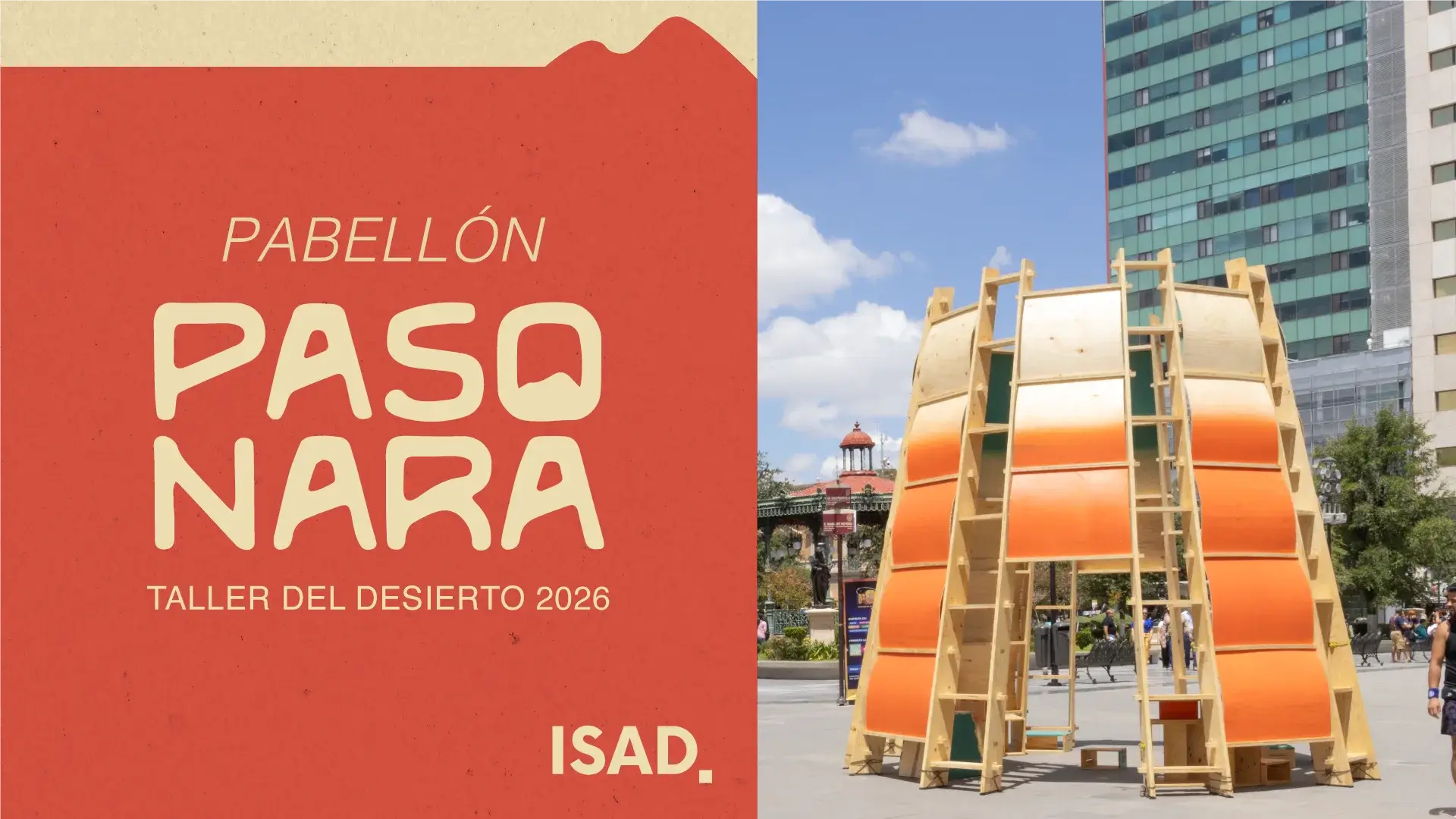
On paper, the form has a clear origin: Paso Nara’s conical geometry borrows the spatial logic of traditional Rarámuri skirts rather than simply quoting their appearance. It narrows toward the sky and widens at the base to increase the shaded area and gathering zone.1 Pleasant as that explanation may be, it only starts to matter when it touches the workshop floor.
Designboom reports curved plywood panels, sixteen repeated modules, a radial arrangement and mechanical timber joints based on gravity, compression and wooden wedges rather than conventional metal fasteners.3 It also says the components were fabricated by three-axis CNC milling directly from digital models, without on-site modification.3 If that account is accurate, the formal reference is no longer just a story attached to a silhouette; it becomes a set of decisions about repeatable parts, tolerances, bending, sequencing and assembly.
This is where the project becomes concrete for IRZ. Plenty of student projects can produce a meaningful form on a presentation board, especially when the reference is culturally legible and the rendering is kind. Paso Nara has a harder test because the form has to absorb plywood behaviour, assembly sequence, transport and future dismantling.
ISAD says the students explored a hybrid process between hand drawing and digital modelling, then brought each pavilion part to three-axis CNC fabrication under the guidance of Daniel Romero Valencia, Mauricio Rey Villarreal, Juan Castillo Cruz and Alexis Pereda Chánez.1 A three-axis CNC router appears in the school’s own FabLab equipment list.4 The open sources do not locate every cut, so we cannot audit the shop route part by part. Still, the technical vocabulary matches facilities the school says it has.
What Is Verified, And What Is Missing
Twenty-three students, all named by ISAD, made the project within Taller del Desierto 2026.1 It was announced for Plaza de Armas in Chihuahua, at the intersection of Avenida Independencia and Calle Victoria, from July 25 to August 8, 2026, before a planned move to Alameda Central in Mexico City during Mextrópoli, from September 17 to 20.1 Those details are relatively solid because they come from the institution and are cross-checked by Designboom’s project sheet, which also provides photography credits and team roles.3
I would not make more of the dates than they can carry. A public installation window and a planned festival appearance tell us that the pavilion entered a civic schedule, with an address, a deadline and a next stop; they do not tell us whether the second assembly will be painless, whether the plywood will weather kindly, or whether anyone will keep documenting the piece once the launch photographs have done their job.
What is missing matters just as much as the neat project information. The available sources do not publish a material bill, full nesting files, assembly time, wind behaviour, maintenance protocol or post-dismantling report, and that gap keeps the word “reusable” in its proper place: a credible technical intention, not a demonstrated performance. The official ISAD pages we checked also carry unrelated spam-like footer material, which is another reason to separate the named project text from any broad trust in the website as a clean source.
Read that way, Paso Nara does not prove that CNC timber solves temporary urban architecture. The lesson is narrower and more useful: once a workshop makes students deliver a public piece, digital fabrication stops being a software aesthetic and becomes a negotiation with material, joints, public use and the planned second life of the object. On the square, the pavilion offers shade and a pause; in the process, it forces a rarer kind of learning, the design of a form that should not end when it has been photographed.