In August 2019, Open Source Ecology compressed its entire wiki into a single 2.96 GB file. A ZIM archive, small enough for an SD card, readable on any Android phone running the free Kiwix reader. The official announcement put it plainly: the "blueprints-for-a-civilization" available off-grid, on an off-the-shelf phone.1
Call it what you want, this wiki is no storefront. The bills of materials, CAD files, build instructions and version genealogies of the fifty Global Village Construction Set machines live there, from the open-source tractor to the compressed earth block press.1
The interesting part arrives seven years later. The wiki kept living: 15,075 content pages, 18,218 uploaded files, 329,129 cumulative edits.6 But the newest offline copy anyone can publicly download is still the one from August 2019. A second archive was built in 2021. Its official link no longer works, and the fallback link now returns a 404.2
The file's story doubles as a lesson about documentation in open hardware projects. A copy does not survive because it was created. It survives when someone puts it somewhere that does not depend on the project.
The machines' memory
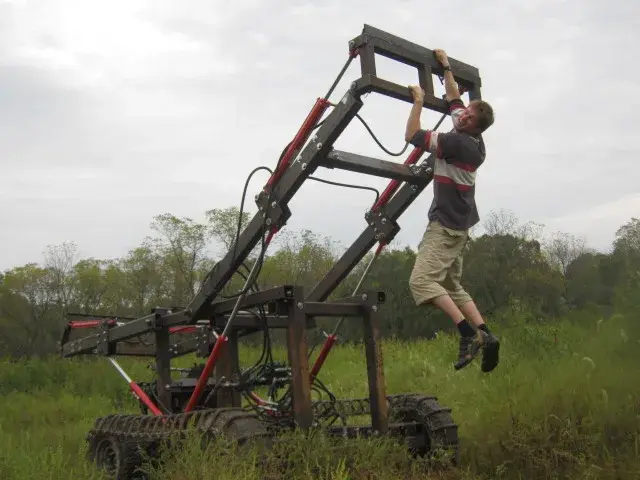
The Global Village Construction Set is OSE's founding bet: fifty industrial machines supposed to be enough to start a decentralized life. On paper, each one must be reproducible by someone who has never set foot in the Missouri workshop. That promise rests entirely on the wiki: exact bills of materials, CAD files, build procedures, version history.1
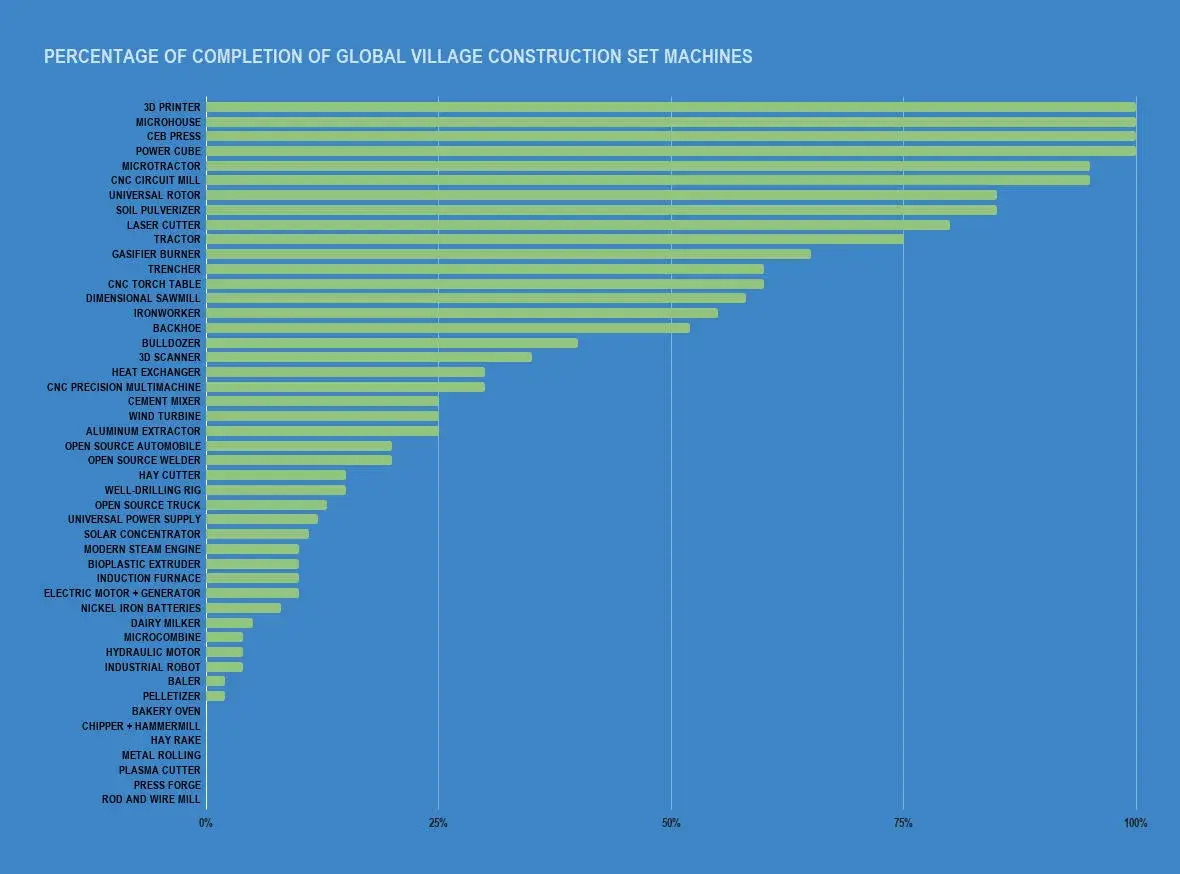
Completion varies wildly from one machine to the next. The completion chart published with the announcement squeezes everything into a single image: the 3D printer, the microhouse and the earth block press near 100 percent, the tractor around 75, and a good half of the catalog still below 25.1
In an open hardware project, this documentation does not accompany the product. It is the product. An earth block press whose wiki disappears becomes an anonymous machine again, with no plans and no repair history.
IRZ has already covered how OSE turns that documentation into a teaching tool at its Future Builders Academy, where students must document every build gesture. The offline copy defends the other end of the same logic: protecting the project's raw material from server failure.
No robots allowed
The naive solution would be to mirror the site with any scraping tool. The team itself documents the wall: the OSE wiki "is not written for scraping," with a restrictive robots.txt, denial-of-service protections and limited hardware resources. No existing scraper tunes finely enough to stay polite.2
The workaround takes two steps.
First, restore a full backup of the wiki (SQL dump and file tree) onto a private server, carefully kept off the internet. Then scrape that local copy at whatever pace you like, without ever hammering the real server.2
In practice, this is a sysadmin job from start to finish. It needs the server admin's approval, and the page warns that a MediaWiki backup carries sensitive information, database passwords included. Even the final file name is imposed, following the osewiki_en_all_YYYY-MM.zim pattern, because the Android app ignores files that break the format.2
The page also recommends a numerical end-of-run check: count the scraped pages and images, then compare with the wiki's official statistics to measure what the copy missed.2
Closed loop
To turn the local copy into a ZIM, OSE picked Zimmer, a Node.js tool that dumps the wiki into static HTML and packs the result, optionally recompressing images to save space.4 The choice is not aesthetic. The standard scrapers of the MediaWiki ecosystem demand heavy dependencies, Parsoid and Redis first, out of reach for a small wiki on a tight budget. Zimmer needs nothing but Node and tolerates old MediaWiki engine versions.4
ZIM is an open format built to store entire websites in compressed form, Wikipedia first in line. Its best-known reader, Kiwix, has existed since 2006 for exactly that reason: reading Wikipedia without internet, born between an offline kiosk prototype in Bamako and a mother without a connection in rural France. The association, based in Lausanne, estimates that more than half the world's population still lacks reliable network access.5
OSE's archive was built by Christian Rupp, a developer on the project, with a how-to video alongside.1 The gesture comes down to a command line; the idea behind it is much bigger: putting a Missouri workshop's documentation into the pocket of someone with neither fiber nor 4G.
Seven years later
The August 2026 inventory fits in a few lines.
The first archive, from August 2019, is still downloadable from the Internet Archive: 2.96 GB, a torrent as a bonus, an explicit CC BY 4.0 license.3 It is the only one.
The second, dated April 2021, took a more revealing path. The wiki page referencing it admits the official link "is not working for unknown reasons" and points to a developer's personal cloud.2 Checked on August 25, 2026: that fallback now returns a 404 error. The Zimmer repository, for its part, has not recorded a single change since April 2021.4
Even Kiwix's official library, which hosts hundreds of offline collections, offers no Open Source Ecology ZIM. Its catalog was checked on this article's publication day.
What survives
So a project built to protect knowledge from loss watched its own links rot. That irony is not the most useful detail here, though.
What survived is the copy placed with a third party. The Internet Archive belongs to OSE no more than the wiki server does, but the file was deposited there with a clear license and a torrent, and it still works. The home-made links, meanwhile, gave out: the wiki's download page, then the personal cloud.
The second lesson is less comfortable. An unsynchronized copy becomes a false source. A builder following the 2019 archive to reproduce a machine updated since risks executing an abandoned procedure, with no way to know from the field. Version synchronization has been an open question in practice since the first archive, and the 2021 attempt remains the last known answer.2
Until an up-to-date ZIM appears, the project lives with a paradox that nobody dramatizes. The online wiki is alive but depends on a server maintained by a handful of people: nine active contributors last month, for fifteen thousand pages.6 The offline copy is robust but frozen in the summer of 2019.
The only version you can put in a pocket is seven years out of date.