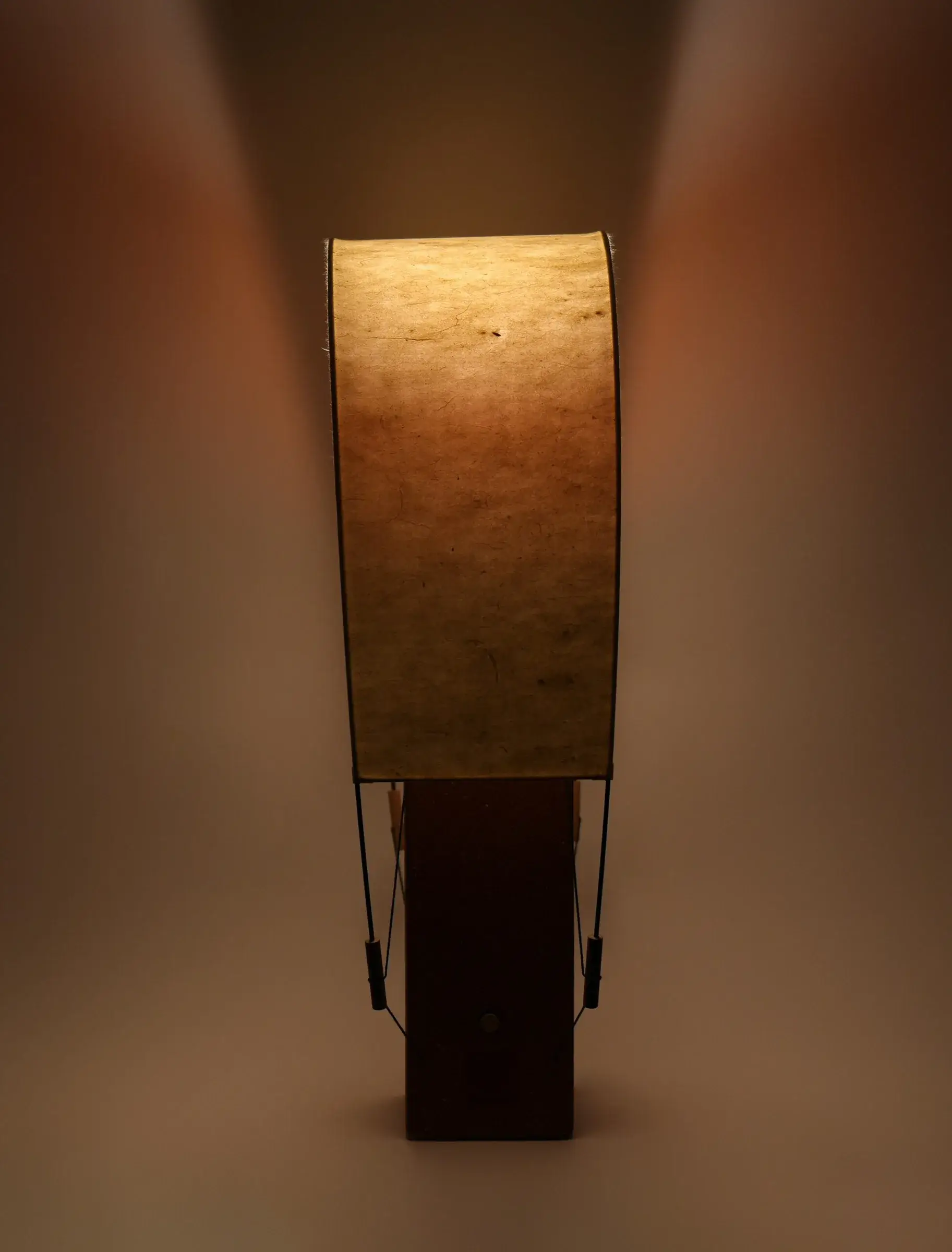
Maison Cédrat's Lumia weighs 8.8 kg. Its extruded-clay base stands roughly 37 cm high, while a Japanese paper veil spreads across about 45 cm above it; seen only as a material pairing, the object looks like an exercise in contrast between a mineral block and something barely heavier than a sheet.1
The construction tells a better story. Clay does not diffuse the light, paper does not carry the lamp, and neither material is asked to solve the joint between them. Turned beech, fiberglass hoops and wooden handles occupy that middle layer, allowing the veil to tilt forward, backward or sideways.1
The lamp works because each material receives a relatively narrow job.
Clay carries
Lumia uses an extruded-clay foot offered in terracotta, waxed raw clay and black finishes. Maison Cédrat lists the complete lamp at roughly 70 × 45 × 20 cm and 8.8 kg.1
That mass is not merely visual. A 45 cm shade that changes angle needs a base that remains settled while the upper part moves, so the clay contributes weight and volume as well as colour. Maison Cédrat also says the different finishes alter the tone taken by the light.1
Designboom describes the Aura collection through the contrast between mineral weight and the near-weightlessness of handcrafted washi, while FORMÆ similarly treats brick and paper as two parts of the same luminous atmosphere.36
What those descriptions do not immediately show is the small structural system between the materials.
Paper diffuses
The veil is made from artisanal Japanese paper, and Maison Cédrat's recent material posts identify Atelier Papetier as the maker.1
The workshop is based in Salasc in southern France. Benoît Dudognon and Stéphanie Allard make Japanese-style paper from locally harvested kozo, or paper mulberry, and describe producing natural white sheets from 7 to 100 g/m² while adapting size, texture and thickness for particular projects.5
For lighting, Atelier Papetier makes the material case directly: long kozo fibres can provide substantial mechanical strength while a thin sheet remains capable of diffusing light. The workshop documents paper being glued, sewn onto structures or suspended below lighting in architectural projects.4
None of this tells us the exact grammage used by Lumia, which Maison Cédrat does not publish. It does explain why a sheet-like material can serve as a large functional surface as long as nobody asks it to support the 8.8 kg underneath.
The paper can stay light because another component is responsible for keeping its shape.
The veil moves
Lumia's shade is not fixed in one position. Two handles let the user tilt the veil, which Maison Cédrat describes as a way to change the direction and character of the light.1
This movement makes the armature important. The fiberglass hoops hold a light geometry, while the beech support transfers the user's gesture without requiring fingers to grab the paper itself. Isola's Lumia listing also describes an orientable veil, and a retailer warns that the paper should be handled through its wooden grips to avoid damage.7
That detail is more useful than the usual language about Mediterranean atmosphere: the hand adjusts the light through a durable part instead of handling the fragile material directly.
Paper is allowed to remain paper because the control interface belongs to wood.
Nova separates it
Nova, the pendant in the same family, pushes the separation further. Its extruded-brick core measures about 10 × 10 × 44.5 cm and the complete fixture weighs 4 kg, while the circular paper veil reaches 60 cm in diameter.2
Maison Cédrat states that the veil is attached with magnets and that a replacement shade can be requested.2 The rest of the assembly includes a brass canopy and rod, turned-beech pulleys and tungsten handles.
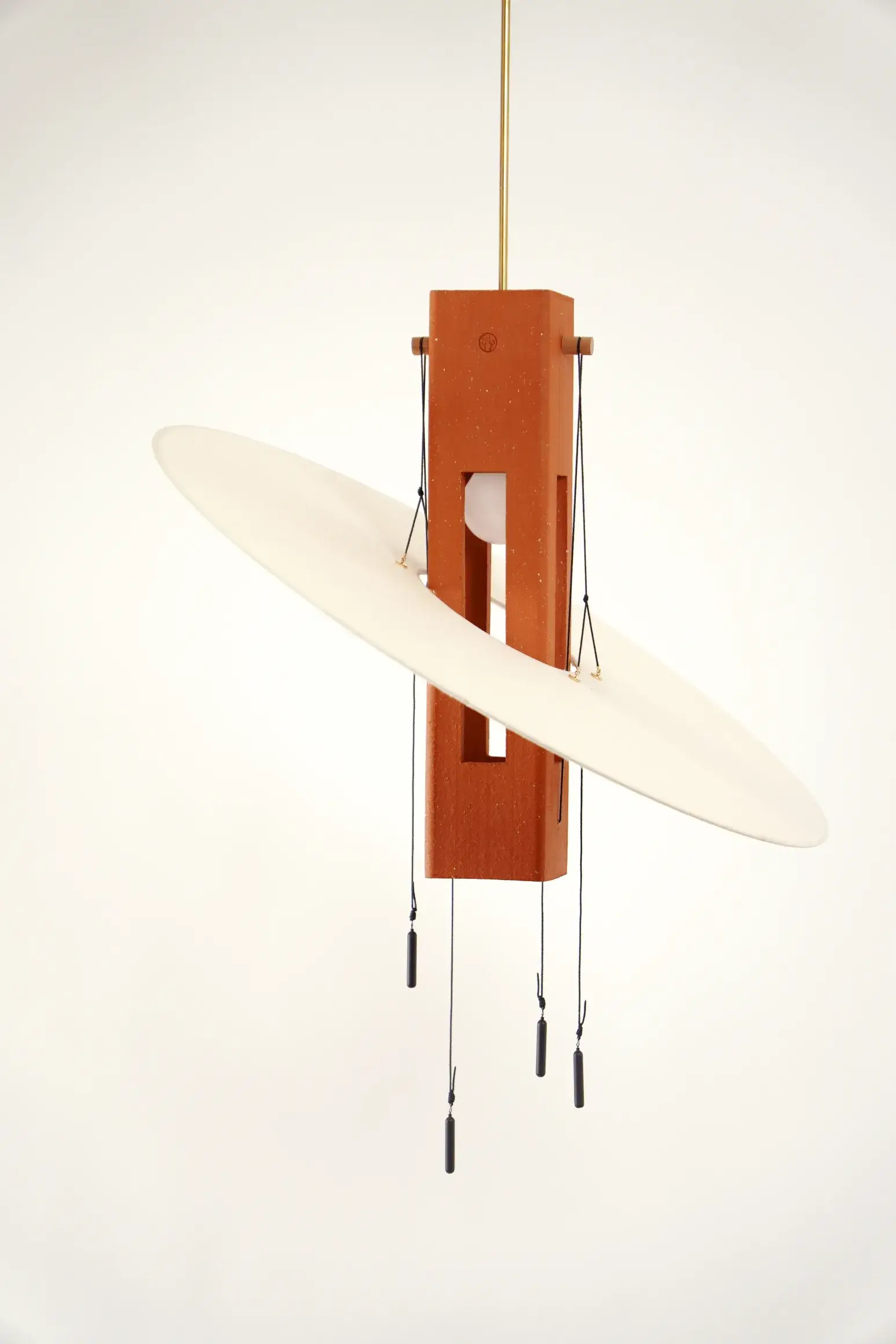
This matters for maintenance. Paper is exposed to creases, tears and handling in a way fired clay is not; making the veil detachable stops the lifetime of the entire lamp from being identical to the lifetime of its most delicate surface. Brick and vegetable fibre age differently, and the magnetic interface accepts that difference instead of treating the fixture as one inseparable object.
Lumia also lists its shade as replaceable on request.1 In both lamps, fragility is therefore not denied. Some of it is designed around.
What light crosses
The current Lumia page specifies an E14 LED at 7 W and 806 lumens, while Nova uses an E27 LED at 11 W, 1055 lumens and 2700 K.12 Isola also lists a 2700 K LED system and CE compliance for Lumia.7
To be sure, those figures establish only the intended electrical source and power. They do not give enough information to calculate the temperature reached by the paper, a minimum safe spacing or a reaction-to-fire classification; none of those measurements appeared in the material we reviewed.
That distinction matters if somebody treats the lamp as a DIY recipe. The separation of roles, the replaceable veil and the handling interfaces are useful ideas to borrow, but a photograph cannot tell us that another paper, bulb or geometry will have the same thermal behaviour.
Reproducibility therefore stops before the electrical and fire-safety design.
The joint matters
“Clay and washi” is a strong photograph and a weak mechanical explanation. A heavy base and a flexible sheet do not collaborate by themselves.
Maison Cédrat inserts a small architecture of mediators between them: fiberglass to form the veil, beech to support and handle it, magnets to detach it, grips that keep fingers away from the paper, and an LED source specified for the finished lamp.
That is the transferable part of the collection. Pairing two very different materials does not require a miraculous adhesive or a permanent fusion; a designer can instead draw an interface around their different lifetimes, weaknesses and jobs.
The clay remains heavy and the paper remains delicate. The lamps work precisely because neither one has been forced to behave like the other.