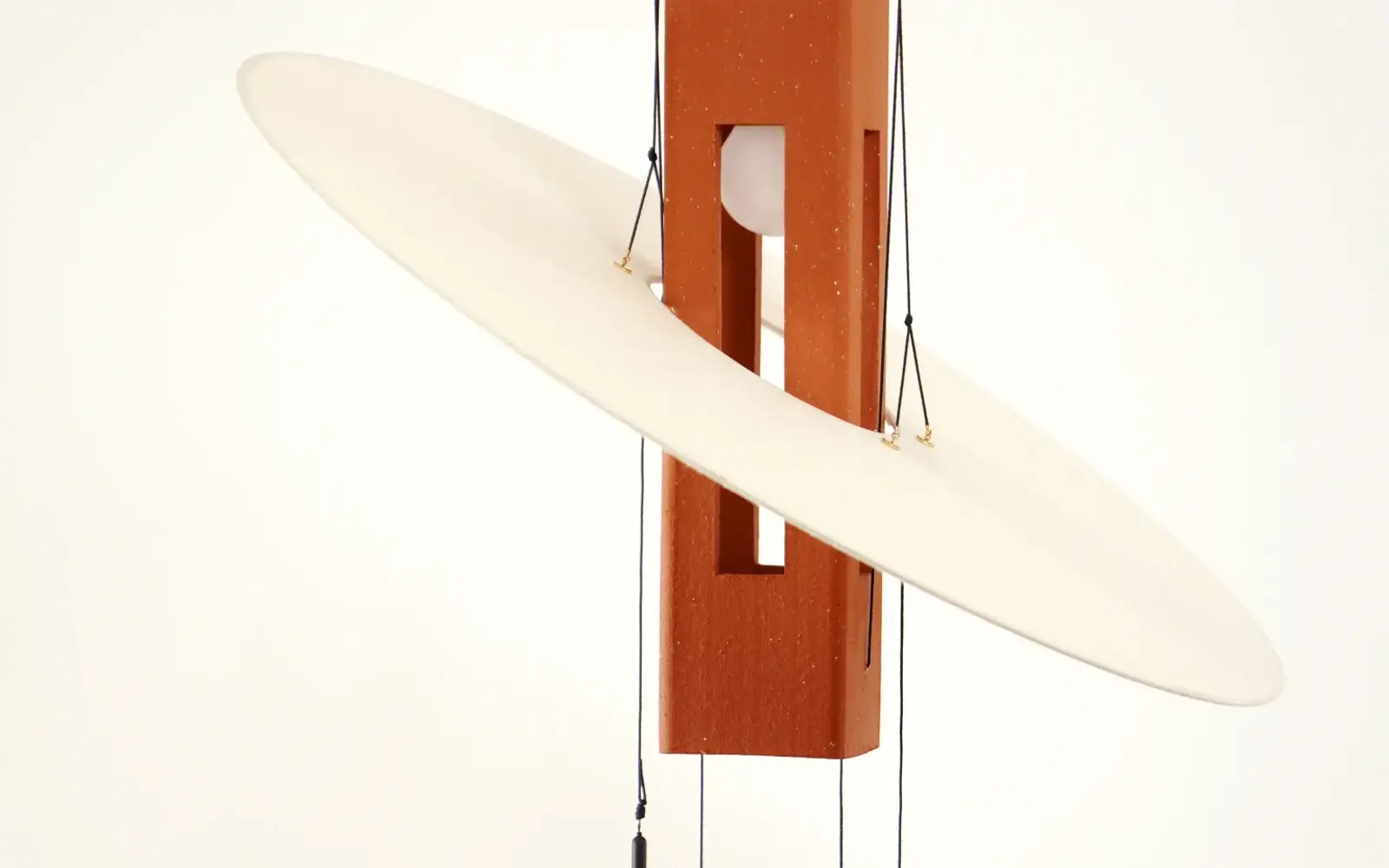
Paper and eight kilos of clay do not age together. This sounds obvious, but plenty of products are assembled so thoroughly that damage to a small part retires everything around it, which is a poor bargain for an object meant to stay in a room for years.
Maison Cédrat's Aura collection starts with a more photogenic contrast, using extruded clay for weight and a rough mineral surface while handcrafted washi sits in front of the light to soften the source and reveal its fibres in the glow.15
The useful detail is less cinematic: Nova holds its paper element with magnets and the product page says a replacement shade can be requested, while Écla and Lumia list the same replacement option even though their mounting is described differently.23 In other words, the lightest and most vulnerable material does not have to retire with the heaviest part of the object.
Clay / paper
Aura comes in three formats: Lumia is the large table lamp, Écla the smaller one, and Nova hangs from the ceiling.1 This division of labour stays readable across the family because clay supplies the mass and paper does most of the optical work for the lamp.
Écla Terre Crue weighs 3.6 kg, Nova Terracotta 4 kg and the special Lumia d'Or 8.8 kg.237 Against that much mineral mass, the washi reads less like conventional lamp structure and more like a membrane held around the source.
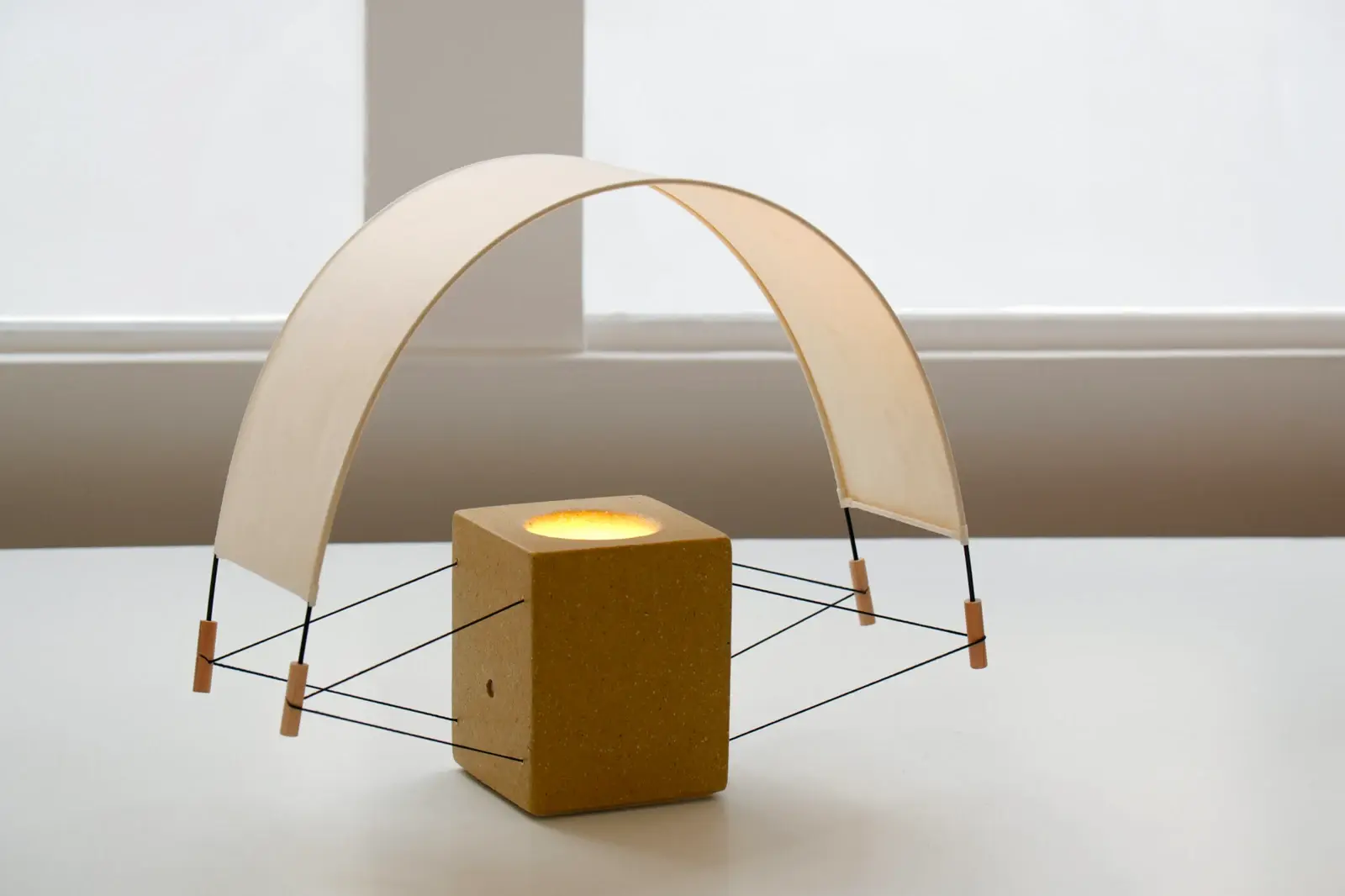
On Écla, the paper does more than decorate the source: wooden controls tilt the sail forward, backward and sideways, changing what the light reaches and what the paper masks.3 The same idea is described by Designboom for Aura more broadly, with the irregular washi texture remaining visible when illuminated.5
No public photometric test or heroic lux chart accompanies the collection, so there is no basis for pretending to quantify the effect. For the user, the mechanism remains physical and legible: moving a translucent surface around a source changes where light travels and how sharply the source is perceived.
Who makes it
“Handcrafted” becomes more useful here because Maison Cédrat names the workshops instead of leaving the word to float on the product page.
Briqueterie Capelle, a family company near Toulouse, develops the ceramic elements with the studio.4 Maison Cédrat describes the process as an exchange rather than a handoff: forms and details move until the drawing, material and manufacturing process stop fighting each other.
Atelier Papetier in Salasc, near Montpellier, makes the washi with a Japanese technique adapted to its French setting.4 Maison Cédrat says their work together concerns resistance, texture and the paper's behaviour around light. Formae describes the same production model more broadly as a close relationship with a brick maker and papermaker in southern France.6
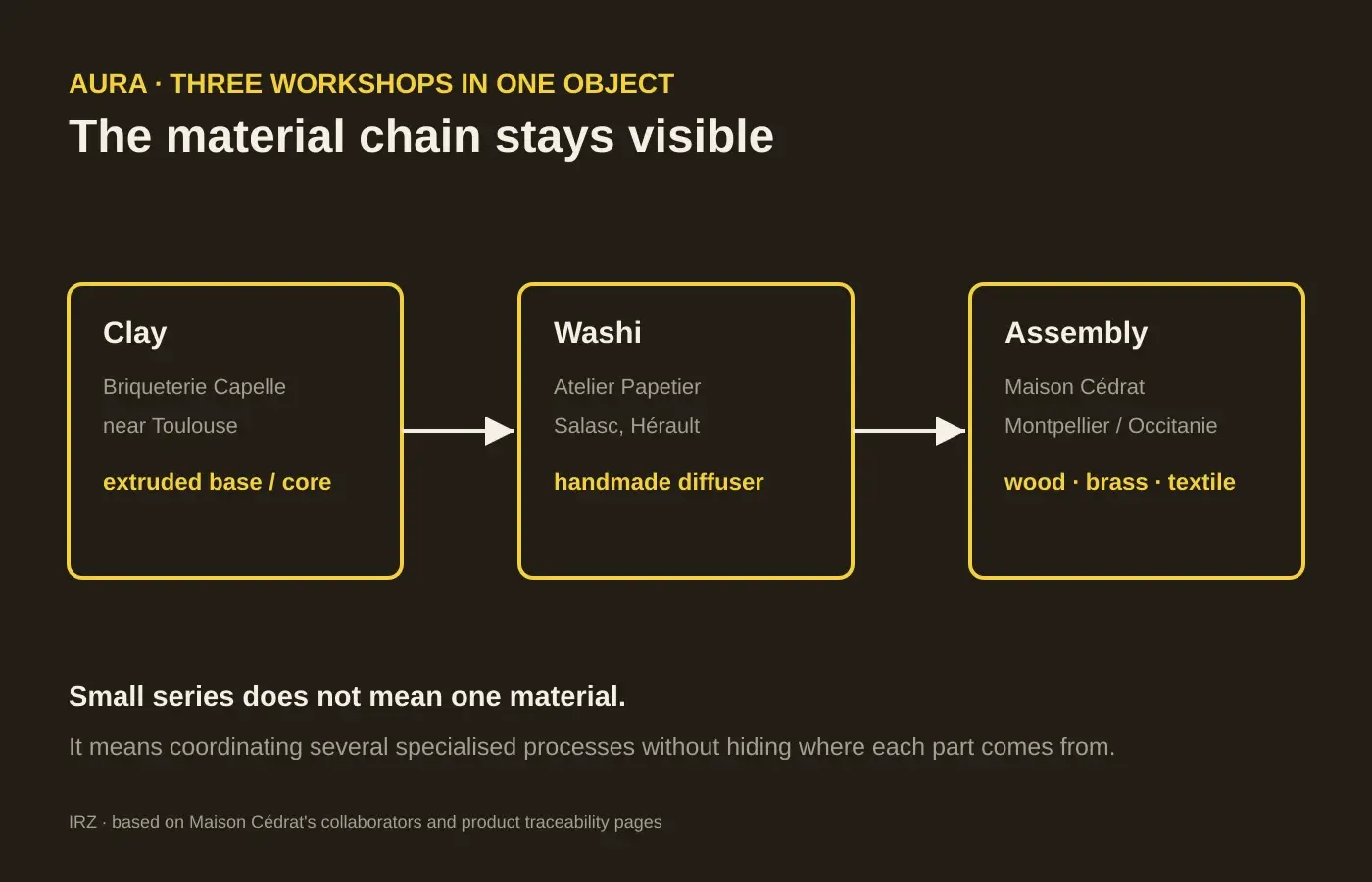
Depending on the model, those two headline materials sit alongside turned wood, brass, glazed cotton cable, wool felt and tungsten controls, making Aura a mixed object rather than an effortless mono-material recycling exercise.23 This matters because the roles of the parts remain legible and the studio publishes enough traceability for a reader to see more than the phrase “made in France”.
Replaceable part
Nova gives the clearest view of the assembly because its specifications list the parts rather plainly: a 500 mm brass rod, an extruded brick body, handcrafted Japanese paper, glazed cotton cable and tungsten controls.2 The paper sail is held by magnets, a useful choice for replacement because Maison Cédrat also offers a new shade on request.
Écla lists the same replacement option without claiming the same magnetic mounting, using turned wood for its internal support and extruded earth for the base.3 Lumia d'Or reaches 8.8 kg and nevertheless lists a replaceable shade around a turned beech support.7
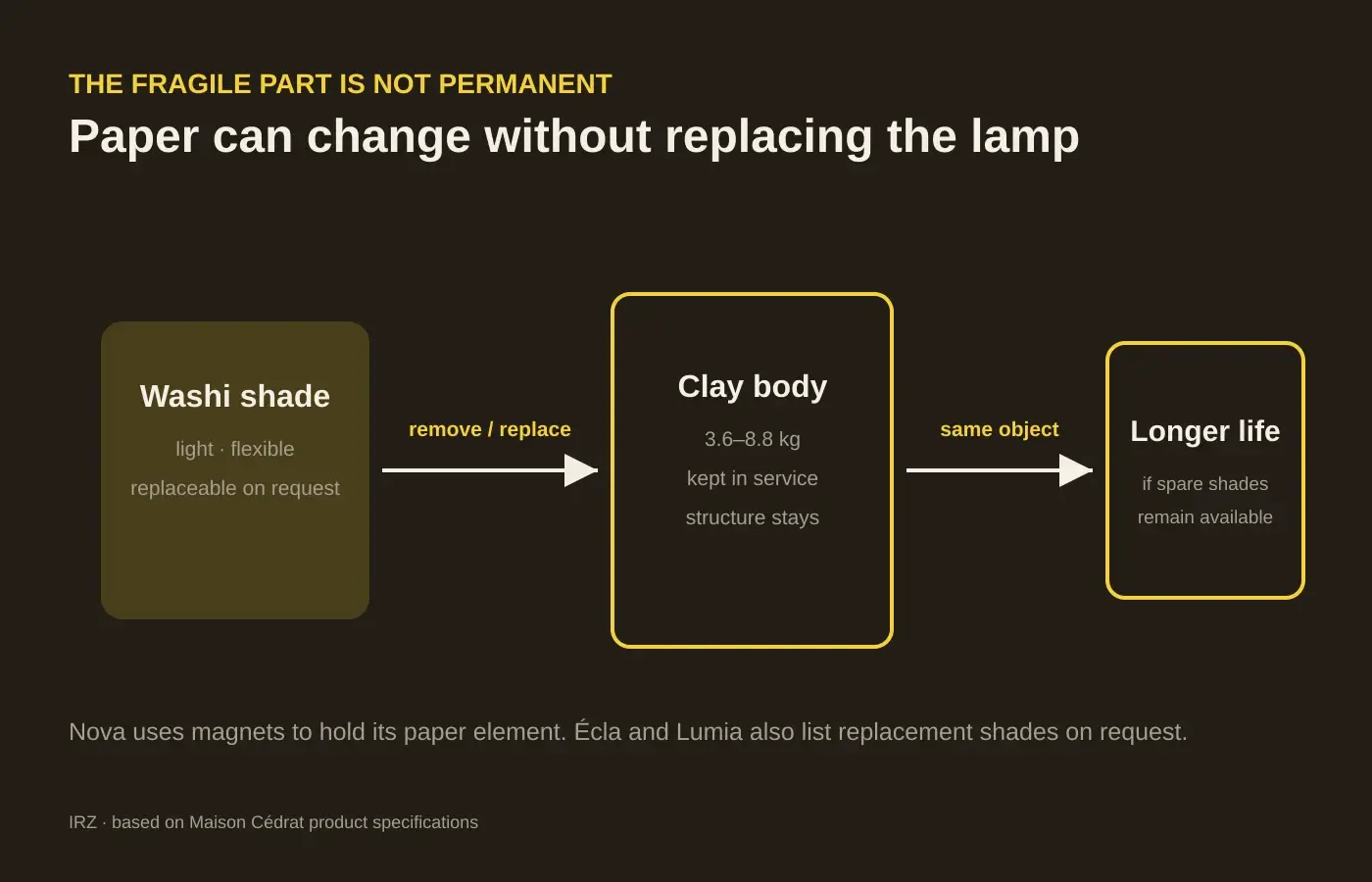
One reservation matters. “Replaceable on request” works only while Maison Cédrat can provide the part, perhaps followed one day by another supplier willing to reproduce it. Nothing in the current documentation turns the shade into an independent standard. This arrangement is more maintainable than a permanently sealed assembly, but future maintenance remains tied to the studio and its supply chain.
The price
The price tag makes the production model hard to romanticise. In August 2026, Écla Terre Crue is listed at €600 and the black version at €650, while Lumia Terre Crue appears at €1,200 and Lumia Noire at €1,300; Nova Terracotta reaches €1,900 and Nova Noire €2,000.23
We cannot read margin or the exact share of labour and material from those figures. The category is obvious enough, though: this is small-series collectible design, with prices far above what would be expected for mass-market lighting.
Lead times point in the same direction, with one to two weeks listed for Écla and four to five for Nova.23 The studio also warns that colours, shades and surface textures vary between pieces, which treats variation as part of the process rather than noise to be engineered away.
Here, “local” carries more information than a badge because small production can preserve awkward operations that mass manufacturing tends to dislike, from handmade paper and adjustable sails to clay finishing, turned components and replacement parts supplied on request. This freedom comes with a cost for the buyer and with dependence on a small network of workshops.
Not frozen
Aura photographs easily as a story about Mediterranean sunsets, a vocabulary Maison Cédrat uses itself and Designboom reinforces when it describes the warm glow through washi.25 The prettier story, however, says less about how the object might survive ordinary wear.
A more durable gesture lies in accepting that the materials do not share a lifespan. Clay body, wooden support and paper shade will age differently. Drawing them as separable parts at least avoids forcing them to fail together.
The paper moves when the owner wants to change the light, and on several models the same paper can later be replaced. Nova glowing in a room will always make the prettier photograph, but ten years from now the quieter assembly choice may matter more for the owner. This benefit survives only while Maison Cédrat can supply the part, which is the awkward truth about repairability: a design made today leaves somebody with an obligation for the future.