Red Craft contains an object that refuses to stand straight, a stool whose cords hang under tension under lava-stone weights, a lamp that lets the wind choose its silhouette, and a small rabbit made from paper and hardened with lacquer.
At first glance, Red Craft looks like a collection of red objects borrowing four Japanese traditions: bamboo fencing, kumihimo, washi and urushi.7 That is the easy version of the story. It is also the least interesting one.
Kenta Yoshizawa's project becomes more useful when we look at what each technique does to the object. Bamboo imposes a bending radius and a memory of heat. The cord is not decoration: it carries tension and makes that tension visible. Paper turns a light into a moving object. Lacquer does not merely coat a form; it changes what paper can support.
That is IRZ's contribution here: comparing the objects by the constraint each one keeps, rather than by colour or exotic appeal. Yoshizawa is not using craft techniques as a library of motifs. He treats them as four construction mechanisms.
Bamboo keeps the curve
The first object, n shelf, is a leaning shelf. Its shape comes from sodegaki, a type of bamboo fence whose n-like silhouette Yoshizawa adapts to furniture.1 The key detail is therefore not “a bamboo shelf”. It is the fact that a form used to define a garden boundary becomes a piece of furniture that holds things.
The studio describes a very simple and decidedly non-digital operation: heat the bamboo with a burner, then bend it by hand. The upper and lower parts retain a curve that makes the material's suppleness visible.1
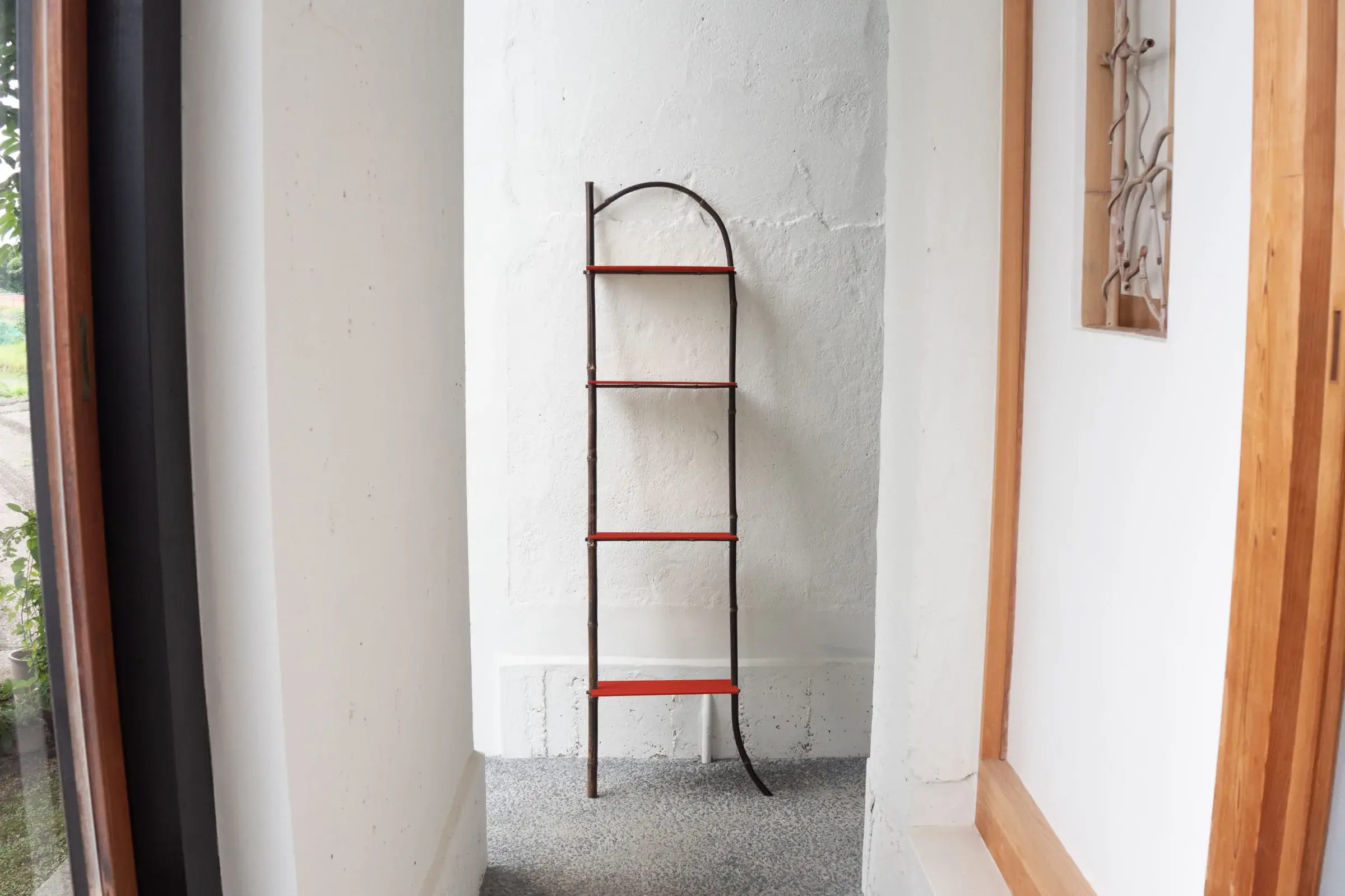
That is the difference between a reference and an imitation. A picture of a fence could have been applied to a wooden shelf. Here, the historical reference becomes a procedure: the chosen geometry is one that heated bamboo can actually take.
Nagaoka Meichiku, the project's partner, normally works on bamboo fences and spatial installations. Its site describes a practice covering the making and installation of traditional fence types such as kenninji-gaki, koetsuji-gaki, inu-yarai and sodegaki.5 This does not prove that n shelf repeats every step used in a garden fence. It places the project more precisely: the material comes from a workshop whose work is specifically concerned with architectural uses of bamboo.
The furniture leaves the separating function behind while keeping a way of working. That is an honest exchange: contemporary design does not claim to preserve the whole traditional object, only a relationship between material, fire and curve.
A cord that hides nothing
kumino is a stool and side table. Yoshizawa starts with the production process of kumihimo, rather than copying a braid as a surface pattern.2
Braided cords run through the upper and lower parts of the structure. Lava stones are attached to their ends as weights to keep the cords straight. The studio credits Showen Kumihimo with the cords and TSU[na]GU furniture with the furniture making.2 Designboom describes the stones as a reference to the weights used in kumihimo to maintain tension while braiding.7
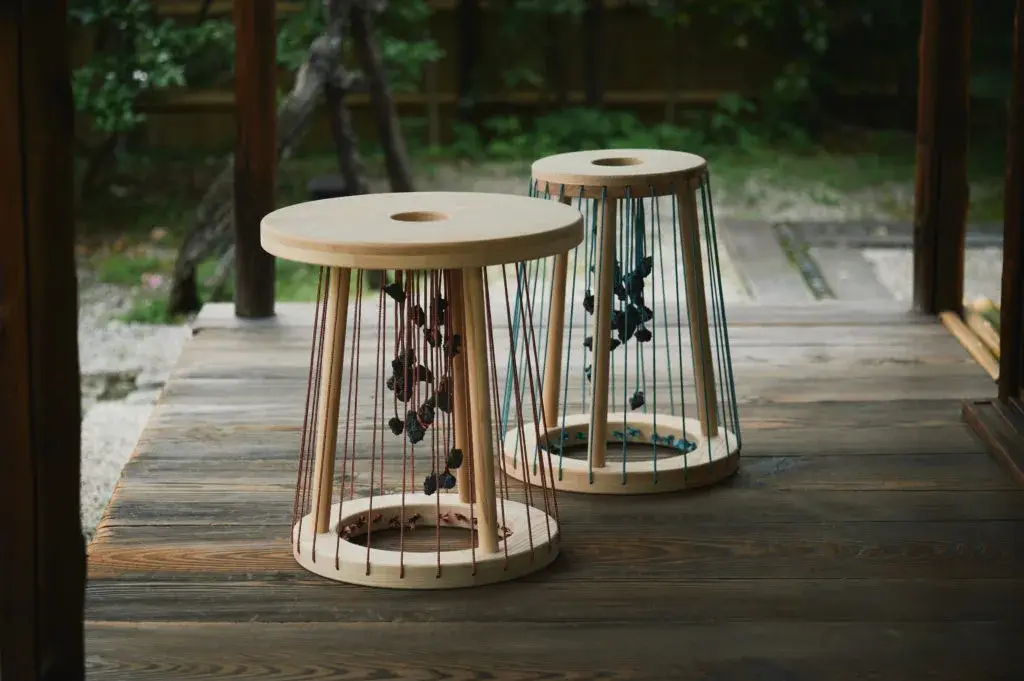
The project moves part of a craft process from the workbench into the finished object. In a textile accessory, tension is a condition of making. In kumino, it becomes a condition of reading: the stones explain why the cords are there because they show what the cords do.
Showen describes kumihimo as a craft in which cord connects objects and people, but its making pages allow us to verify something more concrete: the company produces and sells braided cords, offers hands-on experiences and works on original productions.6 That page does not establish the exact cord structure in kumino, its number of strands or its strength. Those details are not published in the sources consulted, so they stay out of the story.
That restraint matters because “tension” can quickly become decorative metaphor. Here it names a visible operation with an obvious mechanical consequence: without a weight, the cord would not stay straight. The project moves a small production tool into furniture, letting the visible weights explain the cord instead of making a large statement about kumihimo.
Furniture as demonstration
The first two objects show two ways to translate a technique. n shelf keeps a material transformation. kumino keeps a working condition.
That distinction helps avoid a common trap in collaborations between design and craft. We often hear that “tradition and modernity are brought into dialogue”, a flexible phrase that guarantees very little. The more precise question is: which part of the craft remains active after the object changes?
For n shelf, the active element is the curve produced by heat and handwork; for kumino, it is tension regulated by weights. Both mechanisms still have a job rather than serving as cultural signs added after the fact.
Yoshizawa's studio is based in Kyoto and supports the development of craft products and small objects with companies and workshops.4 His background includes planning and designing stationery and construction kits before he became an independent studio in 2023.4 The presentation follows that background: each piece looks like a result, yet also like a small making experiment open to mental disassembly.
The evidence does not justify a general studio method. The official pages describe individual projects, not a manifesto claiming that every collaboration must expose its constraint. The narrower point is enough: Red Craft is especially legible when the making rule has not been swallowed by the finished silhouette.
A lamp that misses its pose
With stickstick, the project leaves furniture behind. The object combines slender metal rods with handmade washi paper. When air moves, the rods sway and light the paper elements attached to their tips from below.3
Yoshizawa describes the problem with unusual honesty on the project page: the rods do not hold the pose he intended. He compares the result to touching a plant that keeps its light source as a seed.3 The sentence is poetic, but the useful fact comes just before it: the system accepts movement the designer cannot fully control.
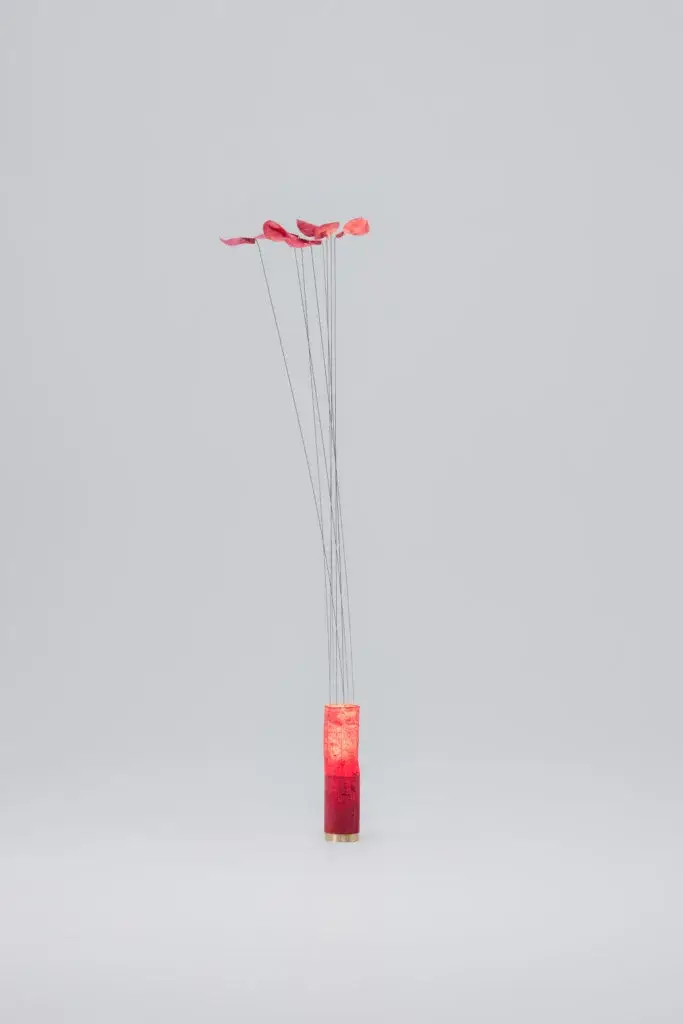
The washi is therefore more than a light-diffusing surface. It becomes a light, moving tip carried by the rods. Metal supplies length and spring; paper receives the light; air completes the mechanism without being enclosed in a machine.
The piece was selected for the 22nd Inshu Washi Akari Exhibition, according to the studio's own page.3 That source does not give the dimensions, the mass of the elements or measured lighting behaviour. We cannot promise a specific choreography or intensity. The stated and shown principle is narrower: part of the lamp's shape belongs to the movement of the room.
This creates a small design risk. Many domestic objects try to cancel variation: a chair should remain stable, a lamp should stay at the chosen angle, a shelf should forget the material it is made from. stickstick does the opposite, turning unpredictability into a visual function without claiming to tame it.
Paper becomes a shell
The fourth object, usahako, is a rabbit-shaped container. Designboom describes it as a washi-paper structure finished with traditional urushi lacquer. The coating reinforces the paper and gives it a smooth, glossy surface.7
This part of the project is less thoroughly documented by the studio than the other three. The official Yoshizawa page found during research presents a different rabbit object, a 3D-printed piggy bank; usahako's making details are absent there. The object, its finish and its lacquer manufacturer, COCOO, therefore remain attributed to Designboom.7
That limit does not make the object less interesting. It changes the level of certainty. The technical point is straightforward: paper can become a shell that holds its shape when a surface treatment changes its behaviour. But the source does not tell us how many coats were applied, how the washi was prepared, or whether the object can hold heavy objects or resist water. The article will not pretend otherwise.
The rabbit is almost a case study in the difference between appearance and mechanism. From a distance, it is a glossy shape. Up close, the question becomes: where does the paper end and the protection begin? Urushi does not erase the fibre. It forces it to play a structural role it could not play alone in that shape.
Four degrees of freedom
Red Craft is presented as a collection unified by red and by four traditional techniques. The objects do not all keep the same thing.
- n shelf keeps a transformation: heating and bending bamboo.
- kumino keeps a tension: braiding, weighting and holding the cord.
- stickstick keeps a variation: letting air move illuminated paper.
- usahako keeps a conversion: turning a sheet into a shell through lacquer.
This is not Yoshizawa's official taxonomy. It is an IRZ reading drawn from the published descriptions, useful for comparing objects that might otherwise remain in the comfortable category of “contemporary reinterpretations of traditional techniques”.
The comparison also exposes a limit. The pages say much more about intentions and visible elements than about the parameters needed to reproduce the objects: exact species, thicknesses, temperatures, number of passes, tolerances, drying times, costs or failure rates. Red Craft documents a design project, not a workshop manual.
An object can transmit a method without publishing its complete recipe, so we have to distinguish what we can learn from what we can remake. Four prototyping questions remain: what shape does my material take when heated, which tension should remain visible, what happens if air gets a role in the object's behaviour, and can a surface treatment change a sheet's mechanical role rather than only its appearance?
The risk of display
Collaborations with traditional crafts are often photographed at their most seductive: the workshop, the hand, the fibre, the flame. Red Craft has those images. Designboom includes scenes of bamboo being heated, cords being made and lacquer being applied.7
Those images are useful when they connect a result to an operation. They become decorative when they merely certify visual authenticity. The difference is narrow. A flame in a photograph does not prove that the final curve depends on heating. Here, the n shelf page makes that connection explicitly: the studio says the curved parts are made by heating and bending bamboo.1 For kumino, the weights are described as a way to keep the cords straight.27 For stickstick, air movement is part of the operation.3
The evidence is thinner for usahako. That is precisely why it should be treated as a qualified case, not as proof that the collection documents four production chains with equal depth.
Image provenance matters too: the visuals in this article come from the studio pages and are credited to Yoshizawa, WACOH or the rights holders identified there, without any claim that they are public-domain or freely licensed. A project photograph remains a project photograph.
What can be carried over
It would be easy to leave Red Craft with a vague conclusion: traditions are a source of innovation. That is not very useful. A more practical conclusion fits in four verbs: heat, tension, let move, harden.
These verbs travel well because they describe operations, not because they belong to a culture that should be copied out of context. A designer who works with neither bamboo nor washi can still test the idea of a curve made through a gradual transformation rather than drawn in advance. They can make a hidden structural tension visible. They can give air a role in an object's behaviour. They can ask whether a coating changes only a material's appearance or also its mechanical job.
Those are starting points, not replacement recipes for Japanese craft. The distinction matters: imitation would copy gestures we do not possess; observation asks how a constraint becomes a formal decision.
Red Craft does not prove that these techniques become more contemporary when they turn red, domestic or sculptural. It shows something more specific and more useful: a tradition remains active in an object when its mechanism continues to make the object work. Bamboo still remembers the fire. The cord still asks for tension. Paper still answers to air. Lacquer still changes what a sheet can be.
The red is a good way to place them in the same room. It is not what keeps them standing.