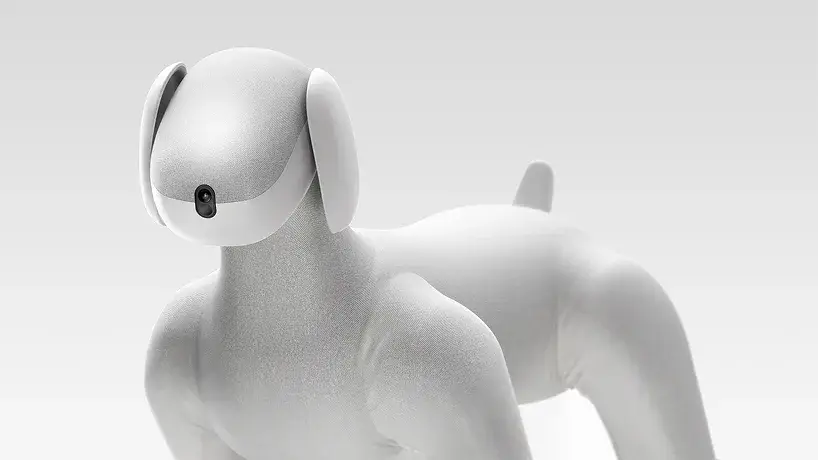
Put the suit on and Lassie immediately stops speaking the visual language of an industrial robot. The useful detail comes next: the softness is not structural.
The concept by creative studio every else and design team Jungmin Park, Hyeonji Yang, Junghyun Kim and Byeol Jang keeps a quadruped mechanism underneath a removable knitted layer.1 That layer uses CORDURA yarn described as water- and stain-resistant. Areas facing more impact and contamination remain hard.1
The concept splits two problems that companion robots often lock into one enclosure: protect the machine and give it a social presence.
A skin, not a shell
The moment a robot goes outside and comes home again, softness meets boring problems: mud, rain, dust, abrasion and cleaning.
Lassie does not pretend those disappear. Textile covers only part of the body. Components more likely to take knocks or dirt stay exposed as hard parts.1
That is more credible than turning every joint into part of a plush toy.
The suit can be washed, replaced or customized without opening the robot. It can also wear out long before the skeleton without taking the skeleton with it.
Clothing and furniture already live with that separation. Consumer robots still tend to mould personality into an expensive enclosure.
Four kinds of legs
Below the body, modularity follows the same pattern.
Four leg families are proposed: Basic for daily walking, Explore for outdoor terrain, Running for speed and Wheel for quieter indoor travel.1 The visuals show a two-button release for detaching a leg module.1
The modular vocabulary still has to be separated from demonstrated performance.
Designboom identifies Lassie as a project received through its DIY submissions channel.1 The published material gives no mass, battery life, speed, ingress rating or quantified terrain tests. Yanko Design and Trend Hunter describe the same concept and modular system without adding independent mechanical validation.23
For now, the value lies in how the product is divided, not in a locomotion advantage nobody has measured.
No eyes required
Lassie also avoids a cartoon face.
Movement, gestures and a head light that appears to breathe carry most of the communication.1 When two Lassies touch noses, for example, light spreads across their faces. The concept also proposes a nose touch for registering an owner and a discreetly integrated camera.1
That communication style fits the textile layer: social cues appear without fully disguising the machine as an animal.
The robot remains legible as a manufactured object.
That may age better than copying a muzzle, eyes and facial expressions that a quadruped mechanism cannot convincingly support without quickly becoming uncanny.
The Lassie effect is still a hypothesis
The behavioral ambition is less secure.
The team says it surveyed more than fifty dog owners and repeatedly heard about walking longer, discovering unfamiliar routes and starting conversations with strangers.1 Lassie tries to reproduce some of those effects without reproducing the animal itself.
As a design brief, the idea works. As behavioral evidence, it does not exist yet.
A living dog imposes needs, schedules, responsibility and unpredictability. A robot that can remain on a charging bed does not necessarily exert the same pressure on a person's routine. Nothing in the published sources demonstrates that users actually walk more because Lassie is present.
The causal claim has to stay hypothetical.
The replaceable layer
For a maker, the best idea to borrow is probably not “the robot that makes you go outside.”
It is the layered construction.
A mobile machine can keep a durable core, stay hard where impacts happen, then add a softer contact layer designed to wear, wash and change. Visual personality can live in that last layer rather than being locked into the costly shell.
Iteration gets cheaper too. Texture, colour or touch can change without redesigning the joints.
For now, Lassie has far more imagery than measurements.
But its removable suit asks a useful manufacturing question: to make a machine feel softer, does the whole machine really need to become soft?
Lassie's answer is no. Softness may work better as a detachable part.